What Is a Trucking ELD? The Benefits Go Beyond Compliance
A trucking ELD records driving time, engine hours and location automatically, which is what the FMCSA mandate requires. The same data stream can also run your preventive maintenance schedules, shorten downtime and give you cost per mile by asset, provided it lands somewhere it can do that work.
Oct 6, 2021 | Updated: Sep 15, 2026
19 min read
What you need to know
- An ELD captures engine-level data automatically. It connects to the vehicle's diagnostic port and records driving time, engine hours, movement and location with no driver input.
- FMCSA requires ELDs for most commercial drivers who keep records of duty status. A handful of narrow exemptions apply, and compliance is the baseline expectation rather than an achievement.
- The data that satisfies an auditor also runs a maintenance program. Odometer readings, engine hours and fault codes are the exact inputs preventive maintenance schedules depend on.
- Integration decides whether ELD data does any work. Sitting in a standalone telematics portal it answers compliance questions. Flowing into fleet management software it advances PM schedules, opens work orders and builds cost per mile.
- Most fleets underuse what they already pay for. Auditing your current ELD and telematics connection usually costs less than buying anything new.
A trucking ELD, or electronic logging device, is hardware connected to a commercial motor vehicle that automatically records driving time, engine diagnostics and Hours of Service (HOS) data. It reads duty status from the engine instead of relying on a handwritten log, which keeps the record accurate and makes it available on demand for a roadside inspection or an audit.
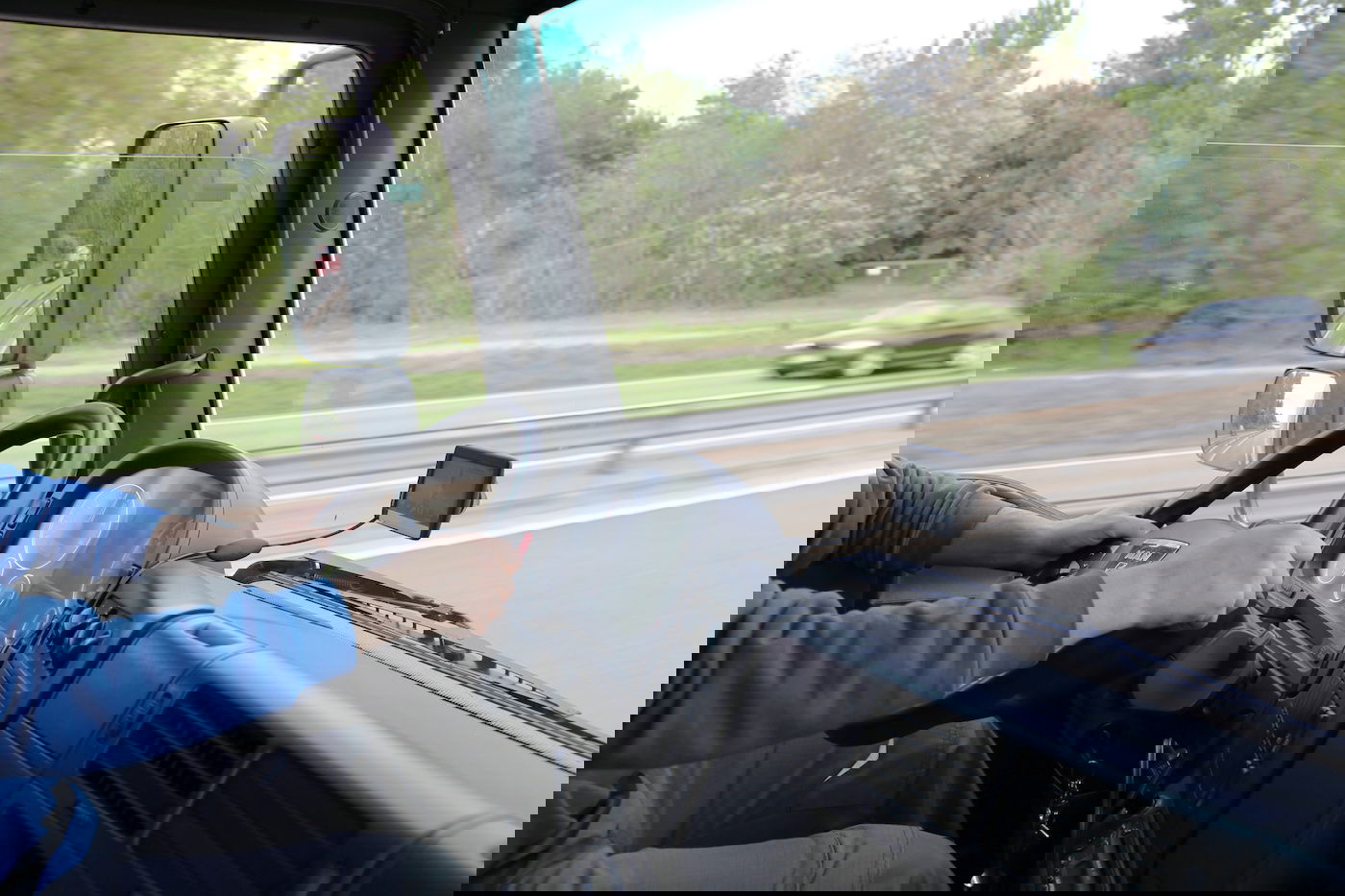
The Federal Motor Carrier Safety Administration requires an ELD for most commercial drivers who are required to prepare records of duty status. The rule replaced paper logs and grandfathered automatic onboard recording devices, and it has been fully enforced since December 2019. FMCSA estimated the ELD final rule would save 26 lives and prevent 562 injuries each year by making fatigue rules enforceable in practice rather than on paper.
While ELDs are required for compliance, their value extends far beyond regulatory reporting. The device sitting in your cab is a continuous feed of odometer readings, engine hours, fault codes and location history, which happens to be the same data a maintenance program, a utilization review and a cost-per-mile calculation all need.
This guide covers what an ELD is and what the mandate requires, the data these devices collect, 10 benefits that show up once you use that data operationally and what changes when ELD output connects to your fleet management software.
What Is an ELD?
An ELD is a regulated recording device. It has to meet a published FMCSA technical specification, be registered with the agency and produce a standardized output file that an inspector can read. Everything else a given unit does is the manufacturer's decision.
What does ELD stand for?
ELD stands for electronic logging device. It is a tool connected to a commercial motor vehicle that automatically records driving time, diagnostics and Hours of Service data to keep the vehicle compliant with federal safety regulations.
The device connects to the engine control module, usually through the diagnostic port, and reads vehicle parameters directly. That connection is what separates an ELD from a logging app. Because the unit can see whether the engine is running and whether the wheels are turning, it changes duty status on its own when the vehicle starts moving and cannot be talked out of it.
HOS recording works from those signals. Federal rules cap property-carrying drivers at 11 hours of driving inside a 14-hour on-duty window, require a 30-minute break after eight cumulative hours of driving and limit drivers to 60 or 70 hours across seven or eight days. The ELD tracks each of those clocks continuously and shows the driver how much of each is left. Drivers still annotate and certify their logs, and they can correct records where the device misread a situation, but the underlying driving time is captured by the machine.
What is the ELD mandate?
The ELD mandate is the FMCSA rule requiring carriers to use registered electronic logging devices in place of paper RODS. It exists because paper logs were impossible to verify at scale. An inspector could see that a log was neat and internally consistent and still have no way to know whether it described the trip that actually happened.
The rule applies to you if your drivers currently maintain records of duty status under 49 CFR 395.8. That includes most interstate commercial trucks and buses along with Canada-domiciled and Mexico-domiciled drivers operating in the US. Several exemptions exist:
- Drivers who use paper RODS on eight or fewer days in any 30-day period
- Drivers operating under the short-haul timecard exception, who stay within a 150 air-mile radius and return to their reporting location
- Driveaway-towaway operations, where the vehicle being driven is the commodity
- Vehicles with an engine model year older than 2000
Compliance involves more than buying a device. Your ELD has to appear on FMCSA's registered device list, and that matters more than it sounds because manufacturers self-certify their own units and the agency revokes listings when a device fails to meet spec. Each vehicle also has to carry a supporting information packet with a user manual, data transfer instructions, malfunction reporting procedures and at least eight days of blank paper log grids. Carriers need a documented process for what happens when a unit malfunctions, and they must retain RODS and supporting documents for six months.
The practical stakes at roadside are out-of-service orders and CSA points. Both cost more than the citation, because a sidelined unit means a missed delivery, a recovery trip and a driver on the clock producing nothing.
What data does a trucking ELD collect?
A compliant ELD captures a defined set of data elements. Most of them have a second life outside the compliance file.
| Data the ELD records | What it is used for in compliance | Where it does work beyond compliance |
|---|---|---|
| Driving time | Enforces the 11-hour and 14-hour clocks | Labor cost allocation, realistic route and shift planning |
| Engine hours | Verifies engine-on duty status | PM intervals for idling-heavy and PTO-driven equipment |
| Vehicle movement and odometer | Confirms distance driven per duty period | Mileage-based service reminders, cost per mile, IFTA mileage |
| Location data | Places each duty status change geographically | Arrival verification, unauthorized use detection, incident timelines |
| Driver logs and identification | Ties duty status to a specific driver | Accountability without paperwork, coaching and performance review |
| Engine fault codes (on telematics-capable units) | Not required by the rule | Early warning on developing failures, proactive work orders |
The last row is where most of the operational upside lives, and it is optional. A minimum-spec ELD logs HOS and stops there. A telematics-capable unit reads diagnostic trouble codes, fuel consumption and driver behavior events off the same connection. If you are choosing hardware, that distinction determines whether your compliance spend produces anything you can use in the shop.
Why ELDs Matter Beyond Compliance
Compliance is the floor. Passing an audit means your records were complete and accurate, which is the minimum condition for operating legally. No fleet has ever gained an advantage by being compliant, because every competitor running legally is compliant too.
The operational value comes from what the data enables downstream. An odometer reading that proves you drove 480 miles on Tuesday is also the reading that advances a PM schedule. A fault code that has nothing to do with HOS is the earliest warning you will get on a failing component. Location history that documents a duty status change also tells you whether a unit sat for 40 minutes at a site that should have taken 10.
What unlocks that is where the data goes. ELD and telematics output landing in a provider portal is useful for the questions that portal was built to answer. Connected to fleet management software, the same feed becomes the trigger for work that used to require someone to notice and act. Odometer values update on their own, PM reminders advance on real usage, fault codes open issues and maintenance costs accumulate against actual mileage.
Fleetio works as the system of record on the receiving end of that connection, holding asset history, inspections, work orders, parts and fuel data in one place so location and meter data arrives already attached to everything else known about the vehicle.
10 Benefits of Trucking ELDs Beyond Compliance
1. Improved hours-of-service accuracy
ELDs record driving time automatically, which removes the error class paper logs produce structurally. Handwritten logs get estimated at the end of a shift, rounded to convenient numbers and reconstructed days later from memory. None of that is necessarily dishonest, and all of it creates discrepancies an auditor will find when your logs are compared against fuel receipts, toll records and dispatch notes.
Timestamped HOS data lowers audit risk because the record and the supporting documents agree. A form-and-manner violation on a paper log is a finding even when the driver never exceeded a limit, and those findings disappear when the device produces the record.
The accountability shift matters just as much day to day. A manager can see who drove which unit, when they started and how long they ran without calling anyone or waiting for a log to come in from the road. Keep expectations realistic here: accurate HOS is a compliance baseline every compliant fleet has. The return comes from what the same data enables in the sections below.
2. Reduced administrative work
Paper RODS create a clerical pipeline. A 40-driver fleet filing daily logs generates roughly 1,200 pages a month that someone collects, reviews for errors, files and retrieves on request. Multiply that by the six-month retention requirement and you are maintaining 7,200 documents you hope you never need.
ELDs eliminate the collection and the transcription. Logs arrive already digital, already legible and already indexed by driver and date. The clerk who spent Monday morning chasing missing pages spends it on something that requires judgment.
Accuracy improves alongside the time saving, because every manual re-entry step is an opportunity to transpose a number. The compounding gain shows up when telematics data syncs into your fleet management software directly. Teams stop reconciling mileage between a telematics portal, a maintenance spreadsheet and a fuel report, which is what turns a monthly reporting cycle into a same-day one.
3. Stronger preventive maintenance scheduling
This is the benefit most fleets leave on the table. PM schedules run on meters, and meters are usually the weakest data in the system because someone has to read them and type them in. A unit serviced at 19,000 miles on a 15,000 mile interval was not neglected on purpose. The odometer in the software was four weeks stale.
ELD and telematics data streams live odometer readings and engine hours into Fleetio, which advances preventive maintenance schedules against OEM recommendations and actual usage with no manual input. Service reminders reset automatically when the task is completed, so intervals hold instead of drifting a little further out every cycle.
The engine hours piece is underrated for equipment that idles or runs PTO. A bucket truck covering 8,000 miles a year can accumulate engine hours equivalent to triple that mileage, and a mileage-only schedule will service it far too late. Hours-based intervals fix that, and the hours come from the same device you installed for HOS.
The outcome is a shift in where your maintenance dollars go. Missed intervals turn into reactive repairs, reactive repairs turn into roadside events and roadside events cost several times what the scheduled service would have. Our fleet maintenance guide covers how to build the program that sits on top of this data.
4. Better DVIR and inspection tracking
Paper DVIRs fail in predictable ways. They get lost in a cab, soaked in a rainstorm, filled out in the parking lot for a walk-around that never happened or submitted in a stack at the end of the week. Digital inspections remove most of that, and Fleetio adds an accountability check by GPS-stamping submissions so an inspection filed from an unexpected location gets flagged rather than filed.
The bigger change is what happens after a defect is found. A failed inspection item can convert straight into a work order, so the defect moves into the shop queue without a phone call, a handoff or a note that gets missed. That closes the loop from detection to repair and leaves an auditable trail tied to the asset, which is exactly what a DOT reviewer asks for.
This is a native capability rather than something ELDs provide, though ELD and telematics data strengthens the signal considerably. A driver-reported brake concern corroborated by a diagnostic code is a different priority than the same concern on its own. For the regulatory detail, see our guides to DVIR compliance and keeping up with inspection compliance, plus the FMCSA inspection and DVIR white paper.
5. Reduced downtime
Telematics-connected ELDs read diagnostic trouble codes off the engine as they appear. A code for a failing aftertreatment sensor shows up in your system days or weeks before it derates the engine on an interstate, which is the difference between a scheduled bay visit and a tow.
In Fleetio, those alerts can trigger maintenance tasks directly, so the code becomes an issue attached to the asset with a record of what was reported and when. Recurring codes are the useful pattern: the same fault on the same unit three times in two months is a diagnosis nobody would assemble from individual alerts.
The cost case for this is straightforward. An unplanned breakdown is rarely just a repair bill. It is the tow, the overtime, the rental or spare unit, the route that did not run and the crew standing around unbillable while a customer waits. Shortening the gap between detection and resolution is where an ELD earns back its subscription.
Turn engine hours into a maintenance schedule
Live odometer and engine hour data keeps PM intervals accurate on their own, so service reminders fire on real usage instead of a number someone typed in last month.
See how it works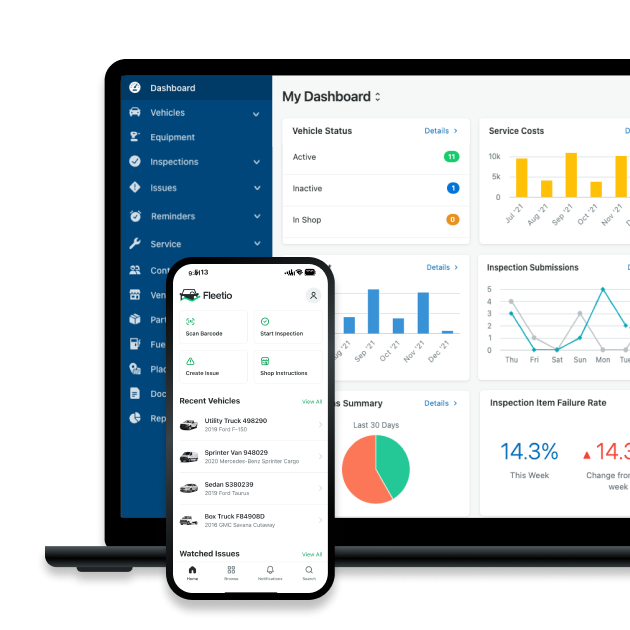
6. Improved driver safety and behavior monitoring
ELD-connected telematics captures speeding, hard braking, rapid acceleration and hard cornering. Those events give a manager something specific to coach on instead of a general sense that someone drives aggressively.
The asset side of this gets overlooked. Hard braking eats pads and rotors. Aggressive acceleration burns fuel and loads the drivetrain. A driver whose habits generate frequent events is also generating a shorter component life and a higher repair spend on that unit, which is visible in maintenance history once behavior data and service records sit in the same system.
Insurance exposure moves in the same direction. Premiums track loss history and CSA scores, and both respond to the behaviors this data surfaces.
How you frame it determines whether it works. Fleets that use behavior data to catch people lose driver trust and get gamed. Fleets that use it to coach, that tell drivers exactly what triggers an event and that treat the record as protection in a disputed incident get cooperation. The log cuts both ways, and it usually cuts in favor of the driver who did the job correctly.
7. Lower fuel costs
ELD and telematics data surfaces the behavioral side of fuel waste. Idle time is the clearest example. A unit idling two hours a day burns fuel for no output and accumulates engine hours that pull PM intervals forward, so you pay twice. Route and driving pattern data shows where the miles themselves are avoidable.
The transactional side needs a different input. Fleetio's fuel management runs primarily on fuel card integrations, which auto-import transactions and send real-time anomaly alerts when a purchase exceeds a tank's capacity, lands at an unexpected location or falls outside normal hours. That is where leakage and fraud get caught, because a telematics feed cannot tell you a card was used 90 miles from where the truck was parked.
The two inputs work on different problems. Telematics identifies behavioral waste from idling and routing. Fuel card data catches transactional leakage. Together they produce a fuel cost per mile figure you can actually defend, which is the number that makes a case for coaching, a route change or a spec change on the next purchase.
8. Better asset utilization visibility
Live engine hours and mileage answer a question most fleets estimate: which units are working, which are sitting and which are close to the end of their useful life. That data feeds utilization and total cost of ownership reporting rather than an annual guess assembled from memory and a spreadsheet.
Repair-versus-replace decisions get concrete once you can see true cost per mile by asset. A unit with rising maintenance spend and falling mileage is making an argument for itself, and so is a unit sitting at 30 percent utilization while you are quoting a new purchase. Redeployment is often the cheaper answer and it only surfaces when you can compare units directly.
Utilization data also changes how capital requests land. A fleet manager asking for six replacements based on experience is asking leadership to take their word for it. The same request backed by cost per mile, downtime hours and utilization by unit is a business case, and that is the difference between being treated as a cost center and being treated as an operation with evidence.
9. Improved audit readiness
Audit exposure comes mostly from retrieval rather than from actual noncompliance. Fleets fail audits because they cannot produce a record within the window, not because the work was never done.
When ELD and telematics data flows into Fleetio, HOS logs, inspection records, maintenance history, work orders and asset documents are centralized and timestamped in one place. Pulling the last six months of service history for a specific unit takes a search instead of an afternoon in a filing cabinet, which matters during a DOT audit or after an FMCSA inspection when the request has a deadline attached.
The same trail serves internal accountability. A manager can see that PM on three units is overdue, that a defect from last week has no matching repair record or that inspection completion has slipped at one location. Catching those while they are still small is the point, and it is only possible when the record is current rather than assembled after the request arrives. Our DOT compliance guide covers the full documentation picture.
10. Centralized fleet data and reporting
This is where the integration pays off. ELD and telematics data feeding into Fleetio alongside fuel card transactions, work orders, parts and labor produces a single record per asset, with total cost of ownership and cost per mile visible by vehicle, class and location.
That consolidation is what makes reporting trustworthy. Numbers assembled from four systems by hand carry four opportunities for a reconciliation error, and everyone reviewing them knows it. Numbers derived from one record get acted on.
Customizable dashboards then give each audience what it needs from the same data. Drivers see assigned tasks and inspections. Technicians see the work order queue. Managers see overdue PM and open issues. Executives see cost trends and KPIs. Nobody exports to a spreadsheet to build a view that already exists.
How Trucking ELD Data Integrates With Fleet Management Software
The connection itself is the differentiator. When integrated with fleet management software like Fleetio, ELD and telematics data automatically updates odometer readings, triggers preventive maintenance schedules and improves asset tracking. Here is what that looks like in each workflow.
Odometer auto-updates. Mileage posts from the engine on a schedule rather than from a driver's estimate or a monthly spreadsheet import. Every mileage-based service interval, warranty threshold and cost-per-mile figure in the system inherits that accuracy.
Engine hours syncing. Hour meters sync the same way, which is what makes hours-based intervals viable for idling-heavy and PTO-driven equipment. Fleets running mixed asset classes need both meters, and manual collection of either one degrades fast.
PM automation. Service reminders advance on live meter values against OEM recommendations and reset when the work order closes. That removes the drift that turns a disciplined interval into an approximate one over a year of cycles.
Work order generation. Diagnostic trouble codes and failed inspection items convert into issues and work orders without a manual handoff. The defect enters the shop queue with its source attached, so a technician sees what triggered it.
Maintenance cost tracking. Parts, labor and outside service costs accumulate against the asset and against accurate mileage, which is what produces a cost per mile you can compare across units and use in a replacement decision.
Most fleets are already paying for the data that drives all five. Our telematics integrations directory lists the providers that connect directly, and fleets running multiple providers across different asset types can connect several and still work from one record per asset.
Turning Compliance Data Into Operational Insight
An ELD is a data collection device that happens to satisfy a regulation. Driving time, engine hours, odometer readings, location history and fault codes are operational inputs first, and the compliance file is one thing you can build from them.
What determines the return is where that data goes. In a compliance silo it answers HOS questions and nothing else. Connected to your maintenance, inspection and cost workflows it advances PM schedules, opens work orders, flags developing failures and produces the cost per mile that makes a replacement case defensible. Uptime and cost control both improve for the same reason: the fleet stops waiting for a person to notice something and act.
So the useful question is not which ELD to buy. Most fleets already have one. The question is how much of what it collects is currently doing any work. If your odometer readings are entered by hand, if fault codes live in a portal nobody opens or if your PM schedule and your telematics data have never been introduced, the gap is in the integration rather than the hardware.
Worth auditing this quarter: pull your current ELD and telematics setup, list what data it produces and mark which fleet decisions that data actually informs today. The blanks are your roadmap. If you want a second set of eyes on it, contact our team and we will walk through what your current provider can feed into a maintenance program.
Put your ELD data to work
Fleetio connects telematics and ELD data to maintenance, inspections and cost tracking in one record per asset, so compliance data starts driving service decisions.
Get a demo
Trucking ELD FAQs

Articles written by "Fleetio Staff" are created by our editorial team through a blend of in-depth research, customer interviews, and analysis of industry studies and statistics. These collaborative pieces bring together multiple perspectives – internal and external – to provide fleet professionals with accurate, practical, and actionable insights.
View articles by Fleetio Staff
Senior Copywriter
Tyler Freeland is a Senior Copywriter at Fleetio. A former creative writer for Freightliner and Western Star, he now transforms complex (and sometimes common) fleet management topics into practical, engaging insights that fleet professionals can apply every day.
LinkedIn|View articles by Tyler FreelandReady to get started?
Join thousands of satisfied customers using Fleetio
Questions? Call us at 1-800-975-5304