Fleet Risk Management: A Complete Guide For 2026 & Beyond
Fleet risk management works best as a daily discipline rather than an annual compliance exercise. Every asset, driver and route carries measurable exposure, and most of it is already recorded somewhere in your inspection, maintenance and hours-of-service data.
May 1, 2019 | Updated: Sep 21, 2026
15 min read

What you need to know
- Risk leaves a paper trail before it becomes a claim. Missed inspections, defects that stay open for weeks and repeat hours-of-service exceptions are early signals, and each one is already recorded somewhere an auditor or an attorney can read later.
- Brakes and paperwork decide most roadside outcomes. During CVSA's 2026 International Roadcheck, brake-related violations accounted for 39.1% of vehicle out-of-service violations, and a missing medical card drove 27% of driver out-of-service orders.
- Documentation is the control that holds up. A defect noted without a matching repair record is a gap in the chain. Traceability from the inspection entry through the work order to completion is what makes a program defensible.
- Trends move programs. Single events rarely do. One failed inspection is a data point. Three failures on the same asset class in 60 days points at a process that needs to change.
Fleet risk management is the work of finding where a fleet is exposed to loss, reducing that exposure through driver safety and maintenance controls and documenting the effort well enough to hold up under FMCSA, DOT and OSHA scrutiny.
Exposure is rarely abstract. It looks like a driver with three harsh-braking events this month, a trailer carrying an open brake defect, a delivery window that pushes someone into their last legal hour or a location that quietly stopped completing inspections in July.
Running this well pays off in ordinary ways. Records are ready when an auditor asks for them. Assets spend fewer days waiting on repairs that could have been scheduled. When something does go wrong, the file shows that the fleet identified the problem and corrected it. If DOT-specific requirements are what brought you here, our guide to fleet DOT compliance covers that ground in more depth.
What Fleet Risk Management Involves
Fleet risk management operates as a loop, not a project with an end date. Five steps repeat on a set cadence:
- Identify exposure across drivers, assets, routes and regulatory obligations
- Assess likelihood and impact so the biggest problems get attention first
- Standardize controls such as inspection forms, preventive maintenance intervals and coaching triggers
- Document execution in records that connect a finding to the action taken
- Review performance monthly, then adjust the controls that are not working
That loop applies across four categories of risk, each with its own owner and data source:
- Driver risk. Behavior behind the wheel, training gaps and whether coaching gets recorded.
- Asset risk. Maintenance compliance, inspection defects and repair follow-through.
- Operational risk. Routing decisions, scheduling pressure and cargo securement.
- Regulatory risk. Hours-of-service violations, inspection failures, CSA patterns and audit exposure.
Recordkeeping is the thread running through all four. Risk that never gets written down cannot be measured, assigned or defended.
How to Assess and Quantify Fleet Risk
Fleet risk is measurable because it surfaces in countable events: incidents, violations, downtime, claims and insurance renewals. Assessment means locating where exposure concentrates, then applying consistent metrics so the same problem does not resurface a third time before anyone acts.
Identify risk factors
Risk factors cluster by category, which makes them easier to hand to an owner and a workflow.
| Category | What it looks like in your records |
|---|---|
| Driver | Speeding, harsh braking and acceleration, distracted driving, seat belt violations, repeat hours-of-service exceptions |
| Asset | Missed or incomplete inspections, overdue preventive maintenance, recurring defects that stay open, repeat out-of-service violations on one unit |
| Compliance | Unassigned ELD driving time, pencil-whipped inspection reports, gaps in roadside inspection history, slow corrective action |
| Operations | High-mileage or high-idle routes on under-maintained assets, tight delivery windows that create hours pressure, multi-site fleets enforcing standards differently |
Mapping factors this way answers a question that stalls a lot of programs: who is responsible for fixing this, and in which workflow does the fix happen.
Measure risk severity and probability
A 2x2 matrix is enough to start. Put likelihood on one axis and impact on the other, then place your known exposures. Repeat inspection failures, overdue preventive maintenance on critical units and documented patterns of unsafe driving land in the same corner, which is where the first round of work belongs.
Qualitative scoring holds up better when real numbers sit underneath it. These metrics are worth trending every month:
- Preventable incident rate
- Roadside inspection pass rate and out-of-service rate
- Inspection report completion rate and average defect closure time
- Hours-of-service exception frequency and repeat violation counts
- Preventive maintenance compliance rate
Each one gives you a baseline, a direction of travel and an early warning that something is drifting before it becomes a violation or a claim.
Prioritize risk mitigation actions
Prioritize on repeatability plus severity. A driver with three documented harsh-braking events needs structured coaching and a follow-up date before the fourth event. An asset failing inspection twice on the same defect needs escalation and a root cause, not a third inspection form.
Corrective energy spent on recurring problems buys durable improvement. Corrective energy spent closing tickets buys a cleaner queue.
Dive deeper into maintenance
Take some cues from the best and brightest in fleet maintenance with our Guide for Managing Maintenance, filled with real tips from real fleet professionals.
Get your free copy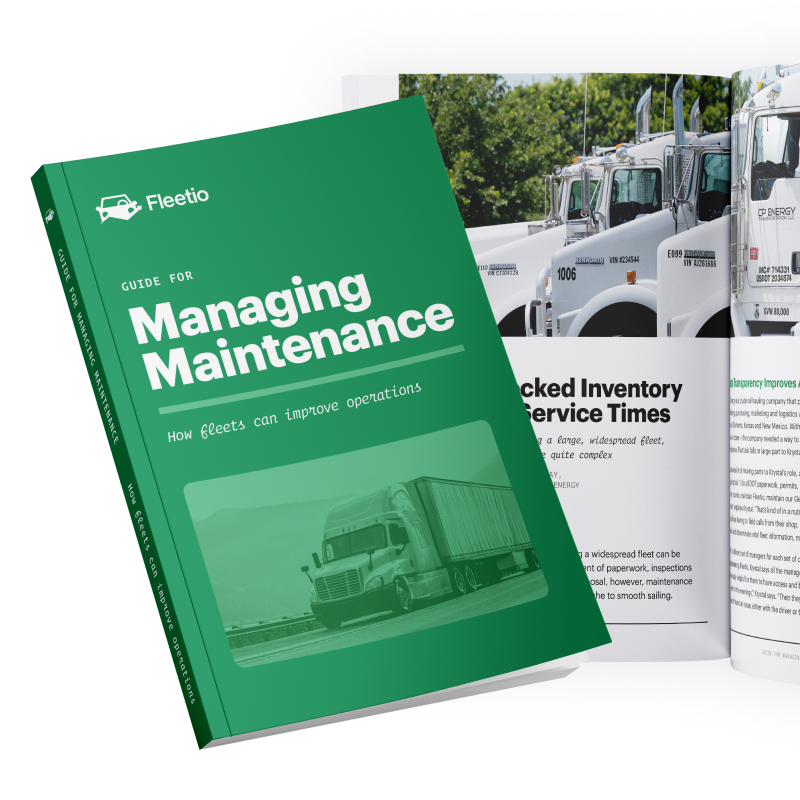
Fleet Driver Safety: Building and Enforcing a Safety Program
Driver behavior is the most controllable variable in fleet risk and the hardest one to shift without structure. Programs produce results when expectations are written down, coaching happens on a schedule and follow-through shows up in the data.
Develop clear safety policies
A working safety policy does four things: it sets the standard, defines what happens when the standard is missed, specifies how coaching gets recorded and schedules refresher training. Cover at least these components:
- Acceptable behavior behind the wheel, including speed thresholds, phone use and seat belt requirements
- How violations are identified, escalated and documented
- Who holds the coaching conversation, and how quickly after the event
- Training triggers, especially after an incident or a second violation of the same kind
Written policy applied unevenly is worse than no policy at all. Inconsistent enforcement across sites creates exactly the inconsistency a plaintiff's attorney looks for, and drivers notice it long before lawyers do. Fleets that bring drivers into the drafting process tend to get better adoption, which we covered in how driver input shapes fleet safety policies.
Use inspections to reinforce safety
An inspection is two controls in one. It catches mechanical problems, and it creates evidence that someone was looking. A record that captures a specific defect, a photo and a driver signature demonstrates active monitoring of vehicle condition in a way that a checked box never will.
The outcomes worth measuring are concrete: fewer vague or missing defect entries, stronger evidence when an item escalates to a repair, faster repair turnaround and a searchable history attached to each asset. Digital inspections using electronic DVIR tools make those outcomes easier to standardize across locations that do not share a yard or a supervisor.
Monitor and coach driver behavior
Telematics and driver-facing cameras surface speeding, harsh braking, rapid acceleration and distracted driving. The visibility only reduces risk when something happens next. Signals have to become documented coaching, a follow-up date and measurable change over the following quarter.
Coaching logs also carry weight in litigation, because they show the fleet identified a behavior and took structured action on it. Pay attention to where events cluster. One harsh-braking event describes a moment. Fifteen events across two drivers on the same route in a month describes the route.
Understanding Compliance Requirements
Compliance is daily execution plus documentation. Inspections, maintenance records, driver hours and supporting paperwork have to hold up in three settings: a roadside stop, a formal audit and a claims review after an incident. Programs that treat it as an end-of-year cleanup project tend to discover the gaps at the worst possible moment.
Key federal and state regulations
The Federal Motor Carrier Safety Administration and the Department of Transportation set the rules that govern operations on the road. OSHA enters in the shop instead, covering technician safety, lift and hoist procedures, hazardous material handling and protective equipment. A few enforcement realities shape what fleets actually need to produce:
- ELD records replace paper logs at the roadside, and inspectors cross-check that data against location history
- Automated hours calculations catch the arithmetic errors that paper logs used to hide
- Digital inspection reports line up with CVSA roadside standards and leave timestamped records behind
- Maintenance records that connect a defect to a repair date carry weight in both enforcement and claims
- Repeat behavior attracts the most scrutiny, since patterns are what feed CSA scores and carrier safety ratings
The FMCSA regulations database remains the authoritative source when a specific requirement is in question.
Daily vehicle inspection report requirements
Under 49 CFR 396.11, drivers prepare a report at the end of each day's work on every vehicle operated. Carriers retain the original report, the certification of repairs and the driver's review certification for three months from the date the report was prepared. General maintenance records under 396.3 stay where the vehicle is housed or maintained for one year, plus six months after the asset leaves the carrier's control. Every commercial motor vehicle also requires a periodic inspection at least once every 12 months under 396.17.
Frequency is the easy part. What holds up under questioning is defect identification, repair documentation and traceability from submission to completion. A report noting "brakes checked" with no specific finding tells an investigator nothing about the condition of the asset on that day.
Digital reports reduce pencil whipping, the practice of signing off on an inspection nobody performed, by requiring field entries and capturing photos with timestamps that are difficult to backfill. A flagged defect can route straight into a maintenance workflow, creating an unbroken chain from identification to resolution. Our guide to DVIR compliance walks through the requirements in detail.
Hours of service and ELD compliance
Hours-of-service compliance covers driver time limits, qualifying exceptions, log edits and the supporting documents behind them. Two failure points show up repeatedly: unassigned driving time, where miles are logged against a vehicle but never attributed to a driver, and a run of exceptions that establishes a pattern an inspector can see at a glance.
The ELD mandate applies to most commercial motor vehicles with a gross vehicle weight rating of 10,001 lbs. or more. Devices must record driving time, location and supporting data in a format transmissible to inspectors on demand. Enforcement interest here is active: hours-of-service violations accounted for 23.4% of driver out-of-service violations during the 2026 International Roadcheck, and inspectors issued 146 out-of-service orders specifically for ELD tampering.
State-specific compliance nuances
Federal standards set the floor. Enforcement patterns, documentation expectations and inspection criteria vary by state and by fleet type above that floor, which is why multi-jurisdictional operations carry the most administrative risk. Standardized workflows and centralized records keep a gap in one location from becoming exposure across the whole operation.
How to Monitor and Measure Risk and Compliance Performance
Risk programs improve when the same metrics get reviewed on the same schedule. The point is catching deterioration while it is still a trend rather than a violation, a downtime event or a claim.
Fleet key performance indicators
| KPI | What it tells you |
|---|---|
| Roadside inspection pass rate | How often inspections close without violations |
| Out-of-service rate | Share of vehicles or drivers placed out of service during inspections |
| Inspection report completion rate | Whether daily inspections are actually getting done |
| Defect closure time | How quickly identified defects are repaired and documented |
| Preventive maintenance compliance | Share of PM intervals completed on schedule |
| Preventable incident rate | Frequency of incidents that existing controls should have caught |
| Repeat violation trends | Whether the same violations recur across drivers or assets |
Review these monthly and read the direction, not the number. An out-of-service rate climbing across three consecutive months is structural. A single bad month usually is not.
Audits and roadcheck preparation
An audit or a CVSA roadcheck should not be the first time anyone verifies the records. Four things need to be retrievable quickly:
- Complete inspection history by asset
- Defect and repair timelines showing what was found and when it was fixed
- Maintenance records tied to vehicle condition
- Hours-of-service supporting documents
The most useful preparation is a mock inspection, where you review your own records through the lens of what an officer would ask for. Running one before an enforcement period such as International Roadcheck surfaces documentation gaps while there is still time to close them. For a practitioner's view, see our tips for surviving a DOT audit.
Trend analysis and reporting
A monthly review covers four things: repeat defects by asset and location, repeat violations by driver, sites where inspection completion or PM compliance has slipped and overdue maintenance clustering on high-utilization units.
Every review should end with corrective actions, owners and dates. Observations without follow-through leave the same audit exposure as not tracking trends in the first place.
Incident response and claims defensibility
After an incident, the documentation created in the following days becomes the foundation of the claims and litigation response. Capture what happened, the asset's inspection and maintenance history, the corrective actions taken and the process or policy change made to prevent a repeat.
Strong post-incident records do double duty. They reduce legal exposure in the current event, and they show insurers and regulators that the fleet acts structurally rather than reactively when something goes wrong.
Tools and Technology for Safety and Compliance
Technology earns its place in a risk program by making daily execution consistent. It standardizes inspection and maintenance workflows, speeds up repair follow-through, centralizes documentation and surfaces recurring patterns while they are still cheap to fix.
Electronic inspection and maintenance workflows
Moving off paper removes lost and incomplete records, cuts down on pencil whipping and leaves an audit trail attached to every asset. With digital inspection reports and connected maintenance workflows, fleets can:
- Capture defect details, photos, timestamps and driver signatures at the point of inspection
- Route failed inspection items into work orders automatically
- Track each repair from identification through resolution
- Approve third-party shop work line by line, so unneeded labor gets rejected before it reaches the invoice
- Schedule preventive maintenance to reduce breakdowns and out-of-service violations
Fleetio's vehicle inspection features connect inspections directly to maintenance workflows, which keeps inspection history, work orders, repair timelines and audit documentation in one system of record across every asset. That connection is what preventive maintenance as a safety system looks like in daily practice.
Telematics and driver behavior monitoring
Telematics platforms track speeding, harsh braking, rapid acceleration and idling, then tie those events to specific drivers, routes and asset types. The output supports coaching, documents corrective action and gives insurers and regulators evidence of active risk management.
Fleetio complements telematics and camera systems by centralizing those signals alongside maintenance and inspection records. Reading behavior data next to asset condition and repair history shows where risk is concentrating and, more usefully, why.
Safety and compliance integrations
Platforms that integrate with telematics, violation tracking and incident management tools cut down the manual reconciliation work that disconnected systems create. Driver profiles assembled from inspections, violations, behavior data and maintenance records make a high-risk driver or asset visible earlier, while the pattern is still small.
Fleetio's integrations ecosystem is built to work as a hub rather than another standalone tool, connecting the data sources your safety and compliance workflows already depend on.
Reporting dashboards and alerts
Programs that rely on end-of-month reporting learn about problems after the fact. Dashboards and alerts change the timing: failed inspections, overdue maintenance, repeat unsafe behaviors and compliance gaps surface as they happen.
A fleet optimization platform like Fleetio lets teams watch inspection completion, overdue maintenance and repeat defect patterns in one place, which gives leaders a chance to intervene before an issue turns into a violation, a downtime event or a claim.
Common Challenges and Mistakes in Fleet Risk Management
Experienced teams tend to run into the same four structural problems.
Compliance gets treated as an annual exercise. Documentation gaps accumulate quietly over months. By the time an audit or a roadside stop exposes them, the window to correct has closed and the record is what it is.
Tools stay disconnected. Inspection records in one system, maintenance in another and driver behavior data in a third means follow-through depends on someone remembering to check all three. The blind spots between systems create the same exposure as not collecting the data.
Behavior data arrives without a coaching workflow. Telematics visibility with no consistent coaching produces noise. Signals reduce risk only when they lead to documented conversations, follow-up dates and improvement you can point to.
The loop from defect to repair stays open. An inspection that finds a problem and a work order that resolves it have to be linked. When they are not, the audit trail has a hole in it and the asset may go back into service with the defect still there.
Building a Resilient, Compliant Fleet Risk Program
A resilient program rests on consistent execution, clear ownership and records that show problems were found early and corrected quickly. Three principles separate those programs from reactive ones:
- Standardize the controls. Inspections, preventive maintenance intervals and coaching workflows should work the same way for every driver, asset and location.
- Centralize the records. Inspection history, repair timelines and compliance documentation belong in one system of record rather than spread across paper files and spreadsheets.
- Let trends drive policy. One out-of-service violation is a data point. Three on the same asset type in 60 days means the maintenance or inspection process needs a change.
Worth checking against your own operation: how long would it take to produce three months of inspection reports, the matching repair records and the hours-of-service documents behind them. If the answer involves calling two people and opening four systems, that is the gap to close first. Fleetio centralizes that data and turns daily operations into a program you can defend.
Never question your compliance
Inspections completed and stored. Defects traced to the repair that closed them. Records ready when someone asks for them. See what that looks like across your fleet.
Book a demo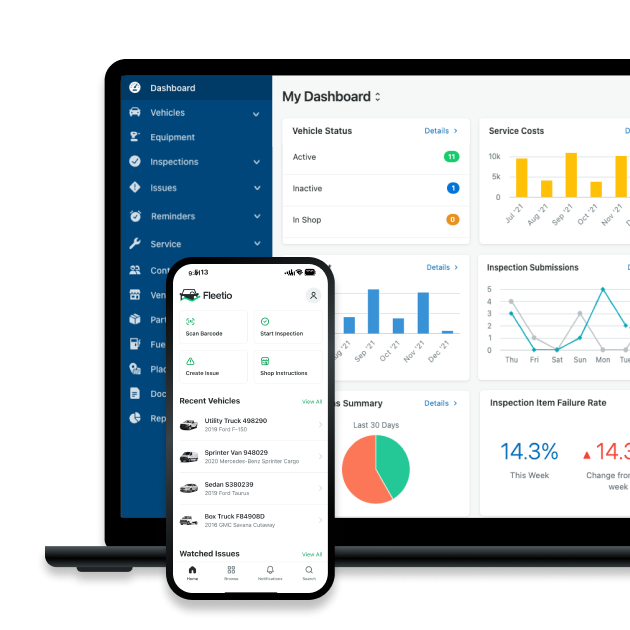
Fleet Risk Management FAQs

Content Marketing Manager
Matt is the Content Marketing Manager at Fleetio. If he's not developing strategies for new, engaging content, you can find him trying to develop his golf game.
LinkedIn
Senior Copywriter
Tyler Freeland is a Senior Copywriter at Fleetio. A former creative writer for Freightliner and Western Star, he now transforms complex (and sometimes common) fleet topics into practical, engaging insights that fleet leaders can apply every day.
LinkedIn|View articles by Tyler FreelandReady to get started?
Join thousands of satisfied customers using Fleetio
Questions? Call us at 1-800-975-5304