Fleet Management: Key Components, Challenges & Tips
This guide explains what modern fleet management looks like today, why it matters more than ever and how fleet leaders can reduce downtime, control costs and improve compliance using proven strategies and technology.
Apr 3, 2025 | Updated: Jan 30, 2026
11 min read

Key takeaways from this guide
-
Fleet management has become a strategic business function: Modern fleets face rising costs, stricter compliance demands and operational complexity that make reactive, manual management unsustainable.
-
Proactive, data-driven practices reduce risk and cost: Automated preventive maintenance, real-time visibility and consolidated data help fleets avoid downtime, control total cost of ownership and make defensible lifecycle decisions.
-
Disconnected systems create financial and compliance exposure: Spreadsheets, paper inspections and siloed tools lead to lost records, inaccurate reporting and preventable overspending across maintenance, fuel and parts.
-
Technology is reshaping how high-performing fleets operate: Centralized fleet management systems, telematics, mobile workflows and automation replace manual processes with accountability, consistency and faster issue resolution.
-
Modern fleet management systems enable scalable results: Fleetio connects maintenance, inspections, costs and assets in one platform, helping fleet leaders reduce downtime, improve compliance and gain the financial clarity needed to operate with confidence.
Fleet operations today are materially more complex than they were even a few years ago. Fleets are managing more assets across wider geographies, facing higher operating and labor costs, navigating tighter safety and compliance requirements and supporting increasingly distributed teams of drivers and technicians. Using manual data collection and tracking means, like spreadsheets, paper inspections and disconnected tools, are no longer sufficient to keep assets on the road, costs predictable and risks under control.
Modern fleet management has evolved into a critical business discipline. When executed well, it reduces operating costs, protects asset uptime, improves safety and compliance and ultimately becomes a measurable competitive advantage. But, when executed poorly, it leads to preventable downtime, budget overruns, compliance exposure and frustrated teams.
This guide breaks down what fleet management really means today, why it matters more than ever, the core components and challenges fleets face, and how technology and best practices are reshaping the industry. You’ll also learn practical steps fleet leaders can take to improve performance and how modern fleet management systems like Fleetio support these outcomes.
What is Fleet Management
Fleet management is the practice of maintaining and optimizing vehicles and equipment to maximize uptime, control total cost of ownership (TCO), ensure compliance and measure performance across maintenance, drivers, costs and asset lifecycle decisions.
At its core, fleet management is about more than keeping assets running. It is strategic asset management that helps organizations operate safely, predictably and profitably. Effective fleet management connects people, processes and data so leaders can make informed decisions about maintenance, utilization, budgeting and replacement timing.
Modern fleet management is proactive and data-driven. Instead of reacting to breakdowns, high-performing fleets rely on automated maintenance triggers, consolidated cost data, real-time visibility into asset health and predictable maintenance cadences. This approach reduces surprises, improves planning and builds confidence across operations, finance and compliance teams.
Why Effective Fleet Management is Important
Fleet operations have changed rapidly in recent years, increasing both financial and safety risk. As fleets grow in size and complexity, the margin for error shrinks, placing a premium on systems that deliver real-time visibility, accountability and predictable outcomes.
Rising operational and financial pressures
Fuel and energy prices remain volatile, labor shortages persist and inflation has driven up the cost of parts and maintenance services. Many fleets are also experiencing longer shop lead times due to supply chain constraints. Without consolidated cost data, fleet leaders struggle to calculate accurate cost per mile or total cost of ownership, making it difficult to forecast budgets or defend repair-versus-replace decisions.
Increasing safety, compliance and audit requirements
Regulatory oversight from organizations such as the FMCSA, DOT and OSHA requires fleets to maintain accurate, auditable records for inspections, maintenance and driver qualifications. Missing or incomplete records can lead to fines, failed audits and increased liability. Paper forms and siloed systems make it easy for critical documentation to get lost, increasing compliance risk and administrative burden.
Growth and dispersed fleet operations
As fleets expand across regions and rely on remote drivers and technicians, data fragmentation becomes a serious challenge. Inconsistent processes, delayed issue resolution and lack of shared visibility slow down operations. Consolidated systems of record are increasingly essential so that issues, inspections and repair histories travel with the asset and can be accessed by everyone who needs them.
Key Terms in Fleet Management
Understanding fleet management terminology is essential for making informed maintenance, budgeting and lifecycle decisions. Let’s take a look at a few key must-know terms.
Total cost of ownership (TCO)
TCO represents the full cost of an asset over its lifecycle, including purchase price, maintenance, fuel, insurance, downtime and disposal. Fleet managers use TCO to evaluate asset performance and determine the most cost-effective replacement timing.
Preventive maintenance (PM)
PM refers to scheduled service based on time, mileage or engine hours. PM helps prevent breakdowns, extend asset life and reduce overall repair costs.
Digital vehicle inspection report (DVIR)
A DVIR is a standardized inspection completed by drivers or operators to document asset condition. Digital DVIRs improve accuracy, speed issue reporting and provide auditable safety records.
Cost per mile
Cost per mile measures how much it costs to operate an asset for each mile driven. It is a critical metric for comparing asset efficiency and controlling operating expenses.
Utilization rate
Utilization rate tracks how often and how intensively an asset is used. This metric helps fleets right-size their fleet, identify underused assets and optimize deployment.
Warranty recovery
Warranty recovery ensures eligible repairs and parts are reimbursed by manufacturers. Proper tracking prevents fleets from paying for repairs that should be covered.
Telematics and odometer automation
Telematics systems collect such asset data as mileage, engine hours and fault codes. Automated odometer updates keep maintenance schedules accurate without manual entry.
Fleet management system
An FMS is a centralized software platform that manages maintenance, inspections, costs, assets and compliance data across the fleet.
Work order management
Work order management tracks maintenance and repair activities, including labor, parts, service duration and costs, providing visibility into asset health and shop efficiency.
Fuel management
Fuel management involves tracking fuel usage, costs and anomalies to control one of the largest operating expenses for many fleets.
Core Components of Fleet Management
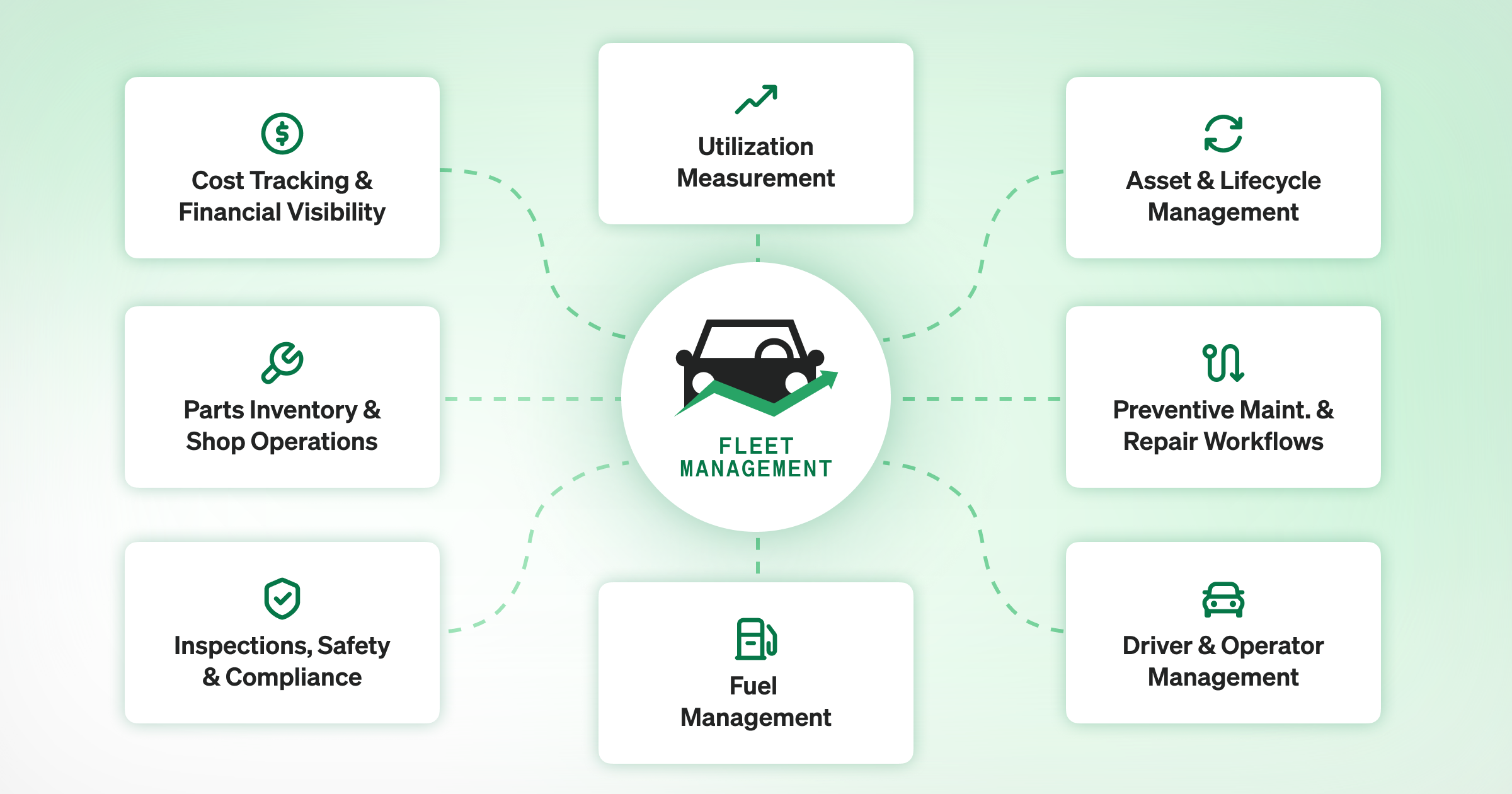
Modern fleet management spans multiple interconnected responsibilities. Weaknesses in any area can impact uptime, safety and cost control. Let’s break down some of the core components of fleet management.
Asset and lifecycle management
This includes tracking acquisition, specifications, utilization, depreciation and disposal. By analyzing TCO, repair history, utilization and residual value, fleets can set clear repair-versus-replace thresholds and optimize retirement timing.
Preventive maintenance and repair workflows
Automated PM scheduling based on mileage, time or engine hours helps reduce unplanned downtime. Digital work orders and parts tracking improve accountability and shorten repair cycles.
Driver and operator management
Driver assignment, safety monitoring, license tracking and inspection reporting all influence fleet performance. Driver-reported issues often surface problems early, reducing repair severity and improving safety.
Fuel and energy management
Fuel and energy are major expenses for many fleets. Automated fuel data imports and anomaly detection help control costs and identify potential fraud or inefficiencies.
Inspections, safety and compliance
Standardized, FMCSA-compliant digital inspections ensure consistency and provide auditable documentation that reduces risk during audits.
Parts, inventory and shop operations
Strong parts inventory management consists of tracking parts usage, balancing inventory carrying costs against expedited shipping and downtime risk to reduce overhead while improving repair times and ensuring warranty compliance and efficient shop operations.
Cost tracking and financial visibility
Centralized expense tracking gives finance and operations teams accurate, defensible data to manage budgets and evaluate performance.
Utilization and performance measurement
Understanding how assets are used helps fleets optimize size and deployment, while recognizing that some underutilization may be strategic for backup or seasonal demand.
Connect all your sites, so your fleet runs as one
When every site is connected, operations run smoothly, assets move, teams align and your multi-site fleet runs as one. Start driving results across every location.
Grab your copy
Common Challenges in Fleet Management
Fleets face a number of systemic challenges that often push organizations toward adopting a fleet management system. Let’s take a look at the these challenges and their impact on fleet operations.
Lack of real-time visibility and disconnected data
Fragmented systems and tribal knowledge lead to conflicting information and delayed decisions. Fleets need a single source of truth for maintenance, cost and compliance data.
Preventable downtime caused by reactive maintenance
Reactive repairs lead to higher breakdown costs, lost productivity and missed revenue. Without consolidated maintenance data, recurring issues go unnoticed.
Avoidable costs and limited financial transparency
Duplicate charges, unnecessary services and fuel fraud are common when data is scattered. Finance teams struggle to trust numbers without centralized reporting.
Administrative burden from manual processes
Paperwork, spreadsheets and manual data entry consume time and increase errors. Automation can reduce hours of weekly admin work to minutes.
Compliance risk due to incomplete documentation
Lost DVIRs, missing PM records and inconsistent inspections expose fleets to fines, audits and safety incidents.
Technology's Role in Fleet Management
Technology is not just digitizing old processes; it is enabling new operating models built on visibility, automation and accountability. Let’s take a look at how.
AI-driven insights and predictive capabilities
AI supports predictive maintenance, anomaly detection, cost forecasting and smarter issue triage, reducing human error as data volume grows.
Centralized systems of record for all fleet data
Consolidating assets, costs, inspections and work orders into one platform eliminates blind spots and drives accountability. This helps fleets standardize maintenance workflows and practices across multiple locations, as well as when using third-party shops or mixed maintenance approaches.
Mobile-first workflows connecting field teams and offices
Drivers and technicians can submit inspections, photos and issues from anywhere, and managers can review and prioritize real-time issue alerts based on DTC faults or inspection item failures, closing the loop from discovery to repair.
Telematics-driven automation
Automated mileage and fault code imports keep PM schedules accurate and shorten response times. Plus, managers can use sensor data snapshots to reduce issue diagnostic time.
Fuel card integrations
Real-time fuel data reduces admin work and immediately flags anomalies such as fueling past the asset’s tank capacity and fueling outside authorized zones, helping reduce fraud and over expenditure.
Automated maintenance scheduling and workflows
PM reminders, auto-generated work orders and labor and parts tracking streamline operations and reduce downtime. Because parts inventory is adjusted based on what’s added to a work order, parts usage tracking and insight into optimal stock counts improves, reducing overhead and shop delays.
Best Practices for Modern Fleet Management
High-performing fleets adopt habits that move them beyond reactive, manual operations. These habits include, but are not limited to:
Building a proactive preventive maintenance culture
Reactive fleets more often face higher TCO and more unpredictable costs while fleets managing PM proactively reduce breakdowns, lower repair costs and increase uptime. Automated scheduling and odometer-based triggers keep teams on cadence and allow for more predictable budgeting.
Empowering drivers as active participants in fleet health
Paper inspections create a gap between when an issue is found and when managers or technicians are notified of it, making it difficult to address critical issues before they escalate. Drivers are often first to spot issues. Mobile inspection tools enable fast, standardized reporting, real-time issue alerts, and prirtization of critical issues.
Standardizing inspections and maintenance workflows
For many fleets, especially those operating across multiple locations, inspection and service data may lack consistency, making it difficult to gain accurate insights into fleet health. A centralized fleet system with digital tools helps fleets standardize inspections and service data to improve repair quality, compliance and turnaround time while creating auditable records.
Using automation to eliminate manual data entry
Manual data entry takes time and is prone to error. Automation improves data integrity, reduces admin time and frees teams to focus on higher-value work. An automation-forward central fleet system pulls in data from telematics, fuel cards, third-party shops and other digital tools to ensure consistent — and correct — data is being collected and stored in one place for a more complete view of the fleet.
Reviewing asset performance regularly
To empower you fleet to perform optimally, there are certain KPIs to consider. While you may want to track specific goal-based metrics, the most common KPIs to track include TCO, cost per mile, utilization and repair history. These data points help you support defensible repair-versus-replace decisions and forecast strategic replacements.
Why Today's Leaders Choose Fleetio
Fleetio is a centralized, cloud-based fleet maintenance and optimization platform that delivers visibility, automation and accountability across fleet operations. By connecting maintenance, inspections, costs and assets in one platform, Fleetio helps fleets reduce downtime, control costs and operate with confidence.
Fleetio customers benefit from:
- Automated PM scheduling & DVIR-to-work-order workflows that reduce preventable downtime and shorten issue-to-repair cycles
- Centralized data, TCO reporting and cost-per-mile insights to improve financial stewardship and support defensible repair-versus-replace decisions
- Mobile-first inspections and real-time issue reporting that strengthen driver engagement and accelerate communication between the field and shop
- Fuel card and telematics integrations that eliminate manual data entry, detect anomalies sooner and keep operating costs under control
- Standardized work orders, parts tracking and audit-ready documentation that enhance compliance, improve shop efficiency and reduce administrative burden
Everybody from the drivers and branch managers all the way to our executives are excited about using Fleetio. They were seeing their actual data for the first time — realizing it’s right there at their fingertips whenever they need it [...] Fleetio allows us to streamline the maintenance process so that we can continue to focus on what matters most to us. Serving our customers. Kathryn Kendrick, Fleet Management Information Systems Administrator, United Site Services
One platform, ten fewer headaches
See how one centralized system can reduce downtime, cut costs and give you full control of your fleet.
Schedule a demo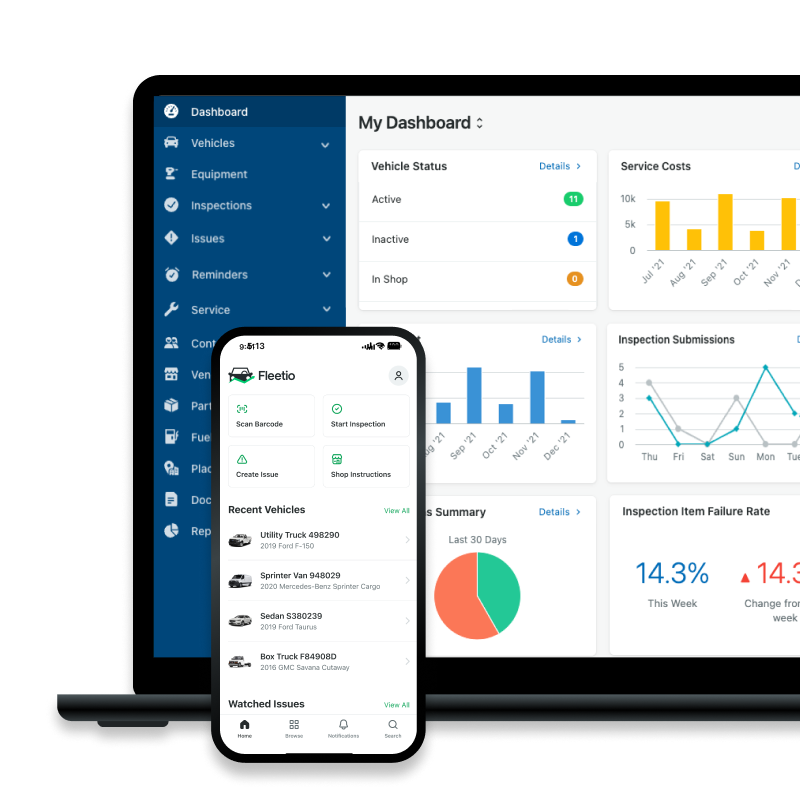
FAQs

Senior Fleet Content Specialist
As a Senior Fleet Content Specialist at Fleetio, Rachael Plant uses her near decade of industry experience to craft practical content aimed at helping fleet professionals tackle everyday challenges with confidence.
LinkedIn|View articles by Rachael PlantReady to get started?
Join thousands of satisfied customers using Fleetio
Questions? Call us at 1-800-975-5304