What 600 Fleet Professionals Think About AI (and Why It Shaped How We're Building It)
AI may be one of the loudest conversations in fleet right now, but our survey shows most fleet professionals are taking a measured approach. More than 600 fleet professionals told us they want proof, human oversight and low-risk ways to start before they trust AI in day-to-day operations.
Apr 14, 2026
7 min read

What the survey tells us
We surveyed more than 600 fleet professionals earlier this year, where we asked them about their operations, their challenges, their plans.
We included an AI section at the end of this year's survey because AI is one of the loudest conversations happening across every industry right now, and we wanted to know how it was actually landing with fleet professionals — not the enthusiasts or the early adopters, but the people managing real fleets, under real budget pressure, making decisions with real consequences.
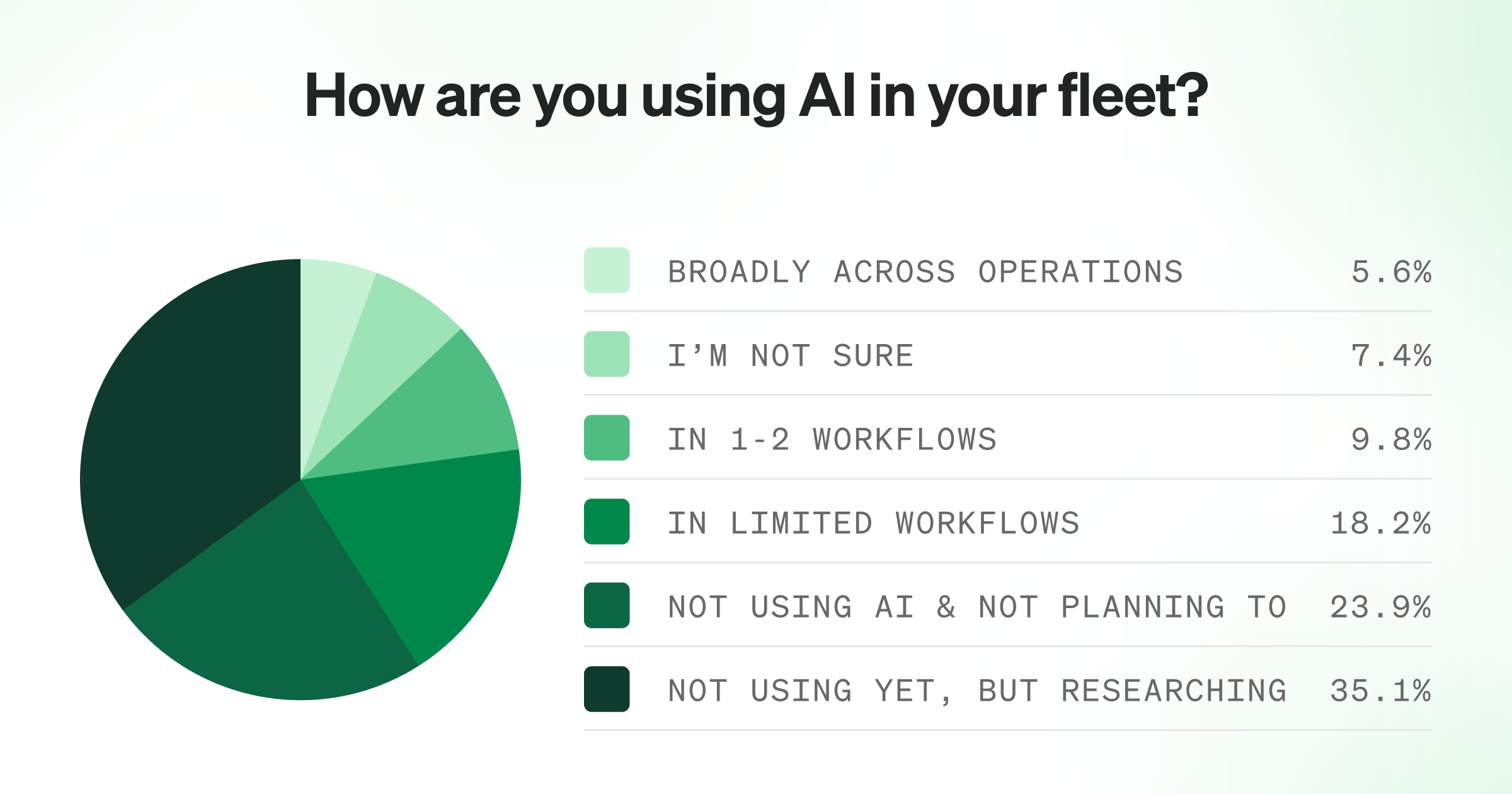
- 35% of fleets are researching AI but haven't adopted it yet
- 59% are either not using AI or not planning to
- Only 1.5% would trust an AI recommendation without any human review
- 87% want AI to act only at low-risk levels or below, or not at all
- #1 ask to increase adoption: a low-risk pilot with support
You hear a lot about the fleet industry being tech averse. I don't think that's quite right. What looks like tech aversion is usually something more deliberate: a calculated, protective posture from people who've learned that a wrong decision doesn't stay wrong quietly – it compounds.
So they move carefully, they ask hard questions and they want proof before they commit.
1. Most fleets are watching, not moving
35% are researching AI. 24% aren't using it and don't plan to. Only 5.6% are using it broadly.
When we asked fleet professionals to describe their current relationship with AI, most of them landed somewhere in the middle – researching cautiously, piloting in limited workflows or genuinely unsure where they'd even start. The people using AI broadly across their operations were a small minority.
Fleet managers are making decisions that affect drivers, vehicles, compliance and budget. Maintenance calls can ground a vehicle. A missed PM can cascade into unplanned downtime. These aren't the kinds of stakes that reward moving fast and finding out.
The industry's measured pace on AI is a risk management response to a technology that hasn't earned consistent trust yet.
2. Comfort is neutral, trust is conditional
The most common comfort level with AI in daily operations: 3 out of 5.
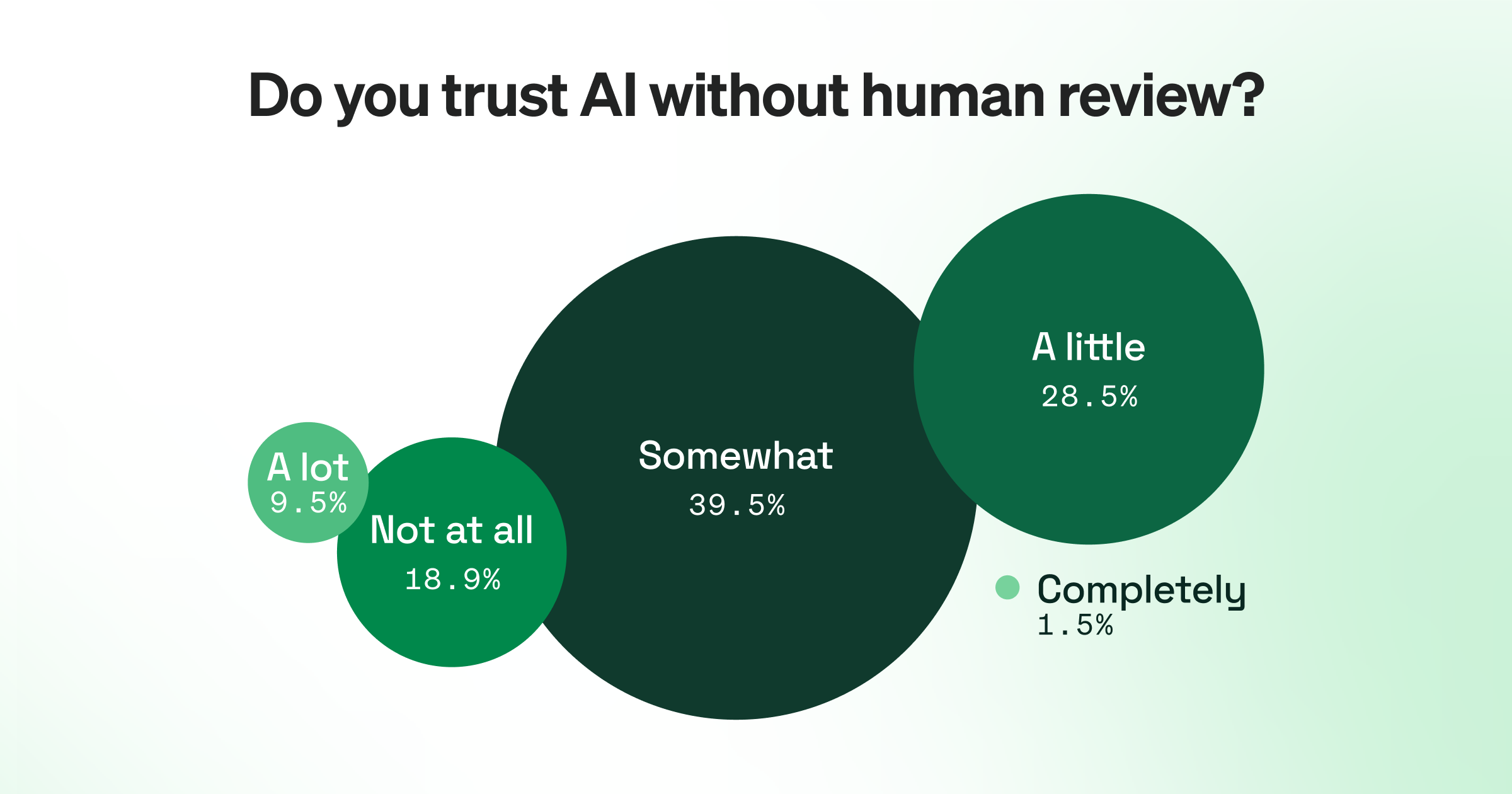
Many fleet managers feel comfortable enough with AI to keep watching, not convinced enough to move. We also asked how much they trust AI-generated recommendations without human review:
- 39.5% — Somewhat
- 28.5% — A little
- 18.9% — Not at all
- 9.5% — A lot
- 1.5% — Completely
Only 1.5% would let an AI recommendation stand on its own. Everyone else wants eyes on it first.
My biggest hesitation with AI is over-reliance without proper human oversight. While AI can be extremely powerful, it can make mistakes, reflect biased data, or produce decisions that aren't fully transparent. Survey respondent
3. They're not waiting for AI, they're waiting for proof
The #1 thing that would increase likelihood to adopt: a low-risk pilot with support.
When we asked what would actually move fleet managers toward adopting AI, the answers weren't about features or pricing tiers. They wanted to see it work in an operation like theirs before betting on it.
4. Where they want AI to act, and where they don't
Less than 1 in 20 fleet managers are ready for AI to touch high-impact decisions without a human sign-off.
We asked where AI should be allowed to act without human approval:
- 57.4% — Low-risk automations only (reports, summaries)
- 31.6% — Moderate actions (PM scheduling, parts suggestions)
- 28.5% — Nowhere — recommendations only
- 4.1% — High-impact actions (vehicle assignment, automated approvals)
Fleet managers are fine with AI handling the administrative grunt work. The closer a decision gets to an asset, a driver or a dollar, the more they want a human involved. That's a consistent, coherent position, rather than a blanket rejection of the technology.
5. What they actually want AI to fix
Ask fleet managers what AI should do first, and they'll tell you: stop making maintenance so hard.
We asked: "If you could wave a magic wand, what would AI fix first in your fleet?"
Across hundreds of open-ended responses, the same themes kept showing up:
- Predicting maintenance needs before something breaks
- PM scheduling that doesn't require someone chasing down drivers
- Parts ordering that gets ahead of stockouts instead of reacting to them
- Knowing when to retire a vehicle before the repair costs answer that question for you
- Eliminating manual data entry: invoices, service records, mileage logs
If I could wave a magic wand, I would have AI fully automate preventive maintenance scheduling. Real-time monitoring of every vehicle, predicting failures before they happen, ordering parts automatically, scheduling service without downtime. Survey respondent
The ask is operational. They want the friction removed from the work they're already doing. But it's worth noting what fleet managers aren't asking for – AI that reinvents how their operation works, or replaces the judgment they've built over years.
6. What's actually in the way
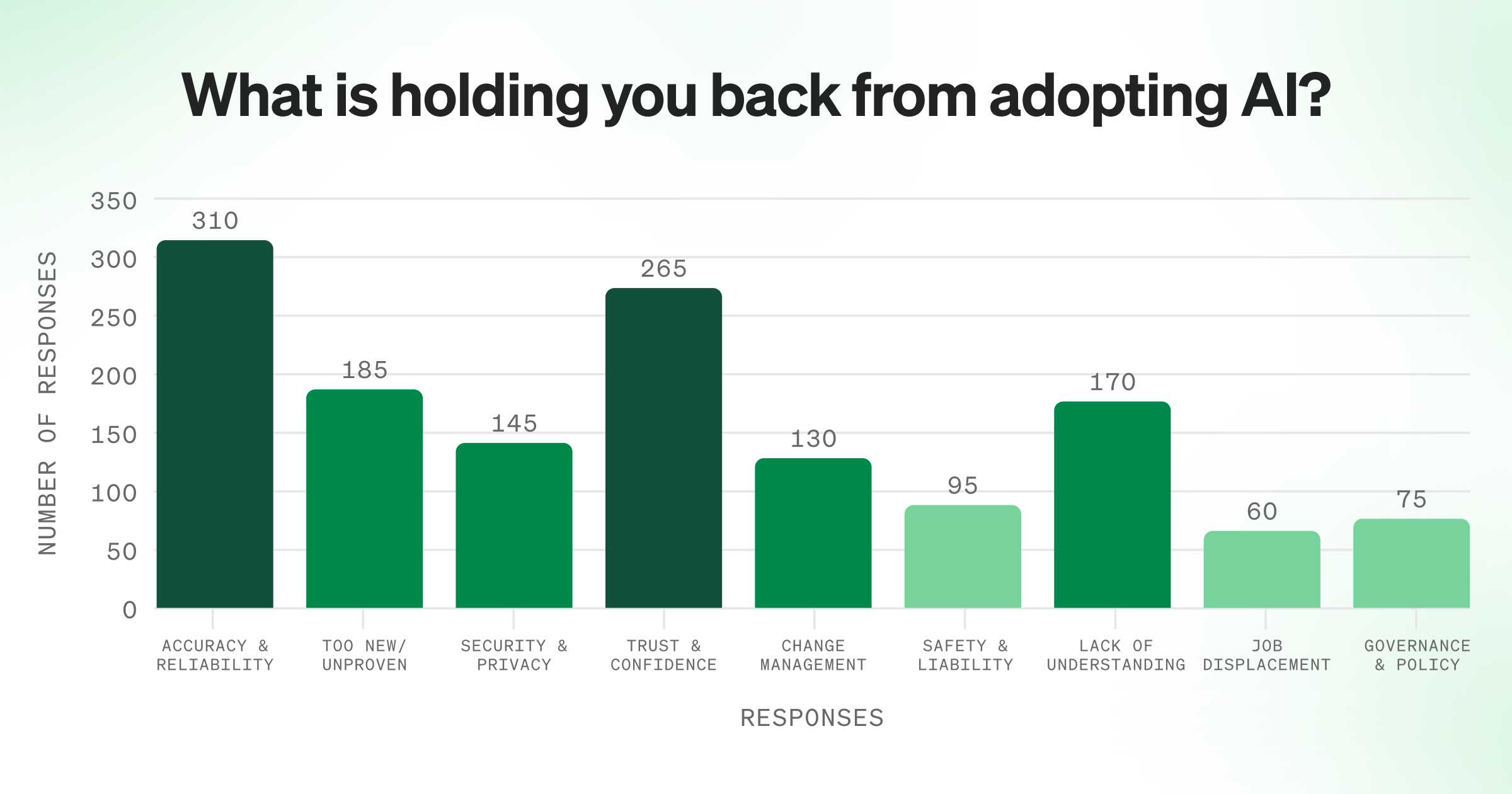
Accuracy and reliability are at the core of almost every hesitation.
Fleet professionals aren't worried about AI in the abstract. They're worried about AI that sounds confident, but pulls from bad data, recommendations that don't account for the nuances of their particular operation, and not being able to trace a bad outcome back to a reason.
AI spits back the most common answer. And that's often not the right one for our specific situation. Survey respondent
And the accountability question came up repeatedly. It's not that fleet managers want to review everything, it's that they want to know who's responsible when something goes wrong. A recommendation with no source and no override is a liability.
Over-reliance without human review. AI works best when paired with accountability and clear oversight. Survey respondent
One person put it plainly: "AI is only as good as its data."
What we're doing about it
The market keeps talking about what AI can do. Fleet managers are asking what it can do reliably, for their operation, within guardrails they control.
We've been building fleet software for 14 years. We know how fleet managers think about risk, because we've watched them think about it across millions of maintenance decisions. Fleet managers aren't opposed to AI, they're waiting for someone to build it in a way that respects how high the stakes actually are.
Most AI in fleet right now is built from the outside in. A model gets trained on general data, a fleet-specific wrapper gets put around it, and suddenly it's a "fleet AI product." The recommendations look plausible – they're sometimes right – but they're not grounded in the actual, specific, messy reality of how maintenance decisions get made, across different vendors, different locations, different reviewers, different policies.
We've been calling what we're building practical fleet intelligence: AI that works inside the decisions that matter, not beside them. For us, that means:
- Recommendations built on 14 years of real maintenance data – more than 9 million work orders, across 110,000 shops, on 8 million vehicles
- Guardrails that keep high-impact decisions in your hands, with automated actions that are visible, auditable, and never a surprise
- Data that stays inside Fleetio's controlled infrastructure – your fleet's specific data is never shared outside your account or used to identify your operation externally
AI Service Advisor, now available in open beta, is where that philosophy shows up in the product. It reviews every repair order the moment it hits Fleetio, flags cost spikes, duplicates, and work that looks out of place, and surfaces the small number of items that actually warrant your attention, while the routine stuff keeps moving.
It doesn't replace the decision. It just makes sure you're spending your judgment on the things that deserve it.
That's the version of AI we think fleet managers are actually asking for. Not a system that acts on its own. Not a product that promises more than it's proven. The goal is AI that does what it says, proves itself in your operation, and earns more trust from there.

Director of Fleet Content, Fleetio
Zach Searcy is the Director of Content at Fleetio with more than 5 years of experience in the automotive and fleet industries. His content creation days started in middle school when he and his friends began filming lightsaber battles to upload to a new website: 'YouTube.'
LinkedIn|View articles by Zach Searcy
Senior Fleet Content Specialist
As a Senior Fleet Content Specialist at Fleetio, Peyton explores the voices and experiences that shape fleet operations. She focuses on how fleet professionals adopt technology, improve efficiency and lead their teams to bring clarity and context to the challenges happening across the industry.
View articles by Peyton PanikReady to get started?
Join thousands of satisfied customers using Fleetio
Questions? Call us at 1-800-975-5304