On-Site Fleet Fueling: Benefits, Hidden Risks and Data Controls
Bringing the pump to your yard buys back driver hours and a better price per gallon. It also hands you a bulk tank gauge, a vendor meter and a dispensing log that nobody cross-checks. Here is to close the gap between gallons delivered and gallons accounted for.
Sep 9, 2026
14 min read
What you need to know
- Fuel theft does not go away on site, it changes form. Retail card misuse drops. Tank-level shrinkage, handwritten PIN logs and uncalibrated delivery truck meters open three new leakage points in its place.
- Savings evaporate when fuel data still runs through spreadsheets. Manual reconciliation at a busy yard is a losing proposition. One fleet manager's team spent more than 15 hours a week on it and still missed misuse until the money was gone.
- Three compliance exposures stay with you after the contract is signed. EPA spill plan thresholds under 40 CFR 112, IRS dyed diesel rules and mobile meter accuracy under NIST Handbook 44, Section 3.31. None of them transfer to your vendor.
- A defensible cost case ties every gallon to an asset. You cannot reduce a fuel cost you cannot measure. When dispensing data lands on the asset record next to maintenance, parts and labor, fuel spend becomes a Total Cost of Ownership (TCO) number leadership can defend.
On-site fleet fueling brings fuel to the place where your assets already park, which replaces the driver trip to a retail station. Two configurations cover most operations.
A bulk storage tank, owned or leased, sits at the yard. A supplier delivers on a schedule and your team dispenses through its own pumps and access hardware. You control when and how fuel moves. You also carry the capital cost of tank installation, secondary containment and every compliance obligation that follows.
Mobile fueling, often called wet-hosing, runs the other direction. A vendor truck arrives on a set schedule or on demand and pumps directly into each asset. The vendor owns the equipment and manages dispensing, so your infrastructure spend drops. So does your visibility into dispensing data and meter accuracy, which matters more than most vendors mention in the first meeting.
The Two On-Site Models and What Each One Costs You
Both models return the time drivers spend at retail stations. They diverge on capital commitment, compliance burden and how much visibility you keep over every gallon dispensed.
| Factor | Bulk tank at the yard | Mobile fueling (wet-hosing) |
|---|---|---|
| Capital commitment | Tank, pumps, containment, permitting | Minimal, the vendor owns the equipment |
| Dispensing control | Fleet controlled down to the driver and the pump | Vendor controlled, with reporting you have to request |
| Compliance burden | Sits with you: SPCC plan, dyed diesel records, inspections | Lighter, though meter accuracy is still your exposure |
| Data visibility | Strong when pump access controls feed your fleet software | Depends entirely on what the service agreement promises |
| Best fit | High volume single yard operations with steady consumption | Fleets that want to skip the pump without buying infrastructure |
On-site fueling gives you more control over fuel costs and usage than a retail card program does, particularly at high consumption volumes. That control is the whole point, and it is also the thing that quietly disappears when the data layer does not keep up.
Does Your Fleet Actually Fit the On-Site Model?
On-site fueling pays off when assets return to a central location overnight in enough density to justify the stop. Dispersed parking or low daily volume breaks the economics fast. Run your operation against these criteria before you sign anything.
- Parking density and overnight dwell time. Assets have to sit at a predictable location long enough to be fueled. Construction yards, government motor pools and utility depots fit the pattern. If your assets park at driver homes or scattered job sites, the core advantage is gone because a vendor has no single stop to service.
- Minimum daily fuel volume. Bulk delivery pricing and mobile service fees only pencil out above a threshold of daily gallons. Operations with four or more assets parking in a central location during off hours can be reasonable candidates. Below that, delivery fees can cost more per gallon than you save at the pump.
- Central versus decentralized operations. One or two yards means one fueling point to manage well. Spreading across many small sites multiplies either infrastructure cost or vendor coordination, and decentralized assets often make on-site service cost prohibitive.
- Local permitting environment. Some jurisdictions restrict above-ground storage tank placement or require environmental permits that add months of lead time and thousands of dollars. Check local fire code and zoning before you budget a bulk installation.
- Mixed fueling reality. You will not fuel 100% on site. Field assets, long routes and emergency fills still send drivers to retail. Decide whether your realistic on-site share justifies the setup cost and the management overhead.
Pro Tip
Before you price a single gallon, pull 90 days of fuel transactions and count how many happened within a few miles of your yard. That share is your realistic on-site volume. Quoting a vendor against total fuel spend inflates the savings and the first month of invoices will show it.
With diesel near $5.62 a gallon in April 2026 according to the Energy Information Administration, the evaluation feels urgent. Urgency is not fit. If your operation clears most of the criteria above, the benefits are measurable.
Where On-Site Fueling Saves Real Hours and Real Dollars
Reclaimed driver time and bulk pricing leverage carry most of the value, and both compound every day the model fits.
A driver who spends 20 to 30 minutes at a retail station each morning burns that time before the first job starts. Overnight or pre-shift fueling returns it to the route. Take a 50-asset fleet and a conservative 15 minutes per asset per day, well under the range most fleets actually see.
The math: For a 50-asset fleet at 15 minutes per asset per day, on-site fueling recovers 12.5 hours daily and more than 62 hours a week.
Fleets with consistent volume can negotiate delivered prices below retail, especially on monthly or quarterly contracts. The spread widens as diesel climbs.
The math: At $5.62 a gallon retail, a $0.10 per gallon delivered discount across 2,000 gallons a week yields $10,400 in annual savings.
Bulk discounts and a consistent baseline price also blunt the effect of fluctuating fuel costs, which makes the budget easier to defend for operations and finance alike.
Route efficiency improves when drivers start the shift with a full tank. Mid-route stops fragment windshield time and raise the odds of off-route incidents or unauthorized purchases. Assets idling in line at a commercial station burn fuel and accumulate engine hours for nothing, and on-site fueling removes that queue along with the wear that comes with it.
Consolidating to one or two controlled locations narrows the reconciliation gap. Fewer fueling points mean fewer receipt trails and fewer data sources to chase. Fewer sources does not mean the remaining ones are accurate. The gap between delivered gallons and accounted-for gallons still trips up most fleets running manual checks, which is why the cost case has to be built on more than the price spread.
The fix for fuel costs
Without clear insights into utilization and spend, fuel costs can skyrocket. With Fleetio, you can finally get the visibility you need to take back control.
See fuel management
How to Build a Fuel Cost Comparison Your CFO Will Trust
Most on-site fueling proposals stall in the same place. They compare the delivered price against the retail pump price and stop. Leadership sees a per gallon saving and asks about the catch. A business case that survives the second meeting compares total fueling cost against total retail fueling cost, including the operational costs that sit outside the commodity spread.
- Regional retail baseline. Use the EIA weekly diesel average for your area. One receipt will not capture what your drivers actually pay across a route, where the spread between the cheapest and the most expensive stop can exceed $0.20 a gallon.
- True delivered cost. Vendors quote a per gallon rate. Many also charge delivery fees, minimum volume surcharges, tank rental and equipment maintenance. Add every line to the per gallon price. Skip this step and the case overstates the spread, which is the fastest way to lose finance.
- Labor recovery. Quantify the driver time you get back. Multiply minutes saved per asset per day by the loaded labor rate, including wages, benefits and overhead. This line often decides the comparison because it represents hours you were already paying for.
- Avoidable idle burn. The Department of Energy estimates 0.8 gallons per hour for a heavy-duty truck at idle. Multiply that by your average station wait time across the fleet.
- Bulk storage carrying costs. If you are installing a tank, include permitting, secondary containment, insurance riders and inspections. Mobile fueling shifts part of that burden to the vendor, so confirm what the agreement actually covers before you claim the savings.
Fewer fuel stop miles also mean less tire wear, lower accident exposure and steadier maintenance intervals. Those are harder to quantify, so present them as supporting factors rather than line items.
Present the whole comparison as a monthly cost per asset. Leadership wants budget impact tied to individual assets, with the operational context behind each number.
The Compliance and Contract Risks Your Fuel Vendor Will Not Raise First
A strong cost case gets you a yes. It does not protect you from the regulatory and contract exposures that eat into the savings after the deal closes. Build these checks into contracting and daily operations and you avoid the surprises that catch other fleets.
Spill prevention thresholds
Any facility with aggregate above-ground oil storage capacity greater than 1,320 gallons, counting only containers of 55 gallons or more, may be required to prepare a Spill Prevention, Control and Countermeasure (SPCC) plan under 40 CFR 112, administered by the Environmental Protection Agency. That means secondary containment, scheduled inspections, employee training and documentation. The plan is mandatory for covered facilities and violations carry daily penalties.
Dyed diesel separation
Dyed, untaxed diesel is legal for off-road equipment and prohibited in highway-registered vehicles under IRS rules. Running mixed assets from a single bulk tank means you need dispensing controls and records clean enough to separate on-road from off-road use. The exposure is auditable and the penalties for misuse are steep.
Meter accuracy on a vendor truck
NIST Handbook 44 sets tolerances for commercial fuel dispensing equipment, including Section 3.31 on the vehicle-tank meters used for bulk delivery. When a vendor truck pumps 500 gallons into your assets, how do you verify the meter is calibrated? Most service agreements say nothing about testing frequency or calibration documentation. Ask for both in writing before you sign.
Bundled line items
Some vendors fold delivery fees, environmental surcharges and price adjustments into one number. Without line-item visibility you cannot audit what you actually pay per gallon delivered. In 2026 the Eleventh Circuit affirmed a summary judgment finding that fuel card marketer Corpay, formerly FleetCor, charged customers hundreds of millions of dollars in hidden fees and unauthorized charges. The same transparency problem shows up in delivery contracts.
Risk does not end at signing, which is why the monitoring matters as much as the paperwork. Eikenhout runs comparative cost analysis between similar-model assets across different branches to surface driver behavior issues and service cost outliers that manual oversight missed. That same pattern matching is what catches drift in vendor pricing or dispensing accuracy months after an agreement is in place.
A Work Truck survey of fleets found that non-adopters cited cost, availability and reasons including supplier honesty and existing on-site storage, while current users named cost, availability and safety as their top operational challenges. Those concerns belong in vendor evaluation, where they can still shape contract terms.
Fuel Theft Changes Form When the Pump Moves to Your Yard
Contract terms cover the risks you can negotiate before fuel starts flowing. Once it does, a different category shows up at the pump. Fleets often assume on-site fueling solves the theft problem. Retail card misuse drops and unauthorized purchases at gas stations disappear, but shrinkage takes new forms in the yard.
Scenario. A tanker delivers 2,000 gallons to your bulk tank. Your gauge reads 1,950 before delivery and 3,900 after, which leaves 50 gallons unaccounted for. Three things could explain the gap: a miscalibrated truck meter, an imprecise tank gauge or siphoning between delivery and measurement. Without automated capture at every step, the answer is a guess, and those guesses compound across dozens of deliveries a year into a real number.
Fuel then leaves the tank and enters assets. Which assets, and how much? If the only record is a handwritten log or a driver PIN entry, the data depends entirely on the person holding the nozzle reporting honestly. Nobody filling a personal vehicle writes it on the clipboard.
Manual reconciliation fails the same way whether the paper comes from retail receipts or delivery tickets. David Bernier, Fleet Manager at Creative MultiCare, described the pattern in his retail card program.
"Every day, receipts were lost. We'd wait for paper from field offices, and sometimes it just never showed up. We had no accurate way to track spend or detect fraud until it was too late." David Bernier, Fleet Manager at Creative MultiCare
His team spent more than 15 hours a week on manual fuel reconciliation and still missed misuse. At the transaction volume a busy yard generates, human review cannot keep up no matter how diligent the staff.
Moving fueling on site does not close that gap. It relocates it, from the gas station to the tank farm, from dozens of receipts to a single delivery ticket nobody cross-checks against dispensing logs. Commercial measurement tolerances exist precisely because small per-transaction variances compound over months in a commodity this expensive. Fuel Capacity Alerts in Fleetio, paired with FuelCloud driver and pump access controls, address the verification gaps at the point of dispensing so discrepancies surface while you can still act on them.
How Asset-Level Fuel Controls Close the Reconciliation Gap
Knowing where fuel goes missing is one thing. Closing those gaps without piling more manual work on your team is another. The answer is removing the human data entry step. When fuel data moves from pump to platform without anyone keying numbers between steps, transcription errors disappear and the audit trail runs unbroken from delivery to individual asset record.
| Capability | What it does | Gap it closes |
|---|---|---|
| FuelMaster integration | Syncs fuel transaction data from FMLive into Fleetio, including cost, volume, fueling station and odometer reading | Removes manual fuel tracking and reporting |
| FuelCloud integration | Centralizes on-site bulk tank data, including driver and pump access controls, alongside maintenance and operating costs, with automatic tax refund forms for off-road use | Surfaces possible tank theft and supports off-road fuel tax rebates |
| Fuel alerts and anomalies | Flags suspicious activity in real time, such as a purchase exceeding an asset's tank capacity or a transaction at a location that does not match its GPS coordinates | Catches misuse that manual review cannot find at scale |
| 60+ fuel card integrations | Auto-ingests retail card transactions alongside on-site data | Gives fleets running mixed fueling one consolidated view of total fuel spend |
Fuel data on its own tells half a story. Connect fuel spend to maintenance costs, parts spend and depreciation at the asset level and a repair-versus-replace decision rests on actual operating cost instead of instinct. Automated ingestion from pumps and telematics keeps that TCO record current without anyone maintaining it.
"The utilization of Fleetio and Coast has really given us visibility into our fleet like we've never had before, because it now allows us to take all of our information and look at it in one system with Fleetio." Jeffrey Cartagena, Executive VP at Leros Transportation Group
Once fuel data stops living in a silo, procurement can forecast monthly or quarterly needs from actual consumption instead of last year's invoices. Asset-level reporting also means you can pull transaction detail by fueling location daily and track site, tank and cost trends faster than any spreadsheet allows.
Closing the Gap Between Gallons Delivered and Gallons Accounted For
The benefits of on-site fueling hold only when your data layer keeps pace with the fueling model. A tank in the yard is a capital asset, a compliance obligation and a measurement problem all at once. Automated dispensing data, tank capacity alerts and asset-level cost tracking turn that problem into a number your leadership can defend.
When every gallon ties back to an asset record sitting next to maintenance, parts and labor, the trail runs continuously from delivery to engine to budget line. The promise of on-site fueling shows up the moment you stop chasing receipts and start managing a complete fuel and cost record per asset.
Know where every gallon goes
See how Fleetio closes the fuel reconciliation gap across your yard, your cards and your entire fleet.
Request a demo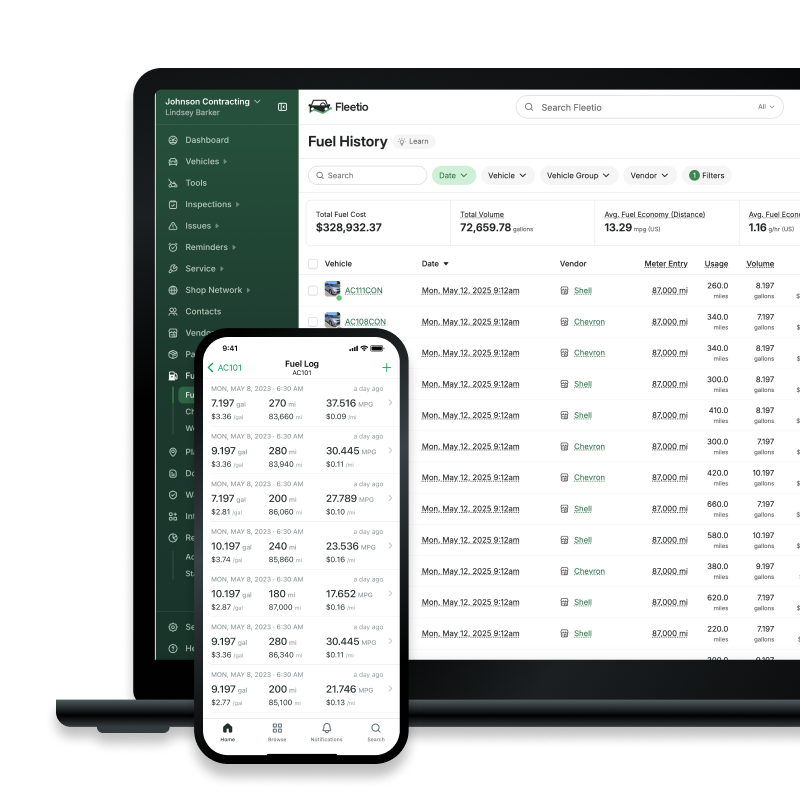

Senior Copywriter
Tyler Freeland is a Senior Copywriter at Fleetio. A former creative writer for Freightliner and Western Star, he now transforms complex (and sometimes common) fleet management topics into practical, engaging insights that fleet professionals can apply every day.
LinkedIn|View articles by Tyler FreelandReady to get started?
Join thousands of satisfied customers using Fleetio
Questions? Call us at 1-800-975-5304