The $50 Decisions That Drain Fleet Budgets: Three Fleets, One Playbook
In a large fleet, there’s no such thing as a small line item. $50 decisions like wiper blades, cabin filters and "recommended" flushes are easy to approve for a single vehicle. But at scale, they quietly snowball.
Nov 6, 2025
7 min read
Key takeaways from this blog
-
Small upsells compound: Tiny $30–$75 add-ons snowball at scale, so treat each as a budget decision.
-
Make line items visible: Use detailed ROs and history to spot off-cycle add-ons and stop rubber-stamp approvals.
-
Centralize decisions, not work: Route estimates to a small expert team. Require proof on pricey items and keep turnaround tight.
-
Run a repeatable playbook: Approve against history, enforce guardrails, tag rejections and approve digitally to cut friction.
-
Operationalize control with software: Bring approvals, history and guardrails into one workflow. Fleetio’s Shop Network surfaces last-done data and blocks off-policy upsells.
"Small repairs" aren’t small in large fleets.
Tiny upsells rarely feel like budget decisions, until you look at them across hundreds or thousands of services. A $40 add‑on here, a $65 upsell there, and suddenly your miscellaneous becomes a line on the P&L. Cost control in large fleets isn’t just about negotiating the big repairs, it’s about building discipline around the everyday $50 choices.
Three fleets, one pattern
Across three very different operations – Second Street Leasing, 3S Services, and Down to Earth Landscaping – the same lesson emerged: when every line item is visible and accountable, small decisions stop leaking money and time.
Second Street Leasing
When Edward Tighe Jr. stepped into Second Street Leasing (roughly 375 light- and heavy-duty assets) he inherited an aging PO template that made approvals feel like a formality. Add‑ons slipped through because the format invited rubber‑stamping.
Our bank account was abused because people would be charging us for stuff that we never approved because they knew our PO format. Eddie Tighe, Jr., Second Street Leasing
The shift came when repair orders arrived with the detail to accept, question, or reject quickly. With service history in view, Edward challenged extras that didn’t match reality. Some shops assumed the fleet would "just click approve." He didn’t, because history told a different story.
3S Services
Spread across Texas with 1,500+ units, Keith Eddings knew volume could bury judgment. Previous systems made reporting a slog and turned decision‑making into a scavenger hunt. With a centralized view of service history and digital approvals, volume turned into clarity.
You will run into a lot of shops that will just add on random repairs that aren’t needed, like a fuel system clean. They just drop a fuel additive into the gas tank, but they want to charge you $50 to do it. With a big fleet, $50 add‑ons pile up. Keith Eddings, 3S Services
And now they’re visible as they arrive. Year‑to‑date, the team processed 785,000 line items and rejected 76,000, many in the $30–$75 range – real money avoided and hours of back‑and‑forth that never had to happen.
Down to Earth Landscaping
Hundreds of vehicles and trailers, 20+ locations, and on week one, Landon Grimm described their maintenance process "non‑existent, inaccurate, and spreadsheets." He built a small, experienced central team to review estimates and line items across branches.
The effect was immediate: cleaner estimates, fewer upsells, consistent control. When a dealership diagnosis didn’t add up, the team towed the unit to their hub, fixed the actual failure in‑house, and saved $13,200 on a single repair.
The big win made headlines internally, but Landon’s point mirrors the others: it’s the everyday $50 decisions that protect the budget week after week.
Steal their playbook, see the savings
Each of these fleets rely on Fleetio to create visibility into third-party maintenance. Try it yourself to see how our line-item history and simple guardrails curb unnecessary upsells without slowing work.
Explore more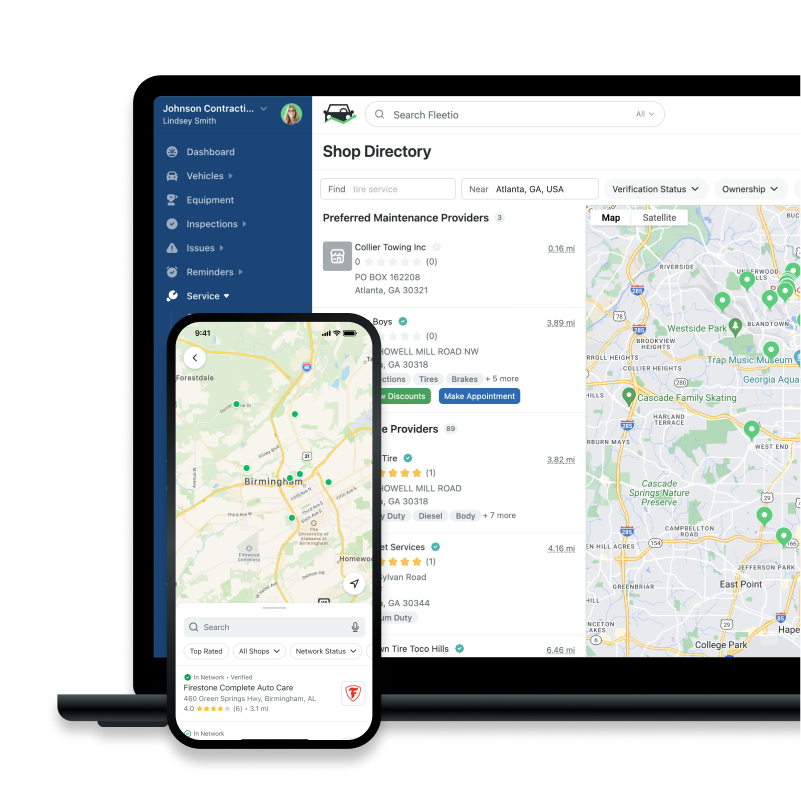
Approve or defer? A quick decision workflow
Large fleets process hundreds of thousands of service line items each year. If even 5% of those are off‑cycle upsells, those harmless $30–$75 choices snowball into real P&L impact. The table below maps common upsells to fast, defensible choices.
| Common upsell | Typical cost | When to Approve | When to Defer | Action |
|---|---|---|---|---|
| Wiper blades Low Risk | $25–$45 | Streaking or failed inspection | Replaced recently | Get driver opinion or schedule in-house inspection |
| Cabin/air filters Low Risk | $35–$70 | Interval reached or visual dirt check | Recent change in history | Get photo of filter at next in-house or pre-trip inspection |
| Fluid flushes Med Risk | $90–$250 | OEM interval or diagnostic evidence | No OEM trigger, upsell only | Request OEM reference or diagnostic note |
| Brake service packages High Risk | $200–$600 per axle | Pad thickness ≤ 3 mm (or OEM min), rotor below spec, pulsation present | Pads above threshold with even wear, rotors within thickness/runout spec, no symptoms | Measure pad/rotor, attach photo + readings |
Your approval playbook for high‑volume ROs
It's not about faster approvals, it's about smarter approvals. The playbook below distills what Second Street Leasing, 3S Services and Down to Earth actually did: a few non‑negotiables that turn line‑item approvals into a repeatable repair approval process without slowing the work.
- Approve against history: Require last‑done dates and mileage for every replaceable item (filters, wipers, fluids). No history, no approval.
- Route to expertise: Send approvals to a small central group with mechanical depth. Keep turnaround tight (<30 minutes) so branches stay productive.
- Set guardrails: Auto‑reject items outside policy (ie. conventional oil on units spec’d for synthetic, off‑cycle PMs, duplicate labor). Use rules to normalize PM intervals.
- Ask for proof when it’s pricey: Require photos/diagnostic notes for high‑dollar items. A quick look often prevents a costly guess.
- Track the rejections: Tag each rejection with a reason code (duplicate, premature, out‑of‑policy, in‑house alternative). Report monthly so savings aren’t invisible.
- Close the loop with vendors: Keep relationships human: call, text, visit. Approve digitally to end the PDF ping‑pong. The relationship stays and the friction goes.
Time is money, too. Reviewing a line item inside your fleet maintenance system takes seconds, while doing it by phone and PDF takes minutes you don’t have. Five minutes across 370 trucks is a long time.
Count the Minutes
Minutes saved per approval × weekly RO volume × fully loaded hourly rate = time savings ROI you can defend
Gain control of outsourced maintenance with software
The simplest way to implement this playbook at scale is inside Fleetio’s Maintenance Shop Network. It brings third‑party maintenance management, digital estimates, line‑item approvals, service history and lightweight policy automation into one workflow.
Approvers have access to last‑done dates, guardrails block off‑cycle items before they reach your desk, and every decision is documented for accountability. That foundation sets your fleet up for success:
- Warranty leverage & accountability: Treat your maintenance platform as the filing cabinet you don’t have to maintain, giving you instant access to service history when you need it.
- Policy enforcement without phone tag: Guardrails block off‑policy items before they land on your desk.
- Operational calm: Fewer fires to fight when estimates are cleaner and history is one click away.
Now, it is vital for our company to continue to have the Shop Network. It would be an entire fire [without it]. I’d go from a director of fleet and safety to a firefighter. Landon Grimm, Down to Earth Landscaping
How to apply this in your fleet
If you manage more than a handful of assets, your biggest savings probably won’t come from one dramatic repair. They come from the steady discipline of saying no to small extras that don’t need to be done now (or can be done in‑house for far less). That discipline is realistic when every request, price, and history entry is in one place at the moment of approval.
- See the last time that air filter was changed.
- Auto‑reject what’s outside your policy.
- Approve the necessary work quickly and keep trucks working.
As Keith said, "those $50 add‑ons pile up." Catching them is how you protect your budget without slowing the work.
Try it yourself
Run a pilot in Fleetio on your next 25 outsourced services. Set 2–3 simple rules, require history for replaceable items, and add photo proof for any repair over a set threshold. Track rejections and avoided costs.
If you don’t see the pattern these fleets did, then you've created additional confidence in your current vendor relationships. If you do uncover unfortunate patterns, you’ll understand why leaders describe this approach as a lifesaver (and why few go back to blind approvals).
Looking for a personalized walkthrough? Schedule a demo with one of our product experts and we can set your fleet on the right path.
Frequently Asked Questions

Director of Fleet Content, Fleetio
Zach Searcy is the Director of Content at Fleetio with more than 5 years of experience in the automotive and fleet industries. His content creation days started in middle school when he and his friends began filming lightsaber battles to upload to a new website: 'YouTube.'
LinkedIn|View articles by Zach SearcyReady to get started?
Join thousands of satisfied customers using Fleetio
Questions? Call us at 1-800-975-5304