Finding the Right Vehicle Upfitting Strategy for Your Fleet
An approved upfit stays with the vehicle for its full service life, shaping driver safety, task speed, chassis wear and resale value. Choosing between custom, stock and standardized builds is the decision that sets all four.
Jul 13, 2021 | Updated: Sep 23, 2026
13 min read
What you need to know
- The layout outlives the decision: An approved upfit shapes driver safety, task speed, chassis wear and resale value for the full service life of the vehicle.
- Each approach trades something away: Custom builds buy precision, stock configurations buy availability and standardized specs buy consistency as the fleet grows.
- Service records settle the next spec: Repair frequency by configuration, fuel cost per mile and inspection notes show which upfits held up and which ones drivers worked around.

Upfitting tends to get handled as a purchase decision. Someone specs shelving, a partition and a ladder rack, the order goes to the upfitter and the file closes. The layout then stays with the vehicle for its entire service life, shaping how many times a day a technician reaches across a load, how much weight the chassis carries and what the unit is worth at disposal.
Assets are staying in service longer, crews are harder to staff and there is less budget slack to absorb a rebuild. A layout that misses by a few inches used to mean a weekend in the shop. Now it means pulling a vehicle off a route you cannot easily cover. The question worth answering before the order goes in is not what fits in the van. It is which layout survives eight years of use, keeps drivers out of awkward positions and can be repeated the next time you add a vehicle.
What Is Vehicle Upfitting and How Should Fleets Approach It?
Vehicle upfitting is the process of equipping fleet vehicles with the tools, equipment, storage and interior layouts needed to perform specific jobs safely and efficiently. In practice that covers shelving and drawer systems, partitions, ladder and pipe racks, service bodies, liftgates and cranes, interior and scene lighting, auxiliary power, telematics hardware and the seating or access changes that make the space workable for a full shift.
Each of those choices has a downstream effect. Reach distance and step height determine how often a technician twists under load. Total weight and its distribution affect brake, tire and suspension wear, fuel burn and remaining payload. Material selection decides whether a shelf absorbs eight years of vibration or starts working loose in year three. The spec you approve is a cost input for as long as you own the asset.
That is why upfitting works better as a long-term systems decision than as a one-time build, particularly now that fleets hold vehicles longer than their original replacement cycles assumed.
Several outside pressures raise the cost of getting it wrong. Upfit lead times have improved since the supply crunch, though three months plus transportation is still a long stretch to hold a chassis that is not earning anything. Labor is scarce enough that a layout costing 10 minutes per stop shows up in payroll rather than in patience. Vehicle, equipment and maintenance costs have all climbed, so money spent on rework competes directly with money set aside for the next replacement.
Corrections after delivery are the expensive kind. The vehicle comes off the road, labor gets paid twice and drilling into the wrong panel can void warranty coverage on the component you just modified. A single spec error also repeats across every unit in the order, which is how one bad measurement turns into a deployment delay and an inconsistent fleet.
Fleets generally work from three approaches. Custom builds are specified around the work. Stock upfits arrive pre-configured by job type. Standardized upfits take a custom build that proved itself in service and turn it into an approved spec for repeat orders.
Vehicle Upfitting Strategies Compared
The choice usually comes down to job complexity, growth plans and how much variation you can live with across the fleet.
| Approach | Upfront cost | Lead time | Flexibility | Scalability | Best fit |
|---|---|---|---|---|---|
| Custom upfits | Highest, driven by customization and labor | Longest, with coordination between OEM and upfitter | Very high, since layouts and materials are built to exact requirements | Limited at first, strongest once a design is finalized and reused | Specialized roles, safety-critical work, complex equipment |
| Stock upfits | Lowest of the three | Shortest, drawn from existing inventory | Limited, since configurations target an industry rather than a workflow | Moderate, as vehicles arrive quickly but layouts vary | Speed to service, temporary needs, less specialized roles |
| Standardized upfits | Lower per vehicle over time through bulk ordering and less rework | Shorter than custom once the standard exists | Balanced, with defined options inside an approved spec | High, holding performance steady as vehicles, sites and drivers are added | Growing fleets that need consistency and predictable cost |
Job variability, regulatory exposure and growth rate tend to decide it. A fleet running one repeatable service call all day can standardize early, while a fleet with permitted loads, inspection requirements or equipment that changes by contract usually needs a precise build before it has anything worth standardizing.
How are your current upfits actually performing?
Repair history, fuel cost and utilization data show which layouts hold up in service and which ones drivers quietly work around. Take a look at how fleets use that record to shape the next spec.
Explore fleet reports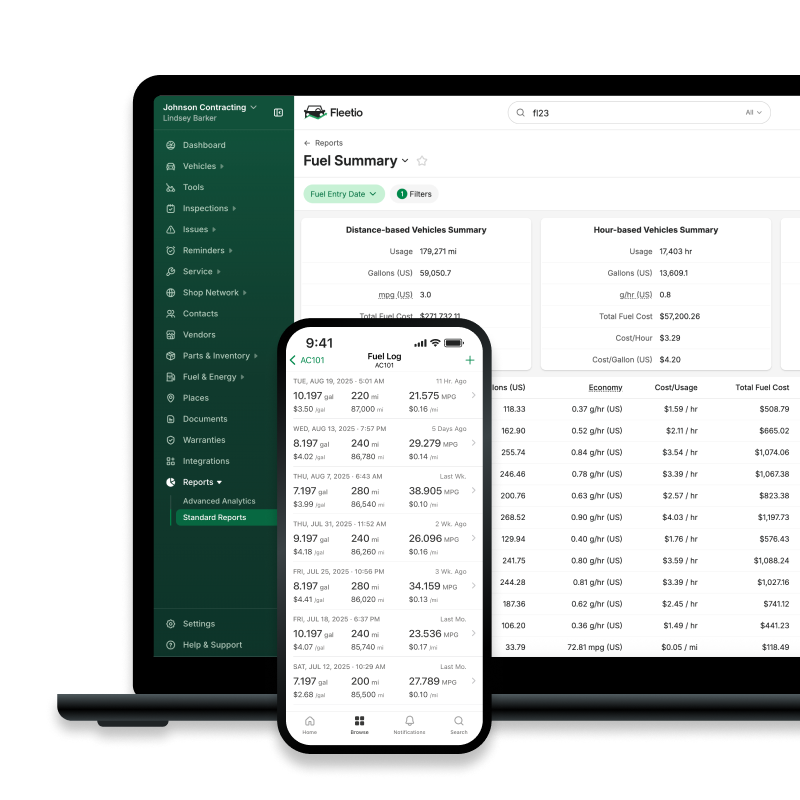
Five Decision Inputs to Settle Before You Order
These inputs come before the strategy choice. They are what you bring to a conversation with a dealer or upfitter, and they separate an approved spec from an educated guess.
Employee and expert input
Ask the people who work out of the vehicle, and ask them in a format you can act on. A structured review at the end of a build cycle, with specific prompts about reach, storage, access and the items that currently have no home, produces a spec. A conversation in the yard produces anecdotes. This matters most when you are carrying specs forward from a previous build into a new acquisition, since the parts nobody questioned are the parts most likely to be wrong.
Example: A torque wrench rides on the passenger seat because the drawer it belongs in sits behind a fixed shelf. Documented, that becomes a repositioned drawer in the next spec rather than a note about housekeeping.
Upfit technicians are the second source worth pressing. Adrian Steel recommends asking them directly for advice, since their build experience surfaces mis-specs before they are installed.[1] Inspection records help here too, because a rack or step that gives drivers trouble usually shows up in inspection notes before anyone raises it formally.
Driver safety and productivity
Layout is a safety control. Placement that reduces repeated twisting, overhead lifting and long reaches is where strain injuries and workers' comp claims get avoided. Automotive Fleet reported that ergonomically designed equipment "can significantly impact the bottom line by reducing workers' comp costs, improving driver productivity, and reducing fatigue-induced operator errors that can lead to preventable accidents."[2]
Drivers already feel the exposure. In a Geotab survey of fleet drivers and professionals in the U.S., 86 percent said the risk of driving accidents has increased over the past five years.[3]
A secured, labeled layout also shows up in inspection results. Loose equipment, blocked egress and unsecured loads are common failures, and they are usually symptoms of a layout that gave the item nowhere to sit. Consistent placement has a quieter benefit as well: two technicians running the same call perform the work the same way when the tools are in the same place. Nissan notes that better upfitted vehicles "can attract more qualified employees," which carries weight when crews are difficult to staff.[4]
Time to delivery and planning ahead
Lead times have improved. Automotive Fleet reported average upfit lead time falling from four or five months to closer to three, with roughly another month for post-production transportation in most cases.[5] That is better than the crunch years and still a long wait on a chassis you have already paid for.
Approve the layout before the chassis order, not while the vehicle sits at the upfitter. Late approvals are what produce redesign, rework and deployment that trickles in across a quarter instead of landing as one batch.
Budget and long-term ROI
Custom builds carry the highest upfront cost and stock configurations the lowest. Neither figure tells you what the layout costs across a full service life. A heavier investment in a layout that fits the work generally returns through fewer equipment repairs, less chassis strain from poor weight distribution and less time lost on every job.
Run upfitting through the same lifecycle math you use for acquisition and vehicle replacement, so the comparison accounts for maintenance and resale rather than sticker price alone.
Weight rating and chassis durability
Talk with your upfitting partner about daily operations before materials are chosen. Technicians can point to options that handle the job and the environment without pushing the vehicle past the 85 percent rule, which keeps the unit operating at no more than 85 percent of gross vehicle weight rating (GVWR). They can also confirm the chassis suits both the build and the work it will do.
Environment deserves as much attention as load rating. Aluminum saves weight and helps fuel economy, steel takes more abuse, and a composite shelf that lasts in a dry climate can delaminate where road salt and frequent washdowns are part of the routine.
Custom Upfits
Fleets go custom when the work has requirements no catalog configuration covers, such as specific equipment mounts, regulated storage, permitted loads or a workflow that has to repeat identically on every call. Custom is the most precise option available. Precision is worth paying for when the job genuinely differs from standard, and not much else recommends it. Many OEMs work with preferred upfitters to streamline the build, and some offer rebates or incentives for using an in-network partner.
Pros
- Matches the actual requirements of the work, including equipment mounts, access height and storage volume
- Removes the workarounds that slow tasks and make execution inconsistent between crews
- Improves safety by placing heavy and frequently used items where drivers can reach them without twisting
- Available through some leasing companies, which spreads the cost across monthly payments
Cons
- Highest upfront investment of the three approaches
- Longest order-to-delivery timeline, with the spec locked in early
- Coordination across buyer, OEM and upfitter, which leaves room for spec errors and delays
- Post-delivery corrections that cost labor twice and repeat across every unit in the order
Stock Upfits
Stock upfits trade precision for deployment speed. OEMs, dealers and leasing companies offer pre-configured vehicles built around common job roles, so you are choosing from layouts designed for an industry rather than for your workflow. That is often good enough. A general service van, a parts runner or a seasonal addition rarely justifies a custom build. It stops being good enough when equipment is specialized, when weight distribution is tight or when drivers start bolting in their own storage to make the day work.
Leasing stock upfit pros
- Lower upfront commitment than a purchase, which keeps capital available
- Faster access to vehicles already sitting in inventory
- A low-risk test of whether a standard configuration suits the work before you commit to buying it
Leasing favors short-term flexibility over long-term optimization, which is the right call for some fleets and a compromise for others.
Leasing stock upfit cons
- Little or no ability to modify the upfit after delivery
- Replacement timing set by the lease term rather than by your replacement analysis
- Workarounds that accumulate when drivers adapt to a layout they cannot change, compounding safety and productivity problems across the term
Purchasing stock upfit pros
- Modification after delivery, which a leased unit generally does not allow
- Lower cost and shorter wait than a comparable custom build
- Consistency across every vehicle ordered in the same configuration
Purchasing stock upfit risks
- Drilling into certain materials can create microfractures and compromise structural integrity
- Unauthorized changes can void warranty coverage on the upfit or the vehicle
- A configuration that does not match the work costs you through lost productivity and added maintenance
Bring the upfitter into any post-delivery change. They know which panels carry load, which fasteners are rated for the job and what the warranty will tolerate.
Standardized Upfits: Scaling What Works
Standardized upfits are repeatable configurations taken from custom builds that proved themselves in service, then written up as approved specifications. This is the move from experimentation to repeatable execution, and it is the step growing fleets most often skip.
The path is straightforward. Run a custom build. Give it a year in the field. Record what drivers changed, what broke, what went unused and what they asked for. Write the revised layout as a standard and order against it. Verify the spec each model year, since chassis dimensions, mounting points and available options change.
What standardization gives you:
- Consistency: Predictable layouts cut training time, and a driver moving between vehicles does not have to relearn where anything is.
- Bulk ordering: Volume orders often carry discounts and simplify coordination with upfit partners, since you are approving one spec instead of negotiating each build.
- Shorter lead times: An approved spec removes the design and approval cycle, which speeds up replacement and expansion units.
Standardization is a maturity step for a growing fleet, and it only pays off when the underlying spec earned its approval in service.
Using Fleet Data to Optimize Your Upfitting Strategy
An upfit spec is a set of assumptions: that this layout suits the work, that this material lasts, that this weight distribution will not punish the chassis. Service and fuel records are how those assumptions get tested.
The records worth pulling before a spec review:
- Maintenance history by configuration, which shows whether one layout generates more brake, tire or suspension work than another running comparable routes
- Fuel cost per mile across configurations, which flags when upfit weight or a roof-mounted rack costs more than the equipment returns
- Repeat repairs on upfit components, which identify the shelving, racks or liftgates that do not survive the duty cycle
- Utilization and inspection results, which reveal the units drivers avoid and the layouts that keep failing the same check
That comparison only works when the records sit in one place. As a fleet management software platform, Fleetio holds maintenance, fuel, utilization and asset history in a single system of record, which is what lets you put two configurations doing the same work side by side instead of relying on recollection. Fleetio is not an upfitting vendor and does not manage builds. What it provides is the cost history a spec review needs, surfaced through fleet reports and dashboards.
Upfitting decisions built on your own service data hold up better over time than decisions built on what the last order happened to look like.
Building an Upfitting Strategy That Evolves
No upfitting standard survives a new model year, a new contract or a new line of work untouched. The spec is a living document, and it should be reviewed on a schedule rather than when something breaks.
Custom builds give you precision when the work is specialized. Stock configurations give you speed and availability when it is not. Standardized specs give you consistency as the fleet adds vehicles, sites and drivers.
Evidence is what moves any of them forward. Maintenance history, fuel trends and lifecycle cost turn a spec review into a decision instead of a repeat of the last order, and they support safety cases, cost control and realistic replacement timing at the same time.
Before the next order goes in, it is worth asking what your service records already say about the last one. The tactical side of the process is covered in our fleet vehicle upfitting guide, and fleet maintenance software is where the history behind these decisions tends to live.
Sources
1 5 Commercial Upfit Mistakes to Avoid
2 Ergonomically-Designed Equipment Reduces Workers' Comp Claims
3 68% of U.S. Fleet Professionals Say Stress Negatively Impacts Driving Performance
Vehicle Upfitting FAQs

Senior Fleet Content Specialist
As a Senior Fleet Content Specialist at Fleetio, Rachael Plant uses her near decade of industry experience to craft practical content aimed at helping fleet professionals tackle everyday challenges with confidence.
LinkedIn|View articles by Rachael Plant
Senior Copywriter
Tyler Freeland is a Senior Copywriter at Fleetio. A former creative writer for Freightliner and Western Star, he now transforms complex (and sometimes common) fleet management topics into practical, engaging insights that fleet professionals can apply every day.
LinkedIn|View articles by Tyler FreelandReady to get started?
Join thousands of satisfied customers using Fleetio
Questions? Call us at 1-800-975-5304