What Is Fleetio?
Fleetio is the intelligent system that keeps maintenance moving. From in-house shops to outsourced repairs, Fleetio is where inspections, issues, work orders, parts, fuel, service history and more live and run in one place.
Oct 28, 2026
13 min read
What you need to know
- Fleetio is a fleet maintenance and optimization platform. Inspections, issues, work orders, parts, fuel and service history live in one system of record, with the intelligence to act on them built into the same workflow.
- It runs in-house and outsourced maintenance side by side. Your shop works in work orders and parts inventory. Outsourced repairs route through a network of more than 110,000 shops with line-item approvals.
- It is open by design. Fleetio sells no hardware. It connects to the telematics, fuel cards, parts suppliers and business systems your fleet already runs.
- The AI works inside maintenance, not in a report you read later. AI Service Advisor drafts repair plans, prioritizes issues and assesses repair orders. A person stays in the loop on anything your policy says needs review.
Before we can dive into what Fleetio is, what it does and how it can fit your fleet, we need to establish how we pronounce it: Fleet-E-O. Great. Now we can begin.
Fleetio is more than software. It’s a fleet intelligence system that helps you optimize operations and manage maintenance in one place, whether the work happens in-house, at a service provider or both.
More than 8,500 fleets use it to manage over 1.3 million assets. Those fleets log more than 50 million inspections and 10 million repairs a year in Fleetio. They range from 20-vehicle service operations to enterprises running tens of thousands of mixed assets across hundreds of locations, including light and medium-duty vehicles, heavy trucks, trailers, yellow iron and powered equipment.
The short version: a fleet captures what is happening to its assets, Fleetio turns that into prioritized work, and the work gets routed, approved, completed and recorded in one place.
Fleetio, the Company and What It Builds
Fleetio was founded in 2012 in Birmingham, Alabama as a cloud-native alternative to the spreadsheets and aging desktop systems most fleets were running at the time (and some still are). Mobile inspections, the first fuel card and telematics integrations and parts tracking followed in 2016. Equipment management and the outsourced maintenance network came in 2020. Today the platform adds automated workflows, advanced analytics and AI Service Advisor on top of nearly 15 years of maintenance data.
Here is what sits inside the platform and the job each part does.
| Product | What it does |
|---|---|
| Maintenance management | Preventive maintenance schedules, service reminders, issues, work orders and complete service history for every asset |
| Inspections | Mobile DVIRs and custom inspection forms in the Fleetio Go app, with photo evidence and automatic issue creation on a failed item |
| Parts and inventory | Parts catalogs, multi-location stock levels, purchase orders and part costs tied to the work order that consumed them |
| Outsourced maintenance | The Maintenance Shop Network of 110,000+ shops, plus Smart Uploads for invoices from shops outside the network |
| Fuel and expense tracking | Fuel card transactions, fuel economy by asset, expense tracking and Total Cost of Ownership per unit |
| Equipment and tool management | Hour-meter based service for powered equipment, trailers and tools, assigned and tracked like any other asset |
| Reporting and analytics | Cost and trend reporting, fleet right-sizing, replacement analysis and configurable dashboards |
| AI Service Advisor | Fault monitoring, issue prioritization, drafted repair plans, repair order assessments and configurable auto-approvals |
| Integrations and API | Telematics, fuel, parts, safety and ERP connections, plus a public API and webhooks |
How Fleets Use Fleetio Day to Day
The platform follows the shape of the maintenance work itself. Five steps, repeating.
- Capture what is happening. A driver submits a digital inspection from a phone. A telematics integration posts an odometer reading and a fault code. A fuel card transaction lands. A technician reports a problem. Each of these creates a dated, asset-level record without anyone retyping it.
- Trigger the right work. A failed inspection item opens an issue. A meter reading crossing a PM interval fires a service reminder. A recall notice or an engine fault raises a flag. Nothing waits on someone remembering to check a spreadsheet.
- Plan and approve. Issues get prioritized and turned into a work order or a repair request with the service tasks, estimated costs and parts attached. Approvals run against the spend rules the fleet sets.
- Execute in-house, outsourced or both. Your technicians complete work orders and pull parts from inventory. Outsourced jobs route to a shop in the network with line-item approval, so you see the labor hours and parts prices before the work starts.
- Resolve, record and learn. The issue closes, the PM schedule resets, the service history updates and the cost rolls into that asset's Total Cost of Ownership. The next decision about that unit starts with a better record than the last one.
That loop is also where fleet software has changed. A system of record answers what happened. Fleetio is built to answer what should happen next, and to carry the routine part of it for the team.

Pro-tip
The fastest value usually comes from connecting the inspection to the work order first. Once a failed item automatically becomes an issue, the gap between a driver finding a problem and a technician seeing it goes from days to minutes.
Where Fleetio Fits in Your Fleet Technology Stack
Fleetio does not sell GPS hardware, cameras or a telematics subscription. That is a deliberate design decision, not a gap.
Telematics answers where an asset is and how it is being driven. Fleetio answers what that asset needs, what it costs and who is doing the work. The two are stronger connected than bundled, because a fleet can change telematics vendors without rebuilding its maintenance system, and a fleet running three different telematics providers across its regions can still hold one maintenance standard.
More than 3,000 fleets run telematics alongside Fleetio today. The platform connects to Samsara, Motive, Geotab, Verizon Connect, Ford Pro and CAT, among others. Odometer and engine hour readings, fault codes and location data flow in automatically and go straight to work on maintenance.
The same applies across the rest of the stack.
- Fuel and payments. WEX, Comdata, Coast and FuelMaster transactions post against the right asset, which makes fuel economy and unassigned transactions visible without manual reconciliation.
- Parts and suppliers. PartsTech connects parts sourcing to the work order that needs them.
- Safety and compliance. Idelic, PSTrax and NHTSA recall data keep driver risk, apparatus readiness and open recalls connected to the maintenance record.
- OE and repair data. DataONE and MOTOR supply factory specs and standardized service information.
- Business systems. APIs, webhooks and connectors move maintenance and cost data into ERP, finance and reporting tools.
For a concrete example of how this works in practice, see how Fleetio and Motive turn telematics data into uptime.
Built for Large and Distributed Fleets
Fleetio is often described as a good fit for small and mid-sized fleets. It is. It is also running operations with thousands of assets spread across dozens of locations, which is a different problem with different requirements.
Four things matter at that scale.
One standard, many locations. Standardized inspection forms, PM programs and approval rules apply across every site, while role-based and location-based access keeps each team in its own lane. A regional manager sees their yards. A national director sees all of them.
Mixed asset classes in one system. Light-duty vehicles, Class 8 trucks, trailers, generators and attachments all live together, serviced on mileage or engine hours as appropriate.
In-house and outsourced in parallel. Large fleets rarely do all their own work. Fleetio runs the internal shop and the outsourced network in the same record, so Total Cost of Ownership includes both.
A real implementation. Enterprise rollouts run through a staged process of discovery and design, data migration, configuration, platform enablement, go live and stabilization, with weekly working sessions and executive sign-off before launch.
Two examples from fleets already doing it. United Site Services tracks maintenance for 7,000 assets across the country in Fleetio. Entelar Group manages more than 1,000 assets on the platform.
AI Built Into Maintenance
Fleetio's AI lives inside the maintenance workflow. It is not a separate dashboard or a chatbot bolted onto the side of the product.
It is built on 14 years of maintenance data: every repair order, every inspection and every shop interaction on the platform. That history is what lets the system tell a reasonable labor rate from an inflated one.
AI Service Advisor covers the decision points in a repair.
- Fault monitoring. Connects engine faults and inspection findings, including patterns a person reviewing items one at a time would miss, such as two fault codes reported 40 minutes apart pointing to a likely coolant leak.
- Issue priorities and resolutions. Ranks what deserves attention first across every open item in the fleet.
- Service Writer. Drafts a repair plan from the reported issue, with the service tasks that resolve it plus the maintenance already due on that unit.
- Assessments. Reviews repair orders, work orders and service entries against comparable work and flags labor hours or line items that run above the vendor average.
- Auto approvals. Lets routine, low-risk work move forward automatically, within the policy and spend thresholds the fleet sets.
Fleets using it report roughly 2.5 hours saved per repair and issues resolved up to three days faster. More than $1.4 billion in maintenance spend has been assessed through it.
The guardrail matters as much as the capability. Fleetio does not make the final call on work your policy says a person should review. Auto-approval thresholds are configurable, access is role-based and the team decides where the line sits.
Ramos Oil put it in practical terms. "The fact that I don't have to go line by line on every work order is huge," says Jill Perry, Fleet Administration at Ramos Oil. "It easily saves me an hour and a half a day."
What Fleets Report
The outcomes follow the same three lines every time: money that stops leaking, hours that come back to the team and assets that stay available.
- Auto-Chlor avoids more than $280,000 in repair spend a year by catching unnecessary repairs before approval.
- Ramos Oil saves 90 or more minutes a day reviewing work orders with AI Service Advisor.
- A&D Environmental maintains 95% compliance across 120+ vehicles.
Dennis Winter at A&D Environmental describes the financial side of it this way: "If I was to ballpark it, Fleetio saves us $15,000 to $20,000 a year. Vehicles go out of here, they're dependable, they're reliable, and we don't have those extra non-essential costs coming back to us. With Fleetio, you can have some data driven behind that and understand your true cost of operating your business."
Who Uses Fleetio
Fleetio is used by the people who keep assets working and by the people who answer for what those assets cost.
- Fleet and maintenance managers run PM programs, approve repairs and track asset health.
- Technicians and shop managers work from work orders, pull parts and log completed service.
- Drivers and operators submit inspections, report issues and record fuel from the Fleetio Go mobile app, available in English and Spanish.
- Safety and compliance teams use documented inspections and maintenance records as audit-ready proof.
- Finance and procurement teams use cost-per-asset reporting, Total Cost of Ownership and replacement analysis.
The industries span construction and contracting, trucking and freight, transportation and logistics, energy, utilities and mining, consumer and business services, public safety, higher education, government and nonprofit. Fleets on the platform include 1-800-GOT-JUNK?, AAA, Artera, Bimbo Bakeries USA, DHL, Emory University, Subaru, TCU, Waste Connections and Wright Service Corp.
What You Get Alongside the Software
Software only works if people adopt it, so the team behind it counts. Fleetio support runs at 94% customer satisfaction with an average chat resolution under 25 minutes, and the group carries more than 275 combined years of fleet experience. Help is available by chat, email and phone, with the Help Center, Fleetio Academy and on-demand webinars for teams that want to go further on their own.
G2 recognized Fleetio in 2026 as a Leader, a Momentum Leader, a High Performer in mid-market and a winner for Best Relationship.
When Teams Are Ready for Fleetio
Most teams arrive at Fleetio when the record stops keeping up with the fleet. The signs are consistent.
- Preventive maintenance is tracked in a spreadsheet, a shared calendar or someone's memory, and intervals get missed.
- Inspections happen on paper and the findings never reach the shop, or reach it days later.
- Invoices from outside shops get approved without a line-item review, because there is no time to do one.
- Telematics is in place, but odometer readings and fault codes never connect to a service schedule.
- A legacy system is still running, but it was built for a smaller, simpler fleet and the workarounds now outnumber the workflows.
- Nobody can answer what a specific asset has cost this year without assembling it by hand.
Fleetio requires no hardware installation, which is why a small fleet can be live in days. A free trial is the usual starting point for smaller operations. Larger and more complex fleets typically start with a demo and a scoped implementation plan.
Frequently Asked Questions
Is Fleetio a GPS or telematics system?
No. Fleetio is a fleet maintenance and optimization platform. It integrates with GPS and telematics providers including Samsara, Motive, Geotab, Verizon Connect, Ford Pro and CAT, so location, odometer and engine fault data flow into maintenance workflows without a hardware purchase from Fleetio.
Does Fleetio work for large fleets?
Yes. Fleets with thousands of assets across many locations run on Fleetio, including United Site Services with 7,000 assets. Role-based and location-based access, standardized programs across sites and a staged enterprise implementation process support operations at that scale.
Can Fleetio manage outsourced maintenance?
Yes. Repairs can route to a network of more than 110,000 shops with digital line-item approvals, and invoices from shops outside the network can be captured with Smart Uploads. In-house and outsourced work land in the same service history and the same cost reporting.
Does Fleetio handle equipment as well as vehicles?
Yes. Powered equipment, trailers, attachments and tools are tracked as assets, with service scheduled on engine hours or usage rather than mileage where that makes more sense.
How does Fleetio's AI make decisions?
AI Service Advisor prioritizes issues, drafts repair plans and assesses repair orders against 14 years of maintenance data. Routine low-risk work can be auto-approved within thresholds the fleet configures. Anything outside those thresholds is surfaced to a person with the cost, warranty and urgency context needed to make the call.
What support comes with Fleetio?
Support by chat, email and phone, plus the Help Center, Fleetio Academy and on-demand webinars. Support satisfaction sits at 94% with an average chat resolution under 25 minutes.
Is there a free trial?
Yes. Fleetio offers a free trial, and no hardware is required to get started.
The Short Answer
Fleetio is where fleets run maintenance. It captures the work, tells teams what to do next and keeps the record that every cost, compliance and replacement decision depends on. The fleets pulling ahead are not the ones with more data. They are the ones acting on it faster.
See how Fleetio fits your fleet
Book a demo and walk through inspections, work orders, outsourced repairs and AI Service Advisor with your own operation in mind.
Book a demo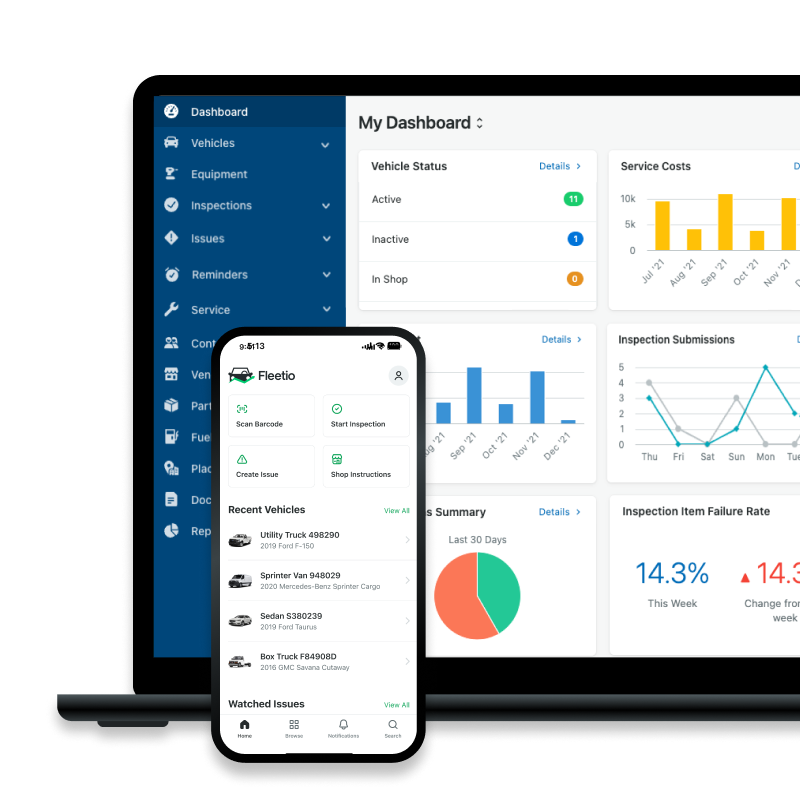

Senior Copywriter
Tyler Freeland is a Senior Copywriter at Fleetio. A former creative writer for Freightliner and Western Star, he now transforms complex (and sometimes common) fleet topics into practical, engaging insights that fleet leaders can apply every day.
LinkedIn|View articles by Tyler FreelandReady to get started?
Join thousands of satisfied customers using Fleetio
Questions? Call us at 1-800-975-5304