Company Vehicle Policy Template Your Insurer Can Verify
A company vehicle policy only works when every rule in it connects to a documented procedure. Here is how to write one that produces timestamped, asset-level evidence, with a full template to start from.
Oct 6, 2026
16 min read

What you need to know
- A policy is only as good as the records behind it. Every rule should connect to a repeatable procedure that produces timestamped, asset-level evidence. The signed PDF is step one.
- Name every asset category you actually govern. Company-owned units, leases, short-term rentals, personal vehicles driven on company business and take-home assignments carry different insurance, maintenance and mileage obligations.
- The inspection section has to read like an SOP. Standardized forms, photo evidence at the point of reporting and an explicit no-drive-until-fixed rule turn a daily checkbox into a usable record.
- Maintenance entries prove the defect was fixed. Asset ID, meter reading, work performed and next service due date are what confirm an asset was roadworthy when it left the yard.
A company vehicle policy works when every rule in it connects to a documented procedure that produces timestamped, asset-level evidence. The signed PDF is the starting point. The inspections, maintenance logs and driver records your team generates daily are what hold up when an insurer, an auditor or opposing counsel starts asking questions.
Most of that documentation is a byproduct of a well-run operation. OSHA recommends that employers establish a crash investigation process and report all crashes regardless of severity, and insurers routinely ask for driver authorization dates, inspection history and maintenance records. Build those records into daily workflows and the proof already exists when renewal season arrives.
Each section below answers a version of the same question: can you prove this rule was followed, on this asset, on this day?
Which Assets and Drivers Your Policy Needs to Cover
A policy that names only "company vehicles" leaves gaps around leased units, short-term rentals, personal vehicles driven on company business and take-home assignments. NIOSH recommends in its Behind the Wheel at Work newsletter that employer distracted-driving policies extend to team members' personal vehicles when those vehicles are driven on company business. A technician who takes their own car to a job site still creates exposure for your organization.
List every asset category the policy governs and spell out what changes between them. Insurance minimums, maintenance responsibility and mileage documentation rarely look the same for a leased box truck and a reimbursed personal car, and writing those distinctions down removes the ambiguity that surfaces when a claim involves an asset type nobody planned for.
Driver eligibility needs the same specificity
FMCSA requires motor carriers to maintain a driver qualification file for every driver under 49 CFR 391.51, and fleets outside FMCSA jurisdiction benefit from running a parallel process. In practice that means a documented MVR review at a defined frequency, annually at a minimum, a written authorized-driver list and a procedure for updating that list whenever someone joins, leaves or changes roles.
Many fleet insurance policies require naming each authorized driver and notifying the carrier of staff changes, so a current list keeps your coverage aligned with who is actually behind the wheel. Each of these scope decisions produces its own record. The authorized-driver list, the MVR review schedule and the insurance notification log form the first layer of documentation your organization can point to.
Personal Use, Distracted Driving and the Rules That Need Written Documentation
Verbal policies around personal use carry no weight with the IRS. Publication 15-B states that under IRS general rules, all use of a company car is considered personal use unless the team member documents the business use of the car, and personal use of a company vehicle generally results in taxable wages for the team member.
A "business use only" rule that lives in a conversation rather than a signed document costs you access to the IRS valuation safe harbors that limit personal-use tax exposure, and unsubstantiated use defaults to taxable personal use for the employer and the team member alike. State the default in writing, whether that is business use only or limited personal use with written conditions, define what qualifies as personal use and reference Publication 15-B for valuation methods.
Distracted driving needs a specific prohibition
OSHA advises employers to review their operational procedures to confirm they are not causing or contributing to distracted driving, noting that systems and procedures for dispatching and rerouting vehicles have the potential to cause cognitive, visual and manual distractions. NHTSA advises employers to set a company policy on distracted driving, and CDC/NIOSH research reinforces that strong employer policies curbing cell phone use are a primary prevention tool.
A verbal "don't text and drive" instruction does not meet that standard. Name the prohibition, which for most fleets means no handheld device use while the asset is in motion, identify the exceptions you allow such as hands-free navigation and state the consequence for a violation.
The operation has to support the rule
Seat belt requirements, impairment policies and fatigue management belong in the same section. The UK's Health and Safety Executive publishes journey management guidance with a point that travels well: schedules and workload expectations should not pressure drivers to speed, skip breaks or drive while fatigued. If your delivery windows or route assignments make safe driving difficult, the operation is undercutting the policy no matter what the document says.
The Inspection and Defect Reporting SOP Most Templates Skip
A policy line reading "drivers shall conduct daily inspections" cannot tell you whether unit 412 was inspected before it left the yard last Tuesday. The inspection section needs to function as a standard operating procedure, detailed enough that every driver follows the same steps and every inspection produces the same kind of record.
Three decisions give that SOP its structure.
- Define the inspection standard. List every item the driver checks, organized by system: brakes, tires, lights, fluid levels and safety equipment. A standardized form keeps the coverage and the order consistent regardless of who completes it, and forms customized by asset type improve accuracy because the checklist matches what the driver is looking at.
- Set the failure action. Specify what happens when an item fails. The driver reports the defect immediately and does not operate the asset until the repair is complete. Write that no-drive-until-fixed rule into the policy along with the escalation path: who receives the defect report, who authorizes the repair and who clears the asset to return to service. Require photo evidence at the time of reporting, because "brake issue" tells an adjuster far less than a timestamped photo of a worn pad.
- Track and refine. Review inspection data on a set cadence to surface recurring defect patterns, assets that fail frequently and drivers who submit incomplete forms. That review is what turns inspections into maintenance intelligence rather than a daily formality.
The Parking Spot saw the difference after formalizing its process. The company's digital inspections increased driver thoroughness and fostered greater care for company vehicles, and Kevin Richardson, VP of Operations, summarized the change: "Fleetio is ingrained in what we do now." When every inspection is documented, timestamped and tied to a specific asset, driver behavior changes because the record follows the work.

Pro-tip
Write the inspection retention period into the policy itself rather than leaving it to whoever manages the files. A stated retention window gives your team a clear rule to follow and tells an auditor exactly how far back the record should go.
Free Vehicle Inspection Template
Get your free vehicle inspection form today to ensure every inspection from here on out is quick, compliant and complete
Read the guide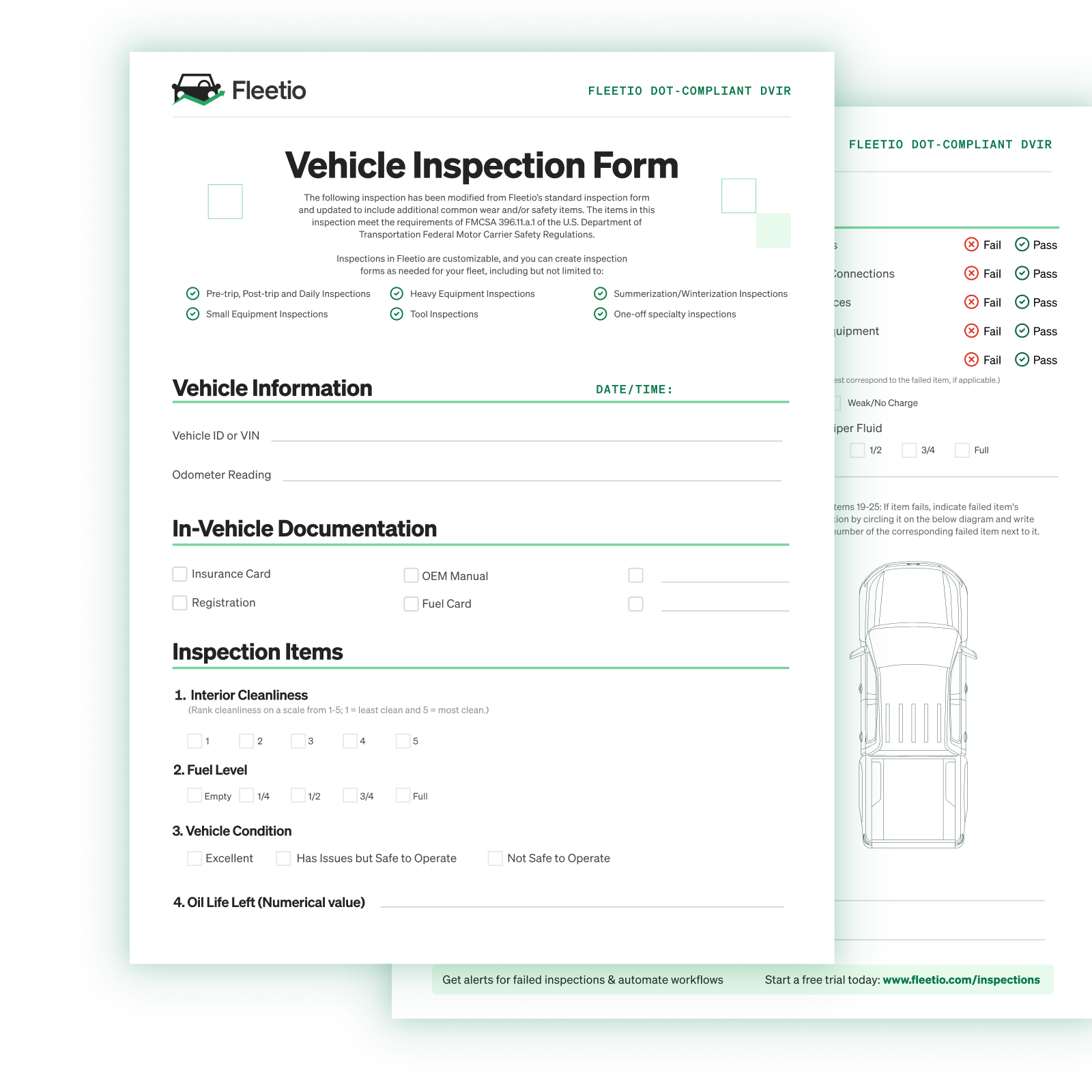
How Maintenance Records Close the Loop from Defect to Repair
Your maintenance records confirm the defect was actually repaired before the asset returned to service. A maintenance log with the right fields is your primary evidence that inspections led to action, preventive maintenance stayed on schedule and assets were roadworthy when they left the yard.
Each entry should capture a consistent set of data points. The table below lists the recommended fields and what each one proves during an audit or insurance review.
| Field | What it records | Why it matters for compliance |
|---|---|---|
| Asset ID | Unique identifier for the asset | Ties the record to a specific asset, enabling per-asset audit trails |
| Date | When the service was performed | Establishes the timeline for defect-to-repair intervals and preventive maintenance adherence |
| Meter reading | Odometer or hour meter at time of service | Proves the asset was serviced at the correct interval |
| Service type | Preventive maintenance, repair or inspection follow-up | Distinguishes scheduled work from reactive repairs |
| Work performed | Description of the specific action taken | Documents how a defect was resolved or what a service included |
| Parts used | Part numbers and quantities | Creates a material trail for warranty claims and cost tracking |
| Labor hours | Time spent on the service | Supports cost analysis and technician workload planning |
| Total cost | Combined parts and labor expense | Feeds Total Cost of Ownership calculations per asset |
| Next service due | Date or meter reading for the next scheduled service | Proves preventive maintenance is planned, reducing deferred maintenance audit findings |
In Fleetio's fleet optimization platform, each entry traces back to the originating DVIR and the resulting work order, including third-party repairs routed through the Maintenance Shop Network with line-item digital approvals. Audit trails cover in-house and outsourced work and roll up into Total Cost of Ownership per asset.
When a defect surfaces during a daily inspection, it should route directly into a work order and, once repaired, feed the maintenance log as a completed entry. That closed loop from inspection to repair to record is what gives your documentation authority under scrutiny.
Eikenhout maintains strict Department of Transportation compliance using standardized digital inspection forms, including custom versions that require drivers to confirm equipment is safe to bring onto a customer's property before unloading. As Curt Van Heuvelen, Safety and Training Coordinator at Eikenhout, puts it, "Fleetio is a very easy system to access and helps make sure we are compliant with government regulations. Non-compliance is not an option for us." Every inspection and every resulting repair lives in a single auditable record that works as a safety mechanism and as compliance proof.
A maintenance record you can rely on
Inspections, issues, work orders and service history in one system of record, with the asset-level detail an insurer or auditor expects to see.
Explore maintenance management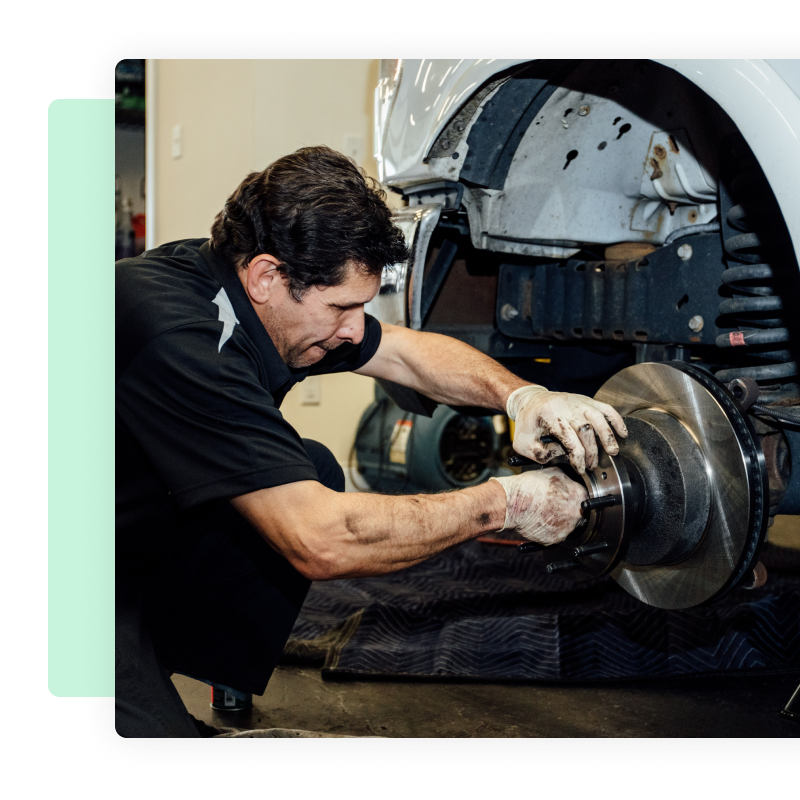
Incident Reporting, Fuel Rules and Consequences for Violations
The remaining sections cover incident procedures, fuel and expense management, prohibited activities and team member acknowledgment. Each needs language specific enough that your organization can demonstrate consistent enforcement across every location.
- Incident and accident reporting. Spell out what the driver does at the scene, including ensuring safety, contacting emergency services, documenting with photos, exchanging information and notifying a supervisor within a defined window. Then spell out what the organization does in the hours that follow: file the claim, preserve all records tied to the asset and driver and conduct a post-incident review within a set number of business days. Include a documentation checklist covering photos, the police report number, witness contact information, injury details and a written driver statement. "Report accidents promptly" leaves too much room for interpretation across managers and locations.
- Fuel, expenses and parking. Define who pays for fuel, which payment method drivers use, what documentation each transaction requires and how parking violations are handled. Assign financial responsibility for parking tickets and toll violations to the driver when negligence caused them, and describe the reimbursement process for legitimate business expenses. These rules prevent disputes and give your finance team a clean paper trail.
- Prohibited activities and consequences. List the specific prohibitions, such as unauthorized passengers, operation while impaired, unauthorized modifications and personal commercial use of company assets. Pair each prohibition with a defined consequence and escalation path. An escalation path that exists only in a manager's judgment produces inconsistency, so putting it in writing holds every team member to the same standard regardless of location or supervisor.
- Team member acknowledgment. Require every driver to sign an acknowledgment before receiving asset access, confirming they have read the policy, understand the rules and accept the consequences for violations. Set a re-acknowledgment cadence, annually or whenever the policy changes, and keep signed copies on file. That signature documents that the driver was informed, which is what matters when you enforce a consequence or defend a decision in litigation.
Company Vehicle Policy Template
Use the template below as a starting point. Bracketed fields mark where organization-specific details go. Review each section with your legal, insurance and operations teams before distributing.
COMPANY VEHICLE POLICY
[Organization Name]
Effective Date: [Date]
Version: [Number]

1. PURPOSE
This policy establishes rules and procedures for the safe operation, maintenance
and documentation of all vehicles and equipment assigned to or used by
[Organization Name] team members. It applies to every asset and driver defined
in Section 2.

2. SCOPE
This policy covers:
- Company-owned vehicles
- Leased vehicles
- Short-term rental vehicles used for [Organization Name] business
- Personal vehicles used for company business (mileage reimbursement, job site
  visits, client travel)
- Take-home vehicles assigned to [list eligible roles]

3. DRIVER ELIGIBILITY AND AUTHORIZATION
- All drivers must hold a valid [state/province] driver's license appropriate
  for the asset class they operate.
- Motor vehicle records (MVRs) will be reviewed [annually / semi-annually].
- The authorized-driver list will be maintained by [title/department] and
  updated within [number] business days of any personnel change.
- Insurance carriers will be notified of driver additions and removals within
  [number] business days.
- Drivers who accumulate [number] or more moving violations within [timeframe]
  will have their driving privileges reviewed by [title/department].

4. ACCEPTABLE USE
- Company vehicles are authorized for business use only unless a written
  personal-use exception is on file.
- Personal-use exceptions require written approval from [title] and are subject
  to IRS reporting requirements per Publication 15-B.
- Drivers may not use company vehicles for personal commercial activity,
  ride-sharing services or any unlawful purpose.

5. SAFE OPERATION STANDARDS
- Seat belts must be worn by the driver and all occupants at all times.
- No use of handheld electronic devices while the vehicle is in motion.
  [Define any hands-free exceptions.]
- No operation of a company vehicle while under the influence of alcohol,
  illegal substances or any medication that impairs driving ability.
- Drivers must comply with all posted speed limits and traffic laws.
- Drivers must not operate a vehicle when fatigued. If a schedule or route
  creates unsafe conditions, the driver must notify [title/department] before
  departing.
- [Organization Name] will not impose delivery windows, route expectations or
  workload requirements that pressure drivers to operate unsafely.

6. INSPECTION AND DEFECT REPORTING
- Drivers must complete a pre-trip inspection using the standardized
  [Organization Name] inspection form before operating any company vehicle.
- Inspection forms must be completed in full. Incomplete forms will be returned
  and the vehicle will not be cleared for operation.
- If any defect is found, the driver must:
  a. Report the defect immediately to [title/department].
  b. Attach photo evidence of the defect.
  c. Not operate the vehicle until the defect is evaluated and, if necessary,
     repaired.
- [Title/department] will evaluate reported defects within [number] hours and
  authorize repairs or clear the asset for service.
- Completed inspections will be retained for [number] months/years.

7. MAINTENANCE AND RECORDKEEPING
- All maintenance activities (preventive, corrective and inspection follow-up)
  will be documented in [Organization Name]'s maintenance log system.
- Each maintenance entry must include: asset ID, date, meter reading, service
  type, work performed, parts used, labor hours, total cost and next service
  due date.
- Preventive maintenance schedules will be established for each asset based on
  manufacturer recommendations and [Organization Name] operating standards.
- Inspection defects that result in repairs must be traceable from the original
  inspection report through the work order to the completed maintenance log
  entry.

8. INCIDENT AND ACCIDENT REPORTING
- All incidents involving a company vehicle must be reported regardless of
  severity.
- At the scene, the driver must: ensure personal safety, contact emergency
  services if needed, document the scene with photos, exchange information with
  other parties and notify [title/department] within [number] minutes/hours.
- The driver must submit a written incident report within [number] business
  days.
- Required documentation: photos, police report number, witness contact
  information, injury details and written driver statement.
- [Title/department] will conduct a post-incident review within [number]
  business days.

9. FUEL, EXPENSES AND PARKING
- Fuel purchases must be made using [fuel card / company credit card /
  reimbursement process].
- Receipts are required for all fuel and vehicle-related expenses.
- Parking violations and toll charges resulting from driver negligence are the
  financial responsibility of the driver.
- Legitimate business-related parking and toll expenses will be reimbursed
  through [process/system].

10. PROHIBITED ACTIVITIES
- Unauthorized passengers are not permitted in company vehicles.
  [Define any exceptions.]
- Unauthorized vehicle modifications are prohibited.
- Use of company vehicles for personal commercial activity is prohibited.
- Violations will follow this escalation path:
  a. First violation: [verbal warning / written warning]
  b. Second violation: [written warning / suspension of driving privileges]
  c. Third violation: [suspension / termination of driving privileges]
  d. Severe violations (impairment, reckless driving): [immediate suspension
     pending review]

11. TEAM MEMBER ACKNOWLEDGMENT
I, [Team Member Name], confirm that I have read and understood the
[Organization Name] Company Vehicle Policy dated [Date]. I agree to comply with
all rules and procedures in this policy. I understand that violations may result
in disciplinary action up to and including termination of driving privileges
and employment.

Signature: ___________________________
Printed Name: ___________________________
Date: ___________________________
Manager Signature: ___________________________
Date: ___________________________

Re-acknowledgment schedule: [Annually / upon policy update]
Signed copies retained by: [title/department]
Customize the bracketed fields for your organization, review the completed document with legal counsel and distribute signed copies before granting any team member access to a company vehicle. If you are writing a broader safety program alongside it, our breakdown of what belongs in a fleet safety policy covers the sections that sit next to this one.
Turning a Signed Policy Into Daily Proof
When a driver submits a digital inspection through the Fleetio Go mobile app with photo evidence attached, a failed item automatically opens an issue and can route to a work order, the asset status updates and the repair routes to a technician. Every step produces a record tied to that asset, that driver and that date.
That is the difference between a policy you can hand to an insurer and one you can defend. The document sets the rule. The daily workflow proves the rule was followed, which is the part nobody can reconstruct after the fact.
Connect your policy to the records that enforce it
Start a free trial to see how Fleetio connects your vehicle policy to the documentation that makes it enforceable, from the daily inspection through the completed work order.
Start a free trial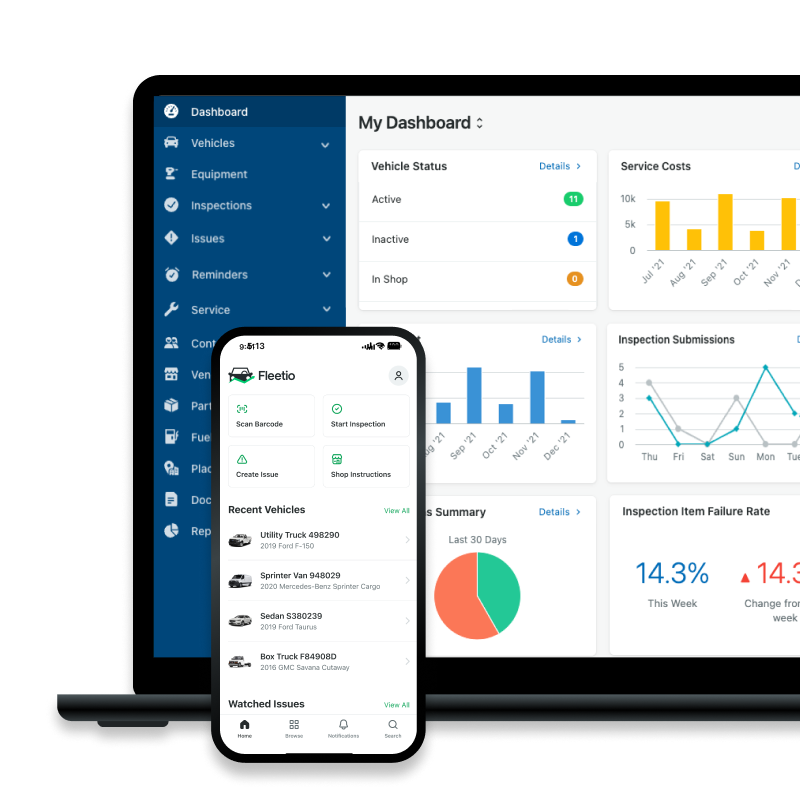

Senior Copywriter
Tyler Freeland is a Senior Copywriter at Fleetio. A former creative writer for Freightliner and Western Star, he now transforms complex (and sometimes common) fleet topics into practical, engaging insights that fleet leaders can apply every day.
LinkedIn|View articles by Tyler FreelandReady to get started?
Join thousands of satisfied customers using Fleetio
Questions? Call us at 1-800-975-5304