Recent and Future Regulatory Updates Fleets Must Know
From emissions to CDL requirements, upcoming fleet regulations are poised to have a profound impact on the industry. Stay ahead of the curve by getting informed on the latest developments.
Jun 9, 2024 | Updated: Oct 21, 2025
5 min read

Navigating an ever-evolving regulatory landscape can be tricky. This round up of notable rules and mandates is here to help your fleet stay compliant.
Note: this list was last updated on October 21, 2025.
Recent Updates to Fleet Regulations
All of the following regulations have gone into effect over the past 12-18 months.Restoring Integrity to the Issuance of Non-Domiciled Commercial Drivers Licenses (CDL)
Overview: Announced as an emergency interim final rule (e.g. a fast-tracked regulation that immediately goes into effect), this statute imposes a stricter process for obtaining/renewing non-domiciled CDLs.
Goal: Aligned with the Trump administration’s other immigration enforcement actions, the rule aims to curb the issuance of CDLs to unqualified applicants.
Impacted fleets: Fleets that work with immigrant drivers (~200,000 individuals, comprising about 5% of all CDL holders).
Effective date: 9/29/25
What to do:
- Audit your personnel files to see if this rule affects any of your personnel
- If you employ one or more non-domiciled drivers, determine when their CDL(s) will need to be renewed
- Work with them to confirm that they have the documents necessary to renew their CDL under the new requirements
Motor Carrier Routing Regulations
Overview: Another regulation that was unveiled as a final rule, this statute repeals the FMCSA’s authority to impose routing limitations on motor carriers and freight forwarders when operating in municipal commercial zones and unincorporated communities.
Goal: When they announced this move, the FMCSA cited an executive order made by the Trump administration that called on agencies to repeal ten regulations for every one they enacted.
Impacted fleets: Motor carriers and fleet forwarders who operate in municipal commercial zones and unincorporated communities.
Effective date: 5/30/25
What to do:
- Confirm if your operations were previously confined by such routing regulations
- If you were, explore the viability of newly unlocked routes in your operating area
Federal Motor Vehicle Safety Standards… Speed Limiting Devices; Withdrawal
Overview: The Federal Motor Carrier Safety Administration (FMCSA) and National Highway Traffic Safety Administration (NHTSA) had proposed a rule that, if enacted, would’ve required heavy vehicles to adopt speed-limiting devices. But, over the summer, both agencies scrapped their plans.
Goal: In their withdrawal, the FMCSA and NHTSA cited safety concerns and uncertainty regarding costs and benefits of the rule.
Impacted fleets: Fleets operating vehicles with a gross weight above 26,000 pounds
Effective date: 7/24/25
What to do:
- This rule was quite unpopular with drivers, so consider sharing the “good news” with your personnel if you think it might brighten their day
Complacency and compliance don’t mix
One missed inspection. One outdated log. That’s all it takes. Use this guide to stay compliant, stay safe and stay on the road.
Check it out
Pending Fleet Regulations
Before they can become law, regulations must survive a long bureaucratic journey of cost-benefit reviews, public comment periods, modifications and withdrawals. Some of the following rules have been delayed multiple times, and it's probable that a few might end up being dropped altogether. Still, whether they're ultimately enacted or not, knowing what's on the radar of the FMCSA can help fleets make decisions that account for possible regulations in the future.Rescinding the Requirement for Electronic Logging Device Operator's Manual Located in Commercial Motor Vehicles
Overview: Currently, drivers of vehicles with electronic logging devices (ELDs) are required to keep a printed ELD operator’s manual in their cab. If enacted, this rule would drop that requirement.
Goal: Reduce the number of physical documents commercial drivers are required to have on hand when behind the wheel.
Impacted fleets: Fleets required to have ELDs installed in their vehicles.
Likelihood to be enacted: Fairly good, given that drivers would be expected to have online access to digitized manuals if prompted by an inspector.
How to prepare:
- Train your drivers on how to access online manuals from their phones
Hazardous Materials: Reducing Recordkeeping Requirements for Domestic Carriers
Overview: Today, drivers hauling certain dangerous loads must keep physical copies of their Pipeline and Hazardous Materials Safety Administration (PHMSA) certificates on them. This rule would allow drivers to keep an electronic copy of their certificate instead.
Goal: Much like the proposal, this rule aims to declutter commercial vehicle cabs by reducing the amount of paper records drivers are obligated to carry.
Impacted fleets: Fleets that haul loads regulated by the PHMSA
Likelihood to be enacted: So-so, due to the fact that hauling certificates have seen less digitization than hours of service logging.
How to prepare:
- Instruct drivers on how to access online documents, but emphasize that digital copies aren’t suitable replacements for physical records yet
ADS-Equipped Vehicle Safety, Transparency, and Evaluation Program
Overview: This rule proposes the development of a voluntary framework for the evaluation of oversight of autonomous vehicles (AVs).
Goal: To collect data on real-life AV performance so that more effective safety regulations can be devised in the future.
Impacted fleets: Fleets operating autonomous and semi-autonomous vehicles.
Likelihood to be enacted: Leaning towards unlikely, due to the Trump administration's opposition to the regulation of emergent technologies.
How to prepare:
- Assess if you’d want to participate in the voluntary evaluation program
Find a modern way to manage your fleet
Spreadsheets can’t tell you in real-time what’s going on with your fleet. Book a personalized demo to see how Fleetio gives you the data and control you’ve been missing.
Let's talk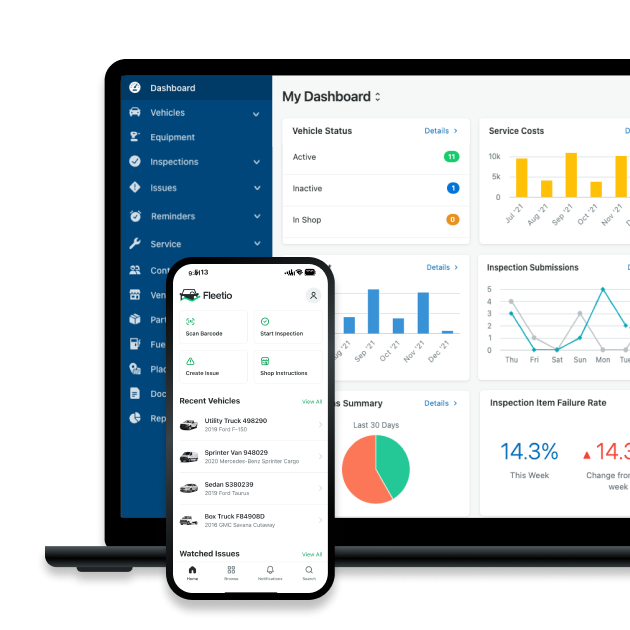
Staying Compliant with Fleet Management Software
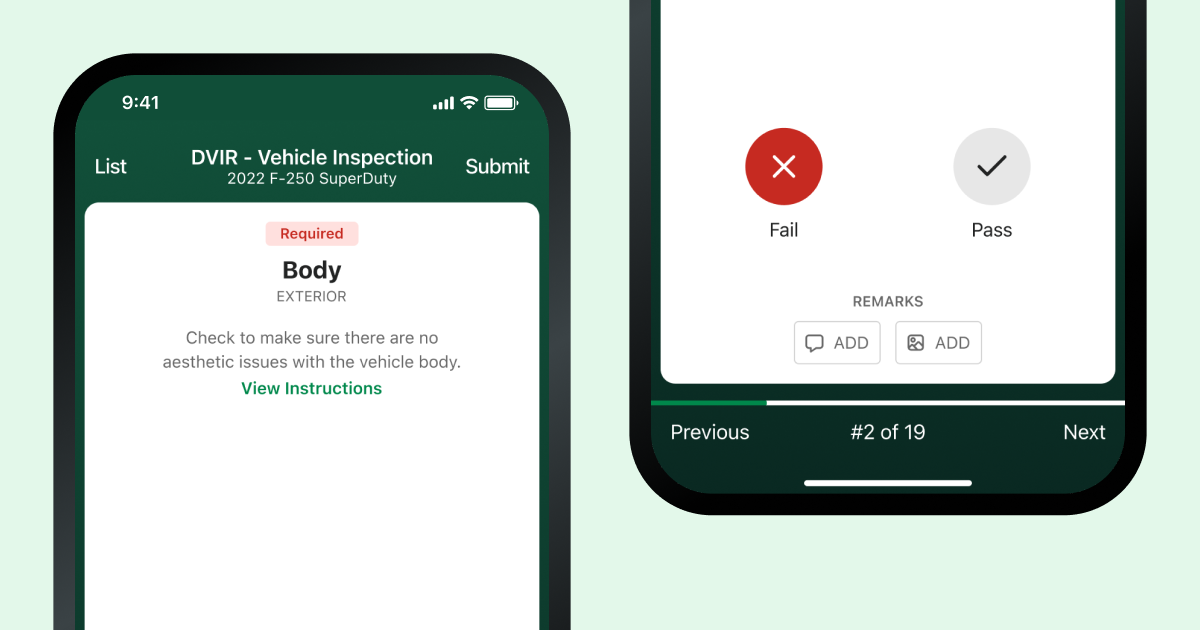
No matter what the future of fleet compliance holds, it's a safe bet that Driver Vehicle Inspection Reports (DVIRs) won't be going away anytime soon. With a fleet management software like Fleetio, your drivers can perform FMCSA-compliant electronic DVIRs right from their phones. eDVIRs are not only faster to complete than paper forms, they also can't be misplaced or damaged, which can be a significant benefit if you're ever audited by the Department of Transportation (DOT).
Fleetio also helps organizations stay on top of their vehicles' service needs via reminder notifications when preventive maintenance work will soon be due. By keeping your vehicles in tip-top shape, you can ensure that you're never penalized for vehicle condition infractions at weigh stations or on the road.

Fleet Content Specialist
Through interviews, blog posts and webinars, Alex covers the tactics and technologies exceptional fleet managers use to achieve results. By sharing their success stories, his work aims to inform and inspire fleet professionals of all stripes.
LinkedIn|View articles by Alex BorgReady to get started?
Join thousands of satisfied customers using Fleetio
Questions? Call us at 1-800-975-5304