Your Playbook to Managing a Fleet in Canada
New to running a fleet in Canada? This playbook will help you stand up a live maintenance schedule, turn daily inspections into action, organize driver and vehicle files, plan for winter, and handle the Canadian twists without drowning in regulations.
Oct 1, 2025
19 min read

Key takeaways from this guide
- Know the rulebook split: Canada runs on federal NSC standards with provincial enforcement and add-ons, so translate HOS, certified ELDs, TDG and NSC 11/13 requirements into province-specific policies to avoid fines and failed audits.
- Stand up a compliant maintenance program fast: Build a documented NSC 11 system with PM schedules, unit histories and NSC 13 daily trip inspections using Schedule 1/2 defects and clear triage rules to keep unsafe vehicles out of service and uptime high.
- Nail cross-border paperwork and taxes: Keep airtight distance and fuel records to stay clean on IRP apportioned registration and IFTA quarterly returns, and apply CRA rules correctly when company vehicles see personal use.
- Plan for Canadian realities: Winterize early, follow provincial tire/chain rules, manage risk for public/private insurance markets, respect privacy laws (PIPEDA, PIPA, Québec’s Law 25) and reinforce it all with structured onboarding and refresher training.
- Centralize compliance to scale confidently: A single source of truth for HOS/ELD docs, driver and vehicle files, PMVI calendars, defect-to-work-order workflows, shop dispatching and KPI dashboards makes audits smoother and downtime shorter. Fleetio provides these capabilities across North America so you can operationalize this playbook quickly.
Keeping a fleet on the road in Canada has its unique challenges. Federal rules set the baseline, but provinces add their own twists. You’re dealing with HOS, maintenance, cross-border paperwork, in addition to privacy. If you’re new to the seat, seeing how it all fits together is step one to a safe, compliant, efficient operation.
This guide gives you a clear, step-by-step path: the agencies that matter, what the core rules mean, how to stand up a real maintenance program, and how to handle risk.
Use it to build a culture of safety and performance in your fleet, and make compliance work for you, not against you.
Agencies & terms you should know
To navigate Canadian fleet compliance, you need the right vocabulary. This list covers most of the agencies, programs and acronyms you'll encounter throughout your day.
- Transport Canada (TC): Oversees extra-provincial truck and bus carriers under the Motor Vehicle Transport Act and sets national policy and regs (e.g., HOS, ELD framework).
- Canadian Council of Motor Transport Administrators (CCMTA): Federal-provincial-territorial group that develops National Safety Code (NSC) standards (e.g., NSC 11 maintenance, NSC 13 trip inspections).
- National Safety Code (NSC): National safety standards adopted by provinces/territories. “Commercial vehicle” commonly means > 4,500 kg RGVW or a bus with more than 10 seats.
- Provincial/territorial ministries: Enforce the federal baseline for extra-provincial carriers and set intra-provincial rules (inspections, winter traction, carrier oversight).
- Hours of Service (HOS): Driver fatigue limits (more details in “Compliance basics”).
- Electronic Logging Device (ELD): Must be third-party certified in Canada (unlike U.S. self-cert). TC maintains the official certified list.
- NSC 11 & PMVI: Part A covers maintenance systems and records. Part B is the Periodic Motor Vehicle Inspection (PMVI) at approved stations on province-set intervals.
- NSC 13 (Daily Trip Inspections): Rules for required daily inspections and defect criteria (Schedules 1 and 2).
- Weights & Dimensions MOU: Harmonizes vehicle configurations on a designated highway system. Provinces designate the specific routes.
- IRP (International Registration Plan): Apportioned registration from your base jurisdiction with one cab card and plate. Fees are split by distance.
- IFTA (International Fuel Tax Agreement): One quarterly fuel tax return via your base jurisdiction for Qualified Motor Vehicles (≥ 11,797 kg GVW, or 3+ axles, or combos > 11,797 kg).
- TDG & ERAP: Transportation of Dangerous Goods requirements. ERAP is required for specified high-risk quantities/classes (TDG Part 7).
- CBSA / ACI & eManifest: Highway carriers submit cargo/conveyance data electronically to CBSA at least 1 hour before reaching the border.
- Privacy laws: PIPEDA is the federal baseline. PIPA applies in AB/BC. Québec’s Law 25 is the most stringent.
The basics of compliance in Canada
Canadian compliance runs on a simple idea: one national standard with many provincial rulebooks. The NSC sets the safety framework, while provinces handle enforcement and add their own details. That split is where most new managers get tripped up.
- National blueprint: NSC standards + federal regs (e.g., HOS/ELD, TDG) set a consistent baseline.
- Provincial playbook: Each province/territory implements/enforces the baseline and may add requirements such as inspection frequency, winter traction rules, carrier safety programs.
Hours of Service (HOS) and certified ELDs
(Source: Transport Canada)
Canada's HOS rules exist to prevent fatigue. The core limits are 13 hours driving inside a 14-hour on-duty window, followed by 10 hours off‑duty daily, including at least 8 consecutive hours before driving; remaining off‑duty time may be split. Drivers run either Cycle 1 (70 hours in 7 days) or Cycle 2 (120 hours in 14 days).
If you operate north of 60°N, the daily limits change (ie. 15 hours driving, 18 hours on-duty, 20 hours elapsed). You’ll need to write a separate policy for those runs.
Canada also requires third-party certified ELDs. Unlike the US, vendors can’t self-certify, so devices must be tested and approved by an accredited body.
Maintenance (NSC 11) and inspections (PMVI)
(Source: CCMTA)
NSC 11 is what drives fleet safety in Canada and is split into two parts. Part A says every carrier must run a systematic maintenance program for all units. Part B is the PMVI at an approved shop: annual for trucks and trailers, semi-annual for buses.
Basics of NSC 11 Part A – Your maintenance program
- What it is: A required, documented system to inspect, repair and maintain every commercial vehicle you control.
- What adherence looks like: You have a written program, set service intervals, standard inspection lists and a way to record repairs and close out defects.
- What you keep: A unit history for each vehicle with inspections, services, repairs and dates/odometer or hours.
Basics of NSC 11 Part B – PMVI at an approved facility
- What it is: A periodic inspection completed at a provincially approved station on a set interval by vehicle class.
- What adherence looks like: You schedule before expiry, use the province’s checklist, fix any defects and only then receive a pass sticker or certificate.
- What you keep: The inspection report, proof of corrections and the current certificate, all filed to the vehicle’s record.
Daily trip inspections (NSC 13)
(Source: CCMTA)
Drivers (or a designate) must complete a daily trip inspection using NSC 13 Schedule 1/2 defect criteria. Most provinces require it once every 24 hours. Log defects with standard language and do not dispatch units with a major defect.
Speak NSC 13, not DVIR
If your team knows “DVIR” from US work, map DVIR to the NSC 13 daily trip inspection in Fleetio so everyone’s speaking the same language.
Vehicle weights and dimensions
(Source: COMT)
Canada uses a national Weights & Dimensions MOU to align allowable sizes and weights for common configs (tractor-semitrailers, B-trains, etc.). The rules apply on a designated highway system, so if your unit meets the spec, you can move between provinces without special permits.
Transporting dangerous goods
(Source: Transport Canada)
If your fleet transports any products regulated under the Transportation of Dangerous Goods (TDG) Act, you have additional compliance responsibilities. Drivers need TDG training, units must carry the correct safety marks/placards, and for certain high-risk goods and quantities you must have an approved Emergency Response Assistance Plan (ERAP) in place before you ship.
Note: This information is for guidance only and is not legal advice. Always consult the official regulations from their sources.
Provincial distinctions & nuance
To stay compliant across the entire country, you need to be familiar with the specifics of each province. While the NSC sets the blueprint, provincial rules have critical variations that have to be built into your operational plan. Here is a quick look at the key differences:
- Ontario (ON): Most carriers must hold a CVOR (Commercial Vehicle Operator’s Registration) which tracks safety performance. Ontario also mandates annual inspections for most commercial trucks/trailers and semi‑annual for buses/accessible vehicles. (Source)
- Alberta (AB): New carriers must complete a Safety Fitness Certificate (SFC) pre‑entry course and pass a knowledge test. CVIP inspection frequencies depend on vehicle class, buses are commonly semi‑annual. (Source)
- British Columbia (BC): Winter tires or chains required on signed routes October through April. BC’s CVIP indicates truck‑tractors often semi‑annual, while many trailers are annual (verify by class and weight). (Source)
- Saskatchewan (SK): PMVI intervals vary by weight, class and where you operate (intra‑ vs extra‑provincial). For example, certain heavy power units extra‑provincially are 6 months, many trailers 12 months. (Source)
- Yukon (YT): Trucks/truck‑tractors and passenger vehicles with 10 seats or more generally every 6 months, heavy trailers 12 months. (Source)
- Québec (QC): Strictest privacy regime under Law 25 (more info in “Privacy & language”). QC also mandates winter tires broadly for passenger/light vehicles. Check sector‑specific requirements if you operate there.
Get repairs anywhere in Canada
Keep vehicles on the road in any province with Fleetio’s Maintenance Shop Network. Find vetted shops, share work orders and track approvals and invoices in one place.
Find a shop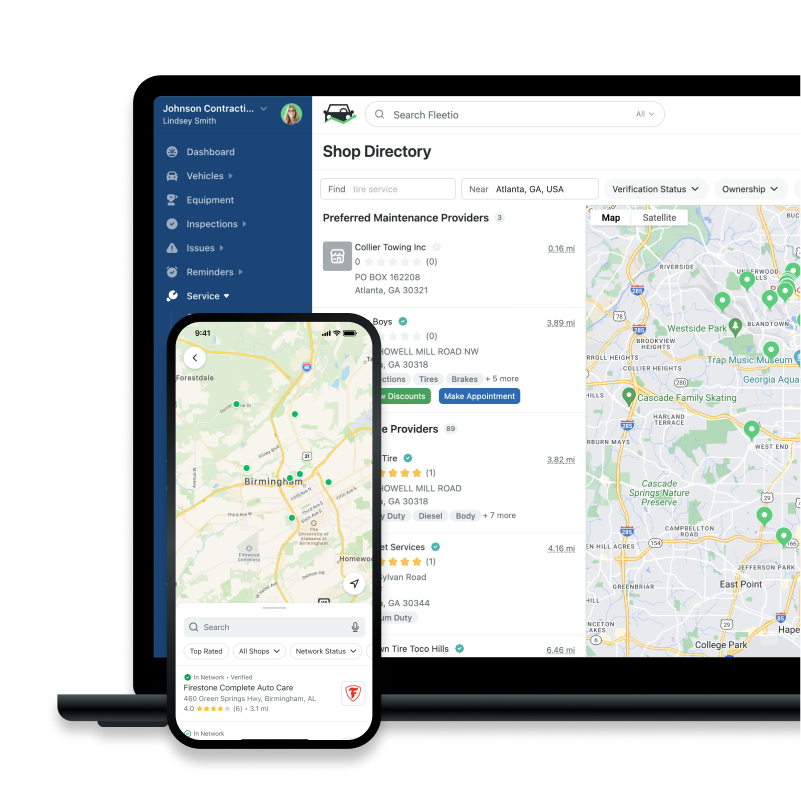
Licensing, registration & taxes
For fleets that operate across provincial or international borders, two key agreements simplify the complex world of licensing and fuel taxes.
The International Registration Plan (IRP)
The IRP allows you to register in your home province (your “base jurisdiction”) and run in all member jurisdictions with one apportioned plate and cab card per vehicle. Fees are split by how many kilometres you run in each place.
The International Fuel Tax Agreement (IFTA)
IFTA is a similar agreement for fuel taxes. Instead of filing separate fuel tax returns in every province and state you operate in, you can just file one quarterly fuel tax return with your base jurisdiction. You report total fuel purchased and distance travelled in all member jurisdictions.
Taxable benefits for personal vehicle use
If an employee uses a company vehicle for personal travel, the Canada Revenue Agency (CRA) considers it a taxable benefit that must appear on their T4. “Personal” includes the daily commute between home and the regular workplace.
To calculate this benefit, the employee has to keep a detailed logbook of all business and personal kilometers and provide a copy to their employer. A special fixed-rate calculation method is available under the "motor vehicle home at night policy," but only if these conditions are met:
- The vehicle is essential for the job and is not an "automobile" (like a sedan or SUV).
- Personal use is strictly limited to commuting between home and work.
- You have valid business reasons for the employee to take the vehicle home (on-call for emergencies, security of tools/equipment, etc.).
- You have a written policy prohibiting other personal use.
If these conditions are not met, you have to calculate a reasonable estimate of the benefit's fair market value.
How to build a preventative maintenance (PM) program
As mentioned earlier, a formal, systematic preventive maintenance (PM) program is a core requirement of NSC Standard 11. Plus, it’s the foundation of a safe, reliable and compliant fleet.
We changed from a business that just fixed things. We just reacted, reacted, reacted to being a company that actually started being proactive and predicting and preventing things. Norma Block, Barmac Contracting
When building a PM program, we always recommend starting with the Original Equipment Manufacturer's (OEM) service schedule for each vehicle, and then adjust it based on your fleet's unique needs. Consider your specific duty cycles (city vs. highway), operating environment (harsh Canadian winters, off-road use), and the minimum legal requirements of the PMVI to create a schedule built for your operation.
A sample PM matrix might look like this:
| Vehicle Class | "A" Service (Monthly/5,000 km) | "B" Service (Quarterly/25,000 km) |
|---|---|---|
| Light-duty vans/pickups | Fluid check, tires, lights, visual inspection | "A" Service + Oil change, filters, brake check |
| Medium/heavy diesel trucks | "A" Service items + Grease chassis | "A" Service + Oil change, filters, brake check |
| Low-km / High-hour units | Follow hour-based intervals for fluids/grease | Follow hour-based intervals for major services |
Preventive maintenance is your safety system, and a quick way to improve safety in your fleet is in how you triage defects found during driver vehicle inspection reports (DVIRs). Using the concepts of "Reject If" and "Hazardous Condition" from the PMVI standard, you can create a clear action plan for every issue. This system helps you manage shop workflow, control costs and maximize vehicle uptime, while demonstrating due diligence to insurers and auditors.
- Critical / Hazardous: A condition that makes the vehicle unsafe to operate (such as a cracked frame or inoperative brakes). You should ground the vehicle immediately until repaired.
- High: A defect that must be repaired before the vehicle's next dispatch (such as an inoperative headlamp or a tire below minimum tread depth).
- Moderate: A defect that does not pose an immediate safety risk but needs to be scheduled for repair soon (such as a seeping fluid leak or a cracked mirror that doesn't obstruct view).
- Low: Minor cosmetic or non-critical issues to be monitored and addressed at the next scheduled PM service.
Shared language
Map your triage levels to Fleetio’s issue priority categories so you can flag urgent work and keep unsafe units out of dispatch. Track those priorities over time by unit, system and vendor to spot repeat problems and keep NSC 11 records clean.
Planning for winter operations & severe weather
Operating a fleet in Canada means preparing for severe winter weather. Take extra steps to get vehicles, drivers and facilities ready early. In places like the Northwest Territories, seasonal Winter/Ice Roads are part of the network, which raises the bar on preparation.
Pre-season preparation (September-October)
- Inspect all block heaters, coolant systems, and batteries.
- Switch to winter-grade engine oil, fuel, and other fluids.
- Test charging systems to ensure they can handle cold-weather demands.
- Stock up on winter supplies like tire chains, shovels, sand/salt, and emergency kits for each vehicle.
In-season habits (November-March)
- Enforce anti-idling policies to save fuel, but ensure driver comfort and safety in extreme cold.
- Remind drivers to perform thorough pre-trip inspections, paying special attention to lights, wipers, and tires.
- Monitor weather forecasts closely and adjust routes and schedules as needed for safety.
Yard and shop readiness
- Have clear snow and ice removal plans in place for your yard to prevent slips and ensure vehicle access.
- Check that shop heating is adequate for technicians to work safely and effectively.
- Keep a ready supply of sand or salt for walkways and high-traffic areas.
Managing insurance and risk
Insurance is a major cost for any fleet, and proactive risk management is the best way to control it. Insurers want to see that you have a robust fleet safety program designed to prevent losses before they happen.
Understanding insurance models in Canada
Canada has a mix of public and private auto insurance systems. The provinces of British Columbia (BC), Manitoba (MB), and Saskatchewan (SK) have fully public insurance systems. Québec (QC) has a split system, while all other provinces and territories rely on the private insurance market.
Key levers for loss control
To keep your premiums down and your fleet safe, focus on these key loss-control activities that demonstrate a commitment to safety:
- Maintenance: NSC 11 compliance and DVIR/defect closure records demonstrate mechanical due diligence.
- Driver performance: Formal onboarding + refresher cadence; use telematics for coaching.
- Tire/traction: Winter tires and chain compliance on signed routes (e.g., BC Oct 1–Apr 30).
- Claims readiness: Incident kits in every cab; documented post‑incident workflow.
Navigating data, privacy & language
Data is a modern fleet's most valuable asset and one of its biggest compliance liabilities. You need to have a proactive data governance plan that factors in Canada's strict privacy laws.
The federal law, PIPEDA, sets the baseline for privacy across Canada. However, Alberta and British Columbia have their own substantially similar laws (PIPA), and Québec's Law 25 introduces some of the most stringent privacy requirements in North America.
Follow these best practices to manage data responsibly:
- Obtain clear, written consent from drivers before collecting and using their personal information, including telematics and location data.
- Establish strict access controls to ensure only authorized personnel can view personal data.
- Have a clear data retention policy that outlines how long you will store personal information.
- If you operate in Québec, ensure that key employment documents and communications are available in French.
- Keep detailed records of driver consent forms and all versions of your data and privacy policies.
Preparing for a sustainable fleet & EVs
Canada is moving toward zero-emission vehicles (ZEVs), especially EVs, and there are often incentives to help fleets adopt them. But the shift still takes planning: cold weather reduces the range and slows down charging, your facilities may need new infrastructure, and you’ll want to match routes and duty cycles to what an EV can realistically handle.
Use this simple checklist to decide if a specific route or duty cycle is a good candidate for an EV:
- What is the daily range requirement? Does it fit comfortably within the EV's real-world winter range?
- Is the vehicle's payload capacity sufficient? Remember that EV batteries are heavy.
- Does the vehicle return to a central depot for overnight charging?
- Can the necessary charging infrastructure be installed at your facility?
Building a culture of safety with people & training
Compliance and safety come down to people. The best lever you have is a real safety culture backed by consistent training. Transport Canada data consistently identifies driver actions as a major factor in serious collisions, which is why training matters.
- Onboarding: Your onboarding program for new drivers should cover essential topics like HOS cycle rules, how to complete NSC 13 daily inspections, winter driving basics, and TDG awareness.
- Driver Files: The NSC requires you to keep a complete file for each driver (licence, abstract, training, discipline). For vehicles, NSC 11 requires a maintenance record with make/model/VIN, dates and nature of each repair, and odometer or hours at service.
- Refresher Training: Implement a regular schedule for refresher training on core safety topics. This reinforces good habits and keeps safety top-of-mind.
Fleetio tip
Fleetio centralizes all driver and vehicle records, including training certificates, licence renewals and maintenance history, for easy management and audit preparation.
Your first 30 days: A quick-start checklist
Here’s a simple, week-by-week action plan to get you started on the right foot.
Week 1: Credentials and core compliance
- Locate and verify all vehicle ownerships, insurance slips, and lease agreements.
- Confirm your company's National Safety Code (NSC) Safety Fitness Certificate is current and valid in your base jurisdiction.
- Verify that every vehicle requiring an ELD has a third-party certified device installed and that drivers are properly trained on its use.
Week 2: Registrations and records
- Confirm all inter-provincial vehicles are properly registered under IRP and that you have a clear process for collecting IFTA data.
- Review a sample of driver qualification files to ensure they are complete and up to date.
- Review a sample of vehicle maintenance files to ensure they meet the record-keeping requirements of NSC 11 Part A.
Week 3: Safety and maintenance schedules
- Build a master schedule of all upcoming mandatory PMVI due dates to ensure 100% on-time compliance.
- Implement or review your daily vehicle inspection report (DVIR) process and ensure you have a clear system for drivers to report defects and for maintenance to triage them.
Week 4: Baselines and readiness
- Review your fleet's winter operations readiness plan and make any necessary adjustments.
- Establish baseline measurements for at least three core KPIs (e.g., PM Compliance %, Downtime, Incident Frequency) to track your progress.
After a month, you’ll start to notice a shift from putting out fires to running a proactive compliance program. The first few weeks are about learning your obligations, building a live maintenance schedule, and creating a baseline for the right fleet KPIs to drive smarter improvements.
What to Do Next
Canadian fleet management is a significant responsibility, but it is entirely manageable with a systematic approach focused on safety and compliance. By mastering the fundamentals outlined in this playbook, you are well on your way to building a best-in-class operation.
If you want to see how a centralized system can simplify your compliance, maintenance and daily operations, Fleetio is the platform where North American fleet maintenance happens.
You often view software as just like a solution, but when implemented correctly, it's a part of your team and it's a vital part of your team... [Fleetio] is part of the team. Norma Block, Barmac Contracting
Having a dedicated system for fleet maintenance keeps you compliant and on schedule. Fleetios enables you to:
- Get full visibility into vehicles, inspections, and due dates and access our Maintenance Shop Network to locate shops and dispatch service in any province
- Create a PMVI calendar and set reminders to stay on top of inspections, and route defects to work orders to start the maintenance process
- Build dashboards and reports to track and improve PM compliance, repeat defects and turnaround time
Gain control of your Canadian fleet
Keep your fleet audit-ready and on the road. Fleetio centralizes vehicles, work orders, inspections and compliance into one platform to help you control costs and stay ahead of PM.
Explore Fleetio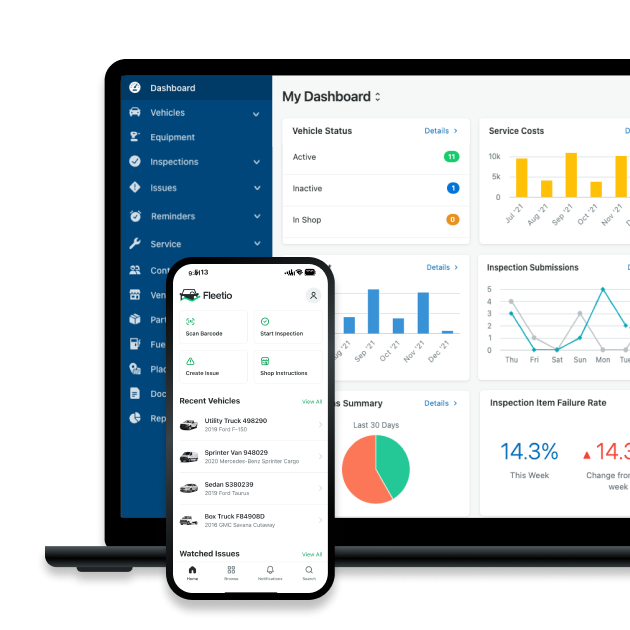
Canadian Fleet FAQs

Director of Fleet Content, Fleetio
Zach Searcy is the Director of Content at Fleetio with more than 5 years of experience in the automotive and fleet industries. His content creation days started in middle school when he and his friends began filming lightsaber battles to upload to a new website: 'YouTube.'
LinkedIn|View articles by Zach SearcyReady to get started?
Join thousands of satisfied customers using Fleetio
Questions? Call us at 1-800-975-5304