How to Prepare for the 2026 CVSA Roadcheck: ELD Tampering and Cargo Securement
The results of the CVSA's annual International Roadcheck provide a clear picture of where fleets need to be stepping up their compliance. Avoiding these common infractions goes a long way towards ensuring your vehicles don't wind up out of service.
Oct 14, 2025 | Updated: May 4, 2026
16 min read

Key takeaways from this blog
- The 2026 Roadcheck is scheduled for May 12–14: Inspectors across North America will conduct driver, vehicle and cargo inspections over the 72-hour campaign.
- ELD tampering is the 2026 driver focus: Fleets should audit records of duty status, driver edits, unassigned driving time and log transfer readiness.
- Cargo securement is the 2026 vehicle focus: Drivers should inspect tiedowns, anchor points, load distribution and securement devices before and during trips.
- 2025 violations still show where fleets are vulnerable: Brakes, tires, lights, cargo securement, HOS and driver credentials remain important prep areas.
- Digital inspections can help standardize Roadcheck readiness: Inspection forms, photos, notes and automated issue workflows can help fleets catch problems before inspectors do.
What is CVSA’s International Roadcheck?
Every year, the Commercial Vehicle Safety Alliance (CVSA) puts trucking fleets to the test through an enforcement initiative called the "International Roadcheck." Over three days across the US, Canada and Mexico, CVSA-certified inspectors examine tens of thousands of commercial vehicles.
When they encounter a vehicle with a mechanical defect that violates CVSA’s North American Standard Out-of-Service Criteria, that vehicle is prohibited from operation for a specified time period or until the failed inspection item is remedied. By conducting these highly publicized mass inspection events, CVSA aims to remind fleets of the importance of following compliance regulations and make roads safer for commercial vehicle drivers across the continent.
What are the 2026 CVSA Roadcheck focus areas?
For 2026, CVSA is putting special emphasis on one driver category and one vehicle category:
Driver focus: ELD tampering, falsification or manipulation
Inspectors will continue reviewing drivers’ records of duty status, but this year they’ll pay particular attention to signs that ELD records have been manipulated or falsified. That can include missing or inaccurate duty status entries, edits that are not properly documented, concealed driving time, ghost co-driver activity or other signs that the ELD record does not accurately reflect the driver’s hours.
Fleets can prepare by:
- Auditing ELD records for unusual edits, missing data or unassigned driving time
- Training drivers on proper annotations, edits and duty status changes
- Confirming drivers can transfer logs during an inspection
- Reviewing personal conveyance and yard move usage
- Checking for ghost driver profiles, inactive users or improper co-driver assignments
- Reinforcing that ELD accuracy is both a compliance issue and a safety issue
Vehicle focus: cargo securement
Cargo securement is the 2026 vehicle focus area. Inspectors will be looking for loads that are properly contained, immobilized and secured so they do not shift, leak, spill, blow off, fall from the vehicle or otherwise create a roadway hazard.
Fleets can prepare by:
- Inspecting tiedowns, chains, straps, binders, anchor points and edge protection
- Verifying working load limits are appropriate for the cargo
- Ensuring cargo and vehicle components are secured
- Training drivers to re-check loads during trips
- Documenting cargo securement checks in pre-trip and en-route inspections
- Replacing worn, damaged or inadequate securement equipment before it becomes a violation
Pro-tip
For more in-depth explanations of what inspectors will be looking out for, refer to the CVSA’s cheat sheets for vehicle inspections and driver inspections.
What were the most common violations this year?
Recently, CVSA published the results of their 2025 International Roadcheck, providing the public with a breakdown of the most common reasons vehicles were taken off the road during the event. Let’s go over the most common compliance infractions affecting commercial vehicles as well as what fleets can do to prevent them.
| Driver Violations | Vehicle Violations |
|---|---|
| 1. Hours of service | 1. Brake systems |
| 2. Missing licenses | 2. Tires |
| 3. No medical card | 3. 20% defective brakes |
| 4. False logs | 4. Lights |
| 5. Suspended licenses | 5. Cargo securement |
Top driver violations from CVSA's 2025 Roadcheck
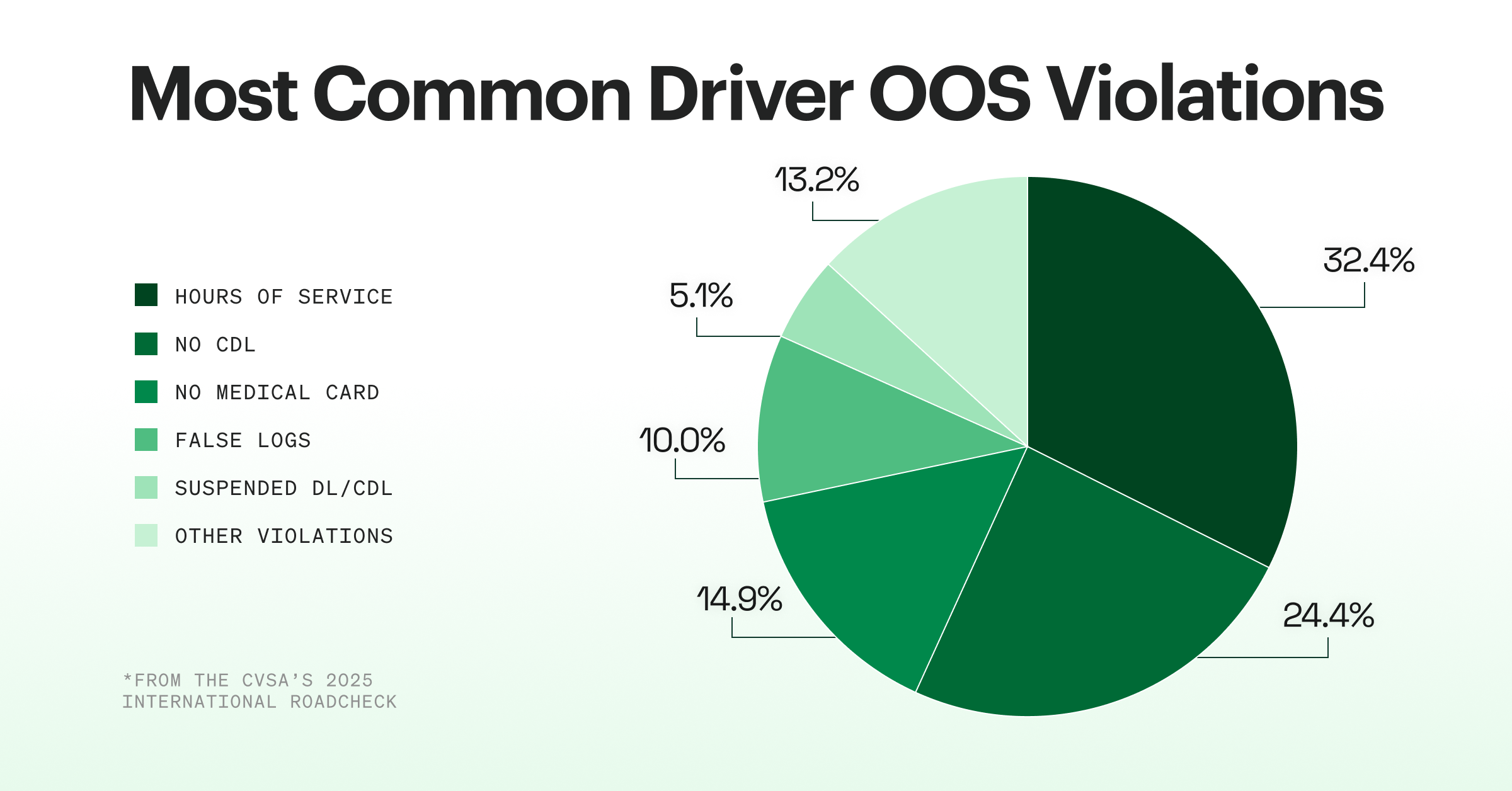
1. Hours of service
At a staggering 32.4% of all driver violations recorded, hours of service (HOS) infractions took 1,076 North American drivers off the road during this year’s International Roadcheck. For veterans of the trucking industry, the fact that HOS violations took the number one spot on this list likely doesn’t come as a surprise. Despite being required across all of the US for years at this point, many American carriers are still adjusting to ELDs. Industry surveys frequently find that a staggering percentage of carriers aren’t aware of or don’t fully understand the latest HOS rules. And due to parking frequently being difficult to find, drivers often end up exceeding HOS limits when trying to take federally mandated breaks. Partly for that reason, when the American Transportation Research Institute polled more than 4,000 motor carrier executives, drivers and other personnel on their top concerns this year, truck parking was the second most pressing issue.
But despite how pervasive HOS violations are in the trucking industry (and to fleets in general), organizations do have countermeasures available to them. First, the Federal Motor Carrier Safety Administration (FMCSA) has a wealth of online resources designed to demystify HOS regulations. From easy to understand explanations on driving limits, exceptions, reporting requirements and more, the FMCSA website contains answers to any HOS-related questions you’ve likely ever had. By keeping up-to-date on the latest developments, carriers can ensure they’re never in the dark on HOS policy updates.
As for challenges associated with ELDs and reporting, fleets should make sure that the training they provide to their drivers is actually equipping them with the knowledge they need on the road. While spending the time and investing the resources to reformat your training processes and reeducate your drivers does come at a cost, by reducing HOS-related fines, carriers will often end up with savings in the long run.
2. Missing/suspended licenses
Out of all the driver violations discovered during the 2025 International Roadcheck, 980 of them had to do with licenses (810 drivers had no licenses while 170 had suspended licenses). Despite being home to about 1 million commercial driver’s license (CDL) holders, in terms of infrastructure designed to alert companies that their personnel have had their licenses suspended, the US doesn’t have much. Only 17 states have Employer Notification Systems (ENS) in place; the rest rely on drivers self-reporting when their licenses are no longer valid.
And while timely self-reporting is mandated by federal law, this lack of oversight is taken advantage of by unscrupulous vehicle operators. According to research conducted by the American Association of Motor Vehicle Administrators (AAMVA), somewhere between 50% to 80% of commercial drivers self-report, leaving a worrying percentage of drivers who disregard laws meant to keep our roads safe.
Fleets outside of the 17 states with ENS systems need to be more proactive if they want to confirm if their drivers’ CDL licenses are in good standing. The exact methods for obtaining driving records vary state by state, but they typically are fairly easy to obtain with driver consent. While it’s not practical to constantly request these files for an entire team of drivers on a regular basis, employers should make CDL validation a standardized part of their personnel management process if they aren’t already. Combined with a company culture that values honesty and compliance, fleets can take steps to curb rates of commercial driving with improper licenses.
3. No medical card
Federal law requires commercial drivers of vehicles that weight 10,000 or more pounds to obtain and maintain a valid Medical Examiner’s Certificate (colloquially referred to as a “medical card.”) But despite that requirement, inspectors at this year’s International Roadcheck found 493 drivers operating their vehicles without a medical card in their vehicle or on their person. The medical card requirement is designed to ensure that operators of commercial vehicles don’t possess any physical maladies that might pose a safety risk for themselves or others on the road. While different states follow different policies on how medical cards are obtained, renewed and enforced, being caught without a valid one is a major problem no matter what state a driver is in.
Fortunately, unlike the difficulties associated with suspended licenses, verifying that their employees' medical cards are in order is a very simple matter for fleets. Medical cards have clear expiration dates listed on them, so employers can instantly tell if one is still valid or not. To ensure their drivers don’t let these cards lapse, fleets can either ask drivers to present these cards to them on a periodic basis or they can maintain a database of when their drivers’ cards are set to expire (and remind them when they are in need of renewal).
Key documents — safe and secure
Never lose track of important fleet documents again. Fleetio’s secure cloud storage keeps everything — from licenses to insurance — safely at your fingertips, giving you and your team instant access to the files you need, whenever, wherever.
See how it works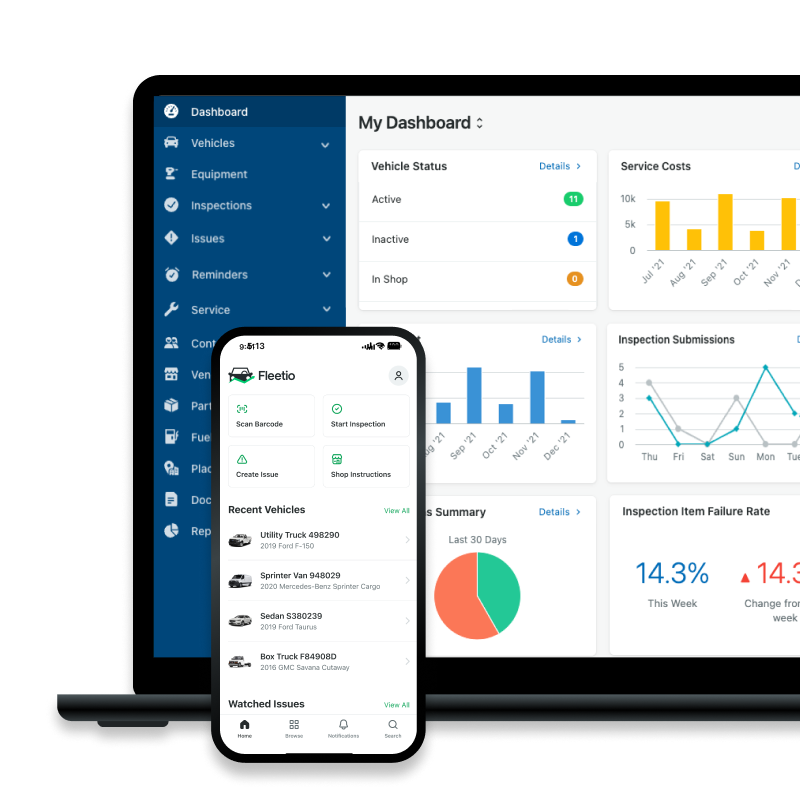
4. ELD tampering, falsification and manipulated logs
CVSA-certified inspectors caught 332 American, Canadian and Mexican drivers with misreported logs this year. And unlike HOS infractions where there are a number of understandable (albeit not exculpatory) reasons for being in violation, false logs are much harder to justify. Even in a post-ELD mandate world, fraudulent reporting remains a pervasive issue for fleets of all sizes and industries. Despite the risk of receiving fines up to $2,500 per false log, drivers looking to subvert federal rules do everything from setting up “ghost” profiles to unplugging their ELD devices to operate beyond legal limits.
To curb the prevalence of false logs, fleets need to establish company cultures that value compliance and the safety and wellbeing of their drivers over maximizing efficiency at (nearly) any cost. By being mindful about overburdening drivers with excessive loads and simply staffing enough drivers to fulfill the hauls they require, organizations can go a long way towards minimizing the pressures that often compel drivers to flout the law. While it certainly won’t be easy to overcome the mentality behind “if the wheels ain’t turning, you ain’t earning,” endeavoring for a healthier balance between productivity and fleet safety is ultimately the best path forward for carriers and drivers alike.
For 2026, fleets should go beyond basic HOS compliance and look specifically for signs of ELD manipulation. That includes unexplained edits, missing annotations, unassigned driving time, improper personal conveyance use, ghost driver profiles, disconnected devices or patterns that suggest driving time is being concealed.
- Review driver log edits and confirm annotations are complete
- Investigate unassigned driving time before Roadcheck week
- Confirm all drivers know how to transfer ELD records during an inspection
- Disable or remove inactive driver profiles
- Verify ELD devices are connected, functioning and assigned to the correct vehicles
- Audit personal conveyance and yard move usage
- Train dispatchers and managers not to pressure drivers into log manipulation
Top vehicle violations from CVSA's 2025 Roadcheck
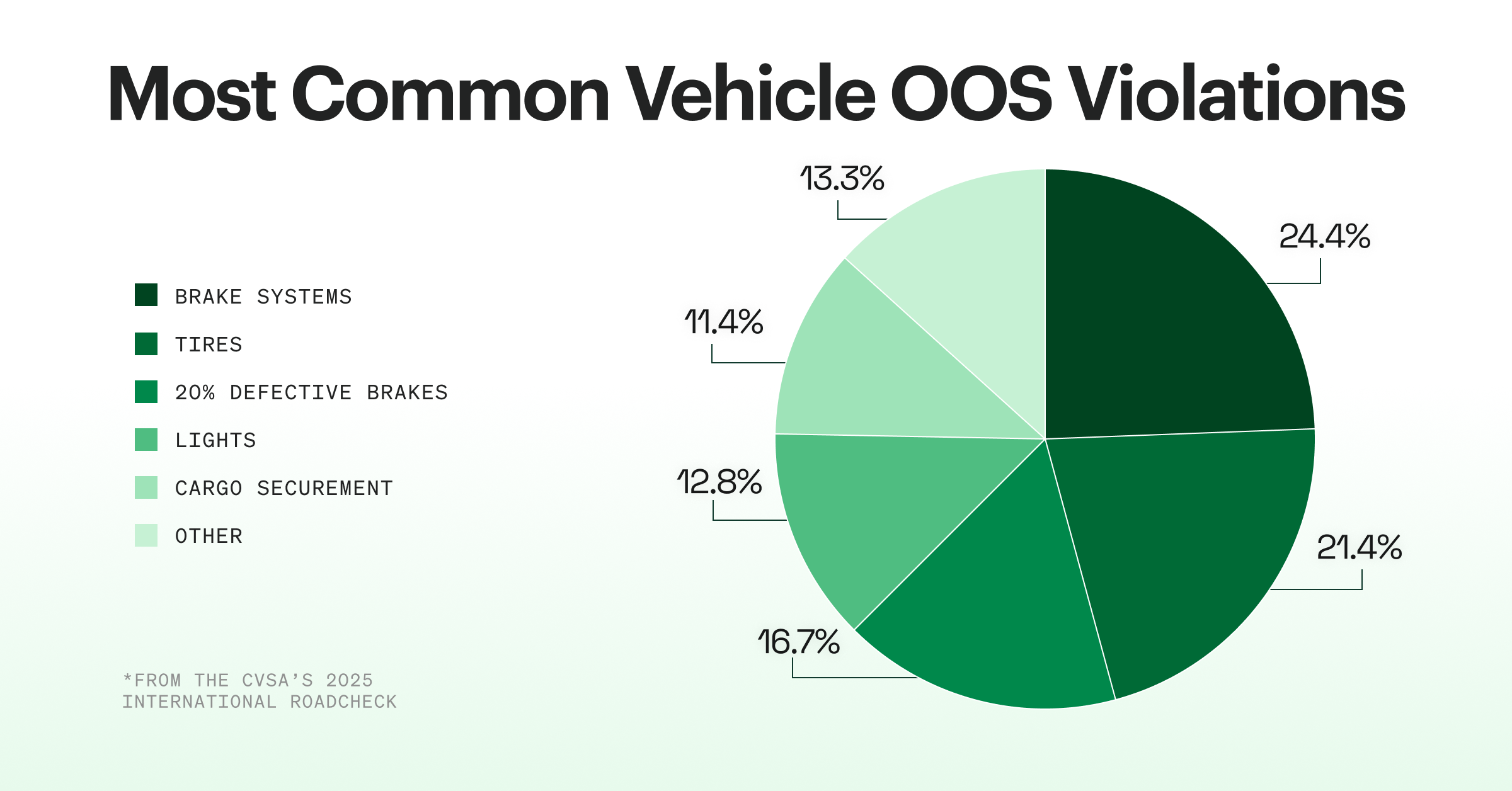
1. Brake systems and 20% defective brakes
Brake-related issues sidelined more than 5,500 commercial vehicles at this year’s International Roadcheck. According to the CVSA, they found 3,304 flawed braked systems and 2,257 vehicles with 20% or more defective brakes.
And while you’re sure to find brake system examinations on virtually every pre- and post-trip inspection checklist, many fleets fail to scrutinize their brake systems to the appropriate degree. Since one flawed chamber, clamp, pushrod, slack adjuster, shoe or drum is all it takes to render a brake system unreliable, checking only a portion of a brake systems’ components is simply insufficient.
Instead, fleets should be comprehensive in their brake system inspections, examining certain components daily, others weekly, and remaining parts monthly (depending on their respective durability). Vehicle inspection apps can make staying on top of these different inspection tasks as simple as following the right checklist for the occasion. For example, these apps can direct users to be on the lookout for loose air chambers everyday, inspect rotors for cracks once a week, and check for air system moisture once a month. By ensuring no brake system component goes overlooked, vehicle inspection apps significantly reduce the likelihood of a vehicle being taken off the road due to the leading compliance infraction.
2. Tires
While not as ubiquitous as flawed brake systems, worn-out tires were the reason nearly 2,900 vehicles were halted at the 2025 International Roadcheck. From exposed fabric and belt material to insufficient tread depth, tires can violate CVSA-determined conventions in a litany of ways. And because tires are so vital to driver safety, a single tire having certain defects can instantly designate a vehicle to be out-of-service. Only roadside service calls can get vehicles back on the road once stopped as out-of-service — vehicles aren’t even allowed to go to the nearest truck stop to get their tires replaced or repaired. Because of this, fleets are both incentivized to take tire compliance seriously from both a safety and cost perspective.
Once again, as part of a larger fleet safety program, vehicle inspection apps can help address this all too common oversight. Using their smart device’s onboard camera, drivers can take pictures of any tire defects when conducting an inspection. This serves to create a record in the associated vehicle’s inspection history that can be reviewed at any time.

FOR FLEETIO USERS
Fleetio’s Tire Management feature allows organizations to closely monitor the health of their vehicles’ tires.
3. Lights
According to the CVSA, more than 1,700 vehicles were placed out-of-service for having defective lights during this year’s International Roadcheck. Due to their nature, lights are among the easiest infractions to prevent and one of the most apparent flaws for inspectors to find. Whether being inspected by a driver or an enforcement official, a light can be determined to be in working order or not instantly through little effort. Because of this, a defective light is often the initial spark that leads to a more thorough inspection of the rest of a vehicle.
To identify malfunctioning vehicle lights as quickly and consistently as possible, fleets should instruct their drivers to look carefully when examining lights during the day. It’s not uncommon for drivers in a rush to mistake a light for being on when it isn’t actually operational (and is merely catching sunlight).
4. Improper cargo securement
According to the National Highway Traffic Safety Administration (NHTSA), unsecured loads result in about 730 fatalities and more than 17,000 injuries every year. To protect drivers and pedestrians from cargo-related mishaps, every state in the US has laws around unsecured loads and government agencies like the CVSA have detailed cargo securement rules. And at this year's International Roadcheck, inspectors found 1,549 instances of vehicles in violation of those cargo securement rules.
Inspections and driver training are the best tools fleets have to ensure their cargo securement practices are up to code. Before and after trips, have your drivers visually confirm that all tie-downs are in good condition. If any appear worn down or damaged, make sure they are replaced immediately. Chains, ropes, straps and similar items should also be inspected for signs of wear regularly.
That being said, the condition of your securement tools hardly matters if they aren't being used effectively. Thankfully, proper driver training can address this vulnerability. Educate your personnel on selecting the right tools for the job based on their working load limit (WLL). Teach them how to select securement points that will keep loads in place without causing any damage to your cargo. And train them on how to perform a thorough load check and how often they should be performing them.
What to add to cargo securement inspections before Roadcheck
- Confirm cargo is immobilized and cannot shift during normal driving conditions
- Verify the number and type of tiedowns meet the load’s weight and shape requirements
- Check tiedowns for cuts, frays, knots, damaged hooks, bent links or weakened fittings
- Confirm anchor points are secure and not cracked, bent or corroded
- Use edge protection where cargo could damage straps or tiedowns
- Secure vehicle equipment, dunnage, tools, spare parts and accessories
- Re-check load securement after the first 50 miles and during required stops
- Document load checks with notes or photos when possible
How to prepare for the 2026 Roadcheck
The CVSA has announced that the 2026 International Roadcheck will take place May 12–14 across North America. This year’s driver focus is electronic logging device (ELD) tampering, falsification or manipulation, while the vehicle focus is cargo securement. Fleets should use the time leading up to Roadcheck to audit driver records, verify ELD processes and reinforce load securement inspections before vehicles reach the roadside.
Free CVSA Inspection Checklist
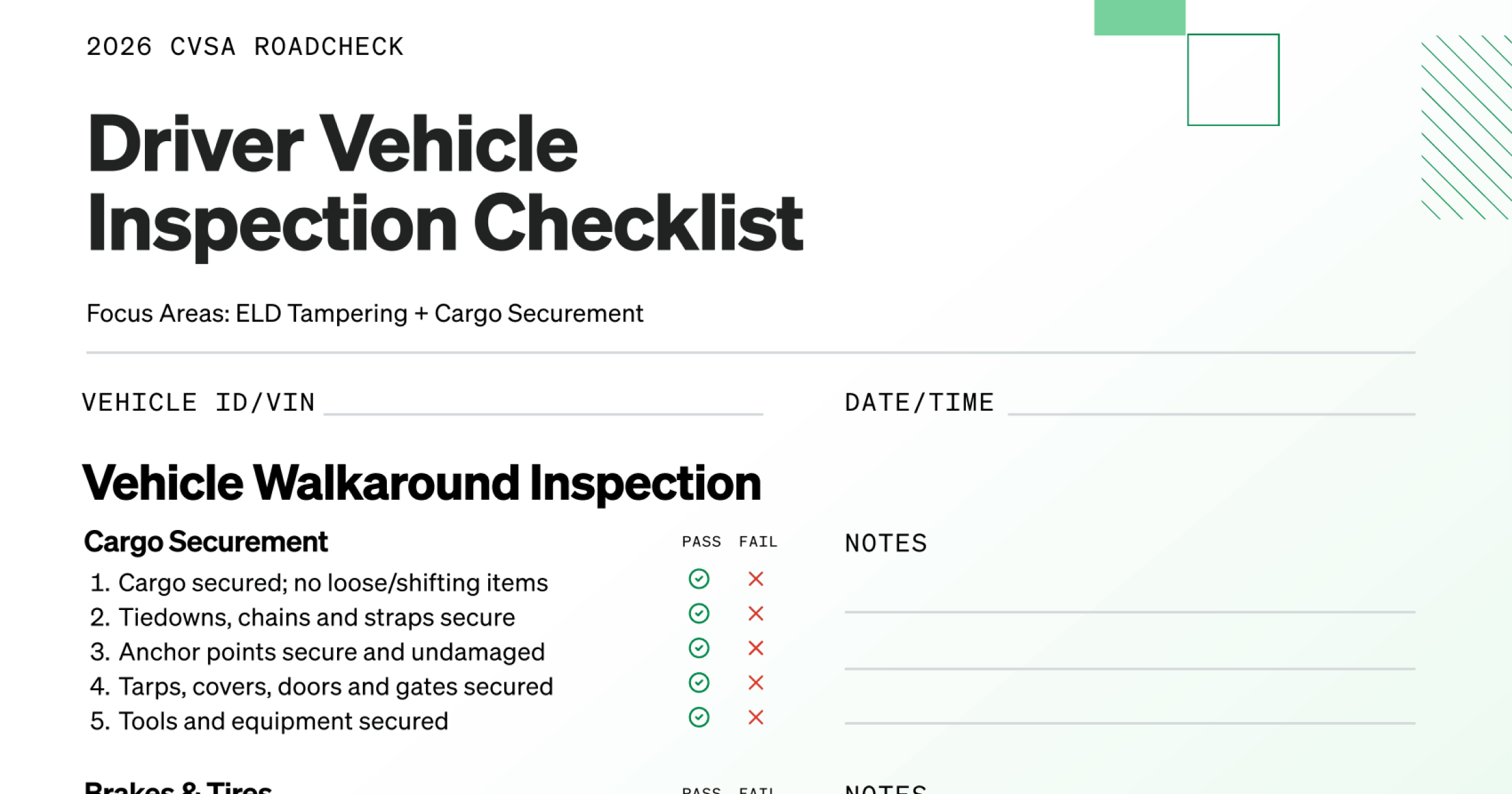
Improve CVSA Roadcheck compliance with Fleetio
Ultimately, if fleets want to avoid having their vehicles sidelined during the next International Roadcheck, it behooves them to be diligent in their inspections and preventive maintenance work. Fleetio helps organizations excel in those areas by providing a comprehensive fleet management system that streamlines how information is shared among your personnel.
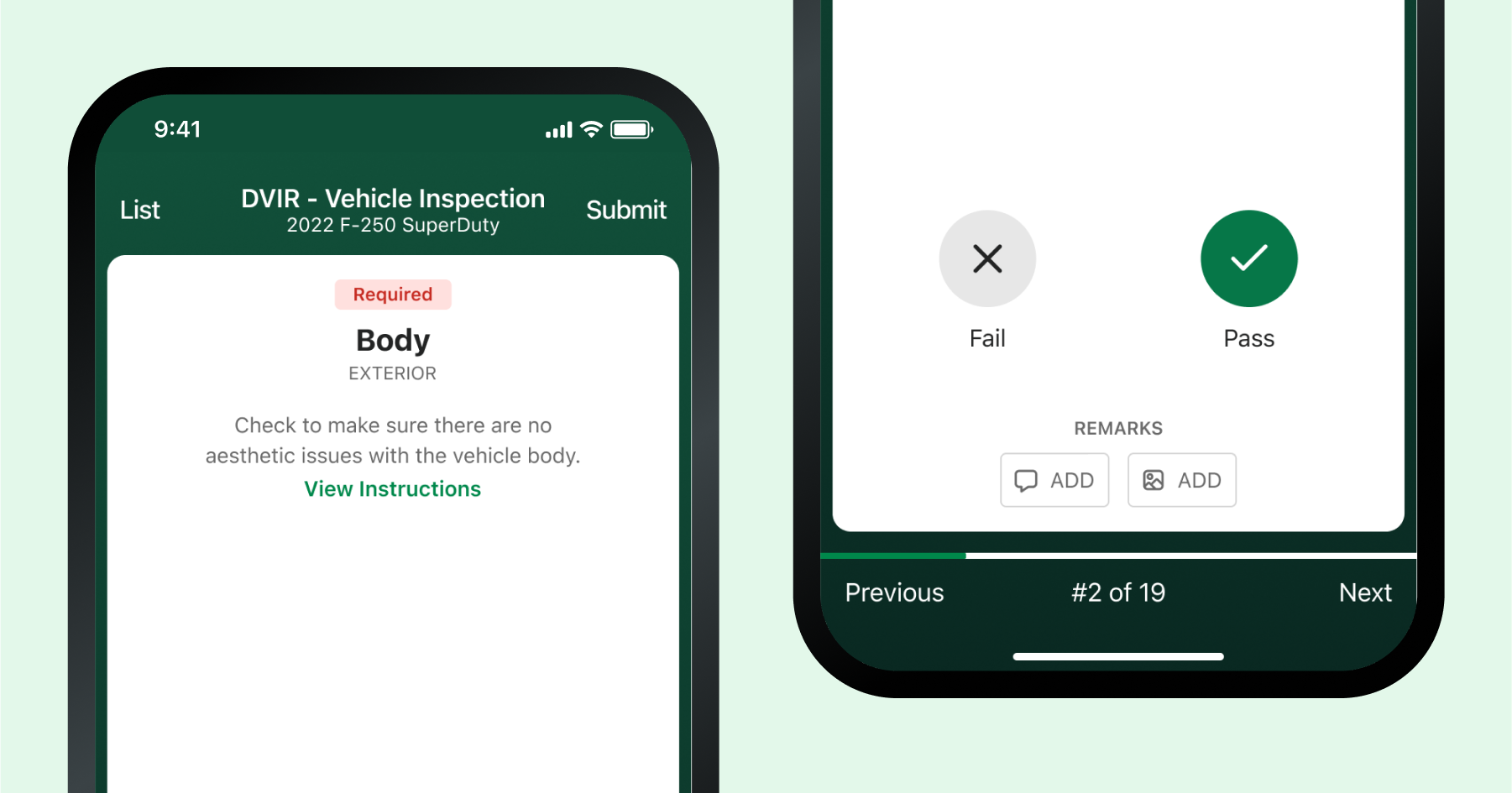
Compared to traditional paper inspection forms, Fleetio's digital inspections are more efficient to fill out and far easier to analyze. The ability to attach photos to inspections allows drivers to document defects with greater clarity. And if an urgent issue is discovered during an inspection, Fleetio immediately alerts designated administrators so they can create a work order ASAP.
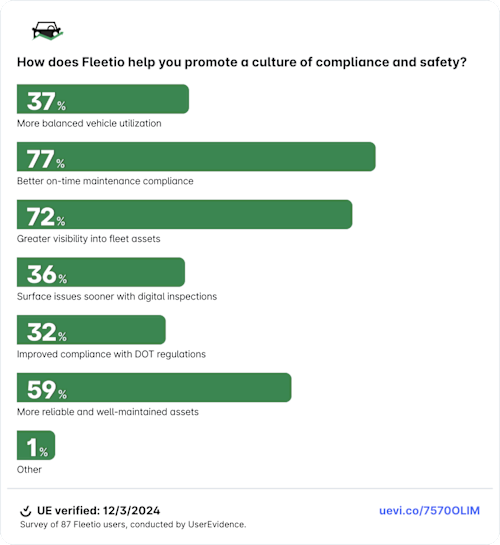
Fleetio also helps organizations stay on top of their preventive maintenance more consistently by automatically tracking when scheduled maintenance actions are due. If a vehicle will soon need an oil change, Fleetio automatically issues a reminder so managers can assign that work to a technician. Fleetio even displays what vehicle manufacturers recommend in terms of when to perform different maintenance actions to help organizations optimize their schedules.
It's for these reasons and more why Fleetio users report that our software helps them achieve greater compliance and safety within their operations.
We have your back — and your fleet
See why thousands of businesses trust Fleetio to simplify their fleet management, giving them complete visibility and control over their vehicles, assets and expenses — all in one easy-to-use platform.
Let's walk you through

Fleet Content Specialist
Through interviews, blog posts and webinars, Alex covers the tactics and technologies exceptional fleet managers use to achieve results. By sharing their success stories, his work aims to inform and inspire fleet professionals of all stripes.
LinkedIn|View articles by Alex Borg
Director of Fleet Content, Fleetio
Zach Searcy is the Director of Content at Fleetio with more than 5 years of experience in the automotive and fleet industries. His content creation days started in middle school when he and his friends began filming lightsaber battles to upload to a new website: 'YouTube.'
LinkedIn|View articles by Zach SearcyReady to get started?
Join thousands of satisfied customers using Fleetio
Questions? Call us at 1-800-975-5304