California Fleet Playbook 2025-2027: Compliance, Costs & the Road to Zero Emissions
California is the roadmap for fleets. If you can stay compliant in California, you’re ready for what’s next everywhere. This guide shows how to lock your testing cadence, control cost per asset and stage ZEV adoption so compliance becomes the byproduct of running a smarter fleet.
Aug 14, 2025
16 min read
Key takeaways from this guide
-
California sets the national tempo: CARB waivers and Section 177 adoption turn California rules into a 12–36 month forecast for other states, with ACT already shaping manufacturer ZEV sales targets. Track ACT enforcement timelines and OEM allocation patterns to anticipate equipment availability and resale market shifts.
-
Lock in your compliance cadence now: Clean Truck Check brings semiannual testing in 2025 and quarterly OBD testing by October 2027, plus annual fees, roadside Notices to Submit, and strict idling limits. Enroll VINs, bundle tests with PMs, and assign ownership for WAIRE trip logs and BIT records to avoid registration holds and fines.
-
Budget for the real cost of compliance: California’s diesel premium, added admin/shop time, and tighter aftertreatment and OBD requirements raise operating costs. Segment California lanes, build a cost-per-asset model (fees + labor + downtime + retests), and lock vendor SLAs for peak testing windows.
-
Treat ZEV transition as a staged operations project: ACT drives OEM ZEV allocations while ACF is paused, and incentives like HVIP and CEC EnergIIZE can compress TCO if infrastructure is ready. Secure build slots early, pilot duty cycles with predictable routes, and file utility interconnects 12–24 months ahead to de-risk charging and hydrogen timelines.
-
Centralize compliance and ZEV ROI tracking: Consolidating Clean Truck Check results, WAIRE documentation, PM schedules, and KPIs (pass rates, idle hours, cost per vehicle, ZEV utilization, charging uptime) turns compliance into a manageable workflow. Fleetio centralizes testing records, automates PM cadences, and models ZEV adoption costs so you can cut downtime and prove ROI.
Why California sets the pace
California has long served as the testing ground for fleet compliance. The California Air Resources Board (CARB) sets rules that often exceed federal standards, and once approved, those rules can ripple out across the country. Through Section 177 adoption, other states can choose to follow California’s stricter standards – meaning today’s California rules can become tomorrow’s national baseline.
Clean fleet mandates are probably the biggest challenge. Compliance is aggressive, and a lot of technology isn’t where we need it to be to meet these expectations. We strive to hit these targets, but until we see some advancements in the industry, our progress will be hindered. Ernie Garcia, Director of Fleet and Business Systems, Gothic Landscape
CARB’s role in shaping policy
- CARB frequently receives federal waivers to enforce emissions standards beyond EPA minimums.
- In Jan 2025, the EPA granted California a waiver for the Advanced Clean Trucks (ACT) rule, making it enforceable.
- By Apr 30, 2025, 10 other states plus California had adopted ACT, setting manufacturer ZEV sales mandates nationwide.
- For fleets, this creates a 12–36 month forecast window: monitoring California gives early visibility into the rules likely to land elsewhere.
Why OEMs follow California:
Certification cycles start with California approvals, ZEV allocation decisions often prioritize ACT states first, and while CARB withdrew its waiver request for ACF in Jan 2025, ACT adoption continues to dictate OEM roadmaps.
Note: On April 30, 2025, the U.S. House voted to rescind EPA waivers underpinning California’s Advanced Clean Trucks rule (the Senate followed on May 22, and the President signed the resolutions on June 12, 2025); litigation by California and other states is ongoing.
Practical impact for non-CA fleets
As California fleets cycle out equipment earlier, the used market in other states fills with vehicles that might not fit your long-term plans. OEMs design specs and production runs to meet California’s mandates first, which means availability in other regions follows their lead, not the federal baseline.
And while incentive programs like HVIP start in California, they often expand outward, setting the stage for the same funding and infrastructure patterns in your state a few years down the road.
California compliance watchlist (2025–2027)
California’s compliance landscape is shifting quickly. Here are the rules and updates every fleet needs to watch between now and 2027.
Clean Truck Check (HD I/M)
California’s Clean Truck Check is a statewide emissions compliance program that requires heavy-duty vehicles to undergo regular emissions testing. It applies to most diesel and alternative-fuel trucks operating in the state, with only limited exemptions, making it one of the broadest inspection mandates fleets must navigate.
Key dates & fees:
- $31.18 annual fee per vehicle (effective Jan 1, 2025).
- Semiannual testing begins in 2025.
- Quarterly testing for OBD-equipped vehicles starts October 2027.
- Roadside monitoring can trigger a Notice to Submit → fleets have 30 days to provide a passing test.
Fleet actions:
- Create account, enroll VINs, confirm device/OBD readiness
- Align testing with preventive maintenance cycles
- Integrate telematics data pulls with compliance uploads
Risks & penalties: Possible DMV registration holds, fines and roadside opacity/PN screening.
Pro Tip
Build emissions testing into your preventive maintenance calendar to reduce downtime and admin burden.
ACT vs ACF
-
[Pending] Advanced Clean Trucks (ACT): Manufacturer mandates for ZEV sales percentages by class. The EPA granted California a waiver in early 2025, making ACT enforceable. By Apr 30, 2025, 10 other states plus California had adopted ACT.
-
[Paused] Advanced Clean Fleets (ACF): CARB withdrew its waiver request in Jan 2025, pausing enforcement. Treat it as a directional signal, not a requirement.
Plan 2025–2027 procurement around ACT-driven availability. Use TCO modeling and duty-cycle pilots to stay ready if ACF-style mandates return.
Because these rules are often confused, here’s a side-by-side look at what they mean for fleets today.
| Factor | Advanced Clean Trucks (ACT) | Advanced Clean Fleets (ACF) |
|---|---|---|
| Who it applies to | Manufacturers selling medium- and heavy-duty vehicles | Fleet operators purchasing or operating vehicles |
| Obligations | Meet annual ZEV sales percentage targets by vehicle class | Transition specified fleet types (drayage, government, large private) to ZEVs over time |
| Status (2025) | Authority in flux: waiver granted Apr 6, 2023; Congress rescinded in June 2025 and the President signed; states have sued. Outcome pending. | Paused: CARB withdrew waiver request in Jan 2025 |
| Geography | Adopted in California + 10 other states | California only (not currently enforceable) |
| Fleet takeaway | Expect OEM allocations and availability to follow ACT sales targets | Monitor as a directional signal, but base planning on ACT + TCO modeling |
WAIRE Rule 2305
The WAIRE Rule is now federally enforceable and applies to warehouses 100,000 square feet or larger in Southern California’s South Coast Air Quality Management District. For fleets, this means shippers and warehouse operators may increasingly favor carriers that bring ZEVs onto their docks, with tighter idling enforcement and stricter dwell-time expectations already in play.
Core mechanics: Facilities must hit annual “WAIRE Points” targets via mitigation actions such as:
- Deploying ZEV trucks
- Installing onsite charging or solar
- Adding filtration or energy storage
- Paying mitigation fees
Fleet actions:
- Engage warehouse landlords/customers
- Model your WAIRE Points contribution through pilot programs
- Document truck trips for compliance
Transport Refrigeration Unit (TRU) update
In Jan 2025, the EPA waived most of California’s 2022 TRU amendments but withheld approval of the zero-emission TRU (ZETRU) turnover requirements. For now, diesel-powered TRUs remain subject to idling restrictions and labeling/registration rules, while the fate of ZETRU mandates is still pending.
Fleet actions:
- Inventory TRUs
- Confirm registrations
- Assess standby/hybrid options for new units
CHP BIT inspections
Effective Jan 1, 2025, California limited 90-day inspections to CMVs ≥26,001 lbs GVWR.
Fleet actions:
- Update vehicle inspection calendars
- Maintain federal periodic inspections for lighter vehicles
Idling restrictions
California enforces a five-minute statewide idling limit, with carveouts for sensitive areas like schools. In addition, certain air districts, especially in Southern California, layer on stricter rules, often tied to WAIRE reporting and warehouse compliance.
Fleet actions:
- Coach drivers on idling best practices
- Use geofenced idle alerts
- Post signage at docks
Operational and cost impacts
California’s rules change what you do, and what it costs to do it. Every new inspection requirement, testing cadence and infrastructure upgrade adds measurable expense to fleet operations.
For managers, staying compliant now means budgeting for vehicles, and also for the systems and staff that keep those vehicles road-ready under California’s evolving standards.
California diesel premium
California diesel prices run materially higher than the U.S. average, creating a built-in OPEX delta for CA routes. In June 2025, the state average was about $1.35/gal higher than the U.S. average (U.S. EIA Gasoline & Diesel Fuel Update).
What to do
- Segment routes by state/district and model fuel cost per mile with a CA uplift
- Revisit fuel card + surcharge policies for California lanes to protect margins
Emissions testing downtime and admin
The Clean Truck Check adds predictable admin and shop time: semiannual testing in 2025 and quarterly testing for OBD-equipped vehicles starting October 2027. Roadside monitoring can trigger a Notice to Submit with 30 days to provide a passing test.
What to do
- Bundle testing with PMs to minimize repeat shop visits
- Standardize a VIN → device → record workflow so results upload cleanly on the first try
- Track “days-to-close” for Notices to reduce registration-hold risk
Pro Tip
Create a recurring PM template that includes: OBD health check, DPF/SCR inspection and compliance upload. Treat it like an A/B service item to keep cadence tight.
Maintenance considerations
More frequent testing increases the emphasis on aftertreatment health (DPF/SCR) and OBD data integrity. Aligning compliance tests with PMs helps you catch faults early and avoid surprise retests.
What to do
- Add pre-test OBD readiness checks and confirm device firmware versions
- Track repeat-fail assets; schedule deeper diagnostics for chronic offenders
- Watch warranty windows when DPF/SCR work is likely to spike
Staffing and vendor alignment
You’ll feel the lift across operations, admin and maintenance shops as cadence tightens in 2026–2027.
What to do
- Cross-train techs on emissions diagnostics and CTC device workflows
- Lock SLAs with external shops for CTC testing windows (Q4/Q1 spikes)
- Assign ownership for portal account/VIN enrollment and recordkeeping
Recordkeeping and risk management
Documentation is your first line of defense: CTC receipts, roadside Notice to Submit closure logs, BIT inspection records and any WAIRE trip documentation if you operate in SoCal.
- CTC requirements & cadence: CARB Clean Truck Check
- Fee: $31.18 per vehicle annually (effective Jan 1, 2025) — CARB fee update
- WAIRE enforceability (SoCal): Federal Register SIP approval, 9/11/2024
- BIT threshold change (≥26,001 lbs, 1/1/2025): JJ Keller summary
Quick Math: Calculating the Cost of Compliance
- Annual fee (CTC): $31.18 per asset
- Tech/admin labor: hours × loaded rate
- Downtime: hours lost × hourly rate
- Retests: fail rate × retest cost
Total = Cost of compliance per vehicle per year
Transition to Zero-Emission Vehicles (ZEVs)
California’s ZEV mandates are already shaping procurement, funding and infrastructure decisions.
The Advanced Clean Trucks (ACT) rule requires manufacturers to meet rising ZEV sales targets by class. That means fleets everywhere are feeling the downstream effects. OEM allocations prioritize California and ACT states, ZEV specs hit order books first, and diesel equipment cycles out earlier, reshaping resale markets. You should secure build slots early and align capital planning with ACT-driven allocation cycles.
There is no one‑size‑fits‑all charging solution like some manufacturers, and 3rd parties would have you believe. Charging is difficult, but there are credible companies out there that I have found that make the journey less painless. Ernie Garcia, Director of Fleet and Business Systems, Gothic Landscape
California also offers the richest set of ZEV incentives in the country. Fleets can layer multiple programs to reduce upfront cost and shorten ROI:
- HVIP: Up to $330,000 for Class 8 battery-electric drayage/refuse trucks and $420,000 for Class 8 fuel-cell vehicles (eligibility dependent).
- CEC EnergIIZE: Infrastructure incentives for charging and hydrogen depots, with funding windows and caps.
- Utility programs: Make-ready infrastructure support and time-of-use rates to cut energy costs.
California has also been preparing its infrastructure for the ZEV shift, with more than 16,000 medium- and heavy-duty fueling points in place as of early 2025. But challenges remain:
- Utility interconnect lead times can stretch 12–24 months
- Depot upgrades (panels, transformers, trenching) often drive hidden costs
- Load management is critical as fleets balance TOU rates, demand charges and resiliency investments like solar + storage
Ultimately, ZEV adoption comes down to math. The costs of EV vs. ICE depends on energy vs. diesel costs, maintenance savings, tire wear and residual values – all offset by the incentives above.
Pro Tip
Start with duty cycles that have predictable routes, dwell time and payload margins. They’re most likely to be “ZEV-ready” in the next 12 months.
At a glance, the routes best positioned for ZEVs are those with daily mileage within current ranges, depots with charging or hydrogen access and predictable dwell time for recharging. If you can run ZEVs in California, you’ll be prepared for mandates (and market expectations) anywhere.
Ready to Plug In?
From incentives to infrastructure, this guide shows how fleets like yours can make EV adoption less guesswork and more game plan.
Download Now
Regional and sector considerations
California compliance is never one-size-fits-all. Rules land differently depending on where you operate and what you haul.
Ports and drayage
- Clean Truck Check and the drayage registry are already accelerating diesel turnover.
- Shore power and local anti-idling rules are stricter around port districts.
- Charging and hydrogen hubs are being prioritized for drayage lanes, but access is still limited.
Drayage carriers should align procurement with HVIP vouchers and port-specific grants to shorten ROI windows.
Southern California (SCAQMD)
- The WAIRE Rule requires warehouse operators to account for truck activity.
- Fleets may face customer mandates to bring ZEVs onto docks.
- Expect tighter idling enforcement and more trip-logging tied to WAIRE Points.
Engage shippers and warehouse landlords early to forecast obligations.
Northern California (BAAQMD)
- No WAIRE rule, but stronger anti-idling enforcement.
- Grants prioritized for municipal fleets and school buses.
- PG&E pilots supporting depot electrification.
What non-CA fleets should watch
Even if you never operate in California, its rules shape what you can buy, when you can buy it, and how you operate:
- ACT adoption: 10 states plus California have plans to adopt ACT. Massachusetts, New Jersey, New York, Oregon and Washington begin enforcement in 2025; Vermont in 2026; Colorado, Maryland, New Mexico and Rhode Island in 2027. OEM allocations will prioritize these states first.
- Enforcement timetables are shifting: MA and OR granted MY2025–2026 discretion; VT paused to 2027; MD easing penalties MY2027–2028 – verify your state’s current guidance.
- WAIRE-like programs: SoCal’s WAIRE Rule is federally enforceable, and other regions are exploring similar “indirect source” rules that tie warehouse permits to ZEV adoption and stricter idling enforcement.
- Federal alignment: EPA’s waiver approval for ACT shows a willingness to let California set the pace. Its policies often become a 12–36 month forecast window for national rules.
- Market shifts: California’s compliance rules influence resale markets, push OEMs to design to California standards first, and drive shippers and investors to require ZEV adoption or idle reduction even outside mandated states.
Rather than relying solely on industry standards, it is essential to take into account the specific requirements of your fleet. Ernie Garcia, Director of Fleet and Business Systems, Gothic Landscape
Fleet manager’s checklist and timeline (2025–2027)
Compliance is easier when you can see the road ahead. Use this quarter-by-quarter checklist to stay proactive.
| Year | Key Actions |
|---|---|
| 2025 |
|
| 2026 |
|
| 2027 |
|
KPIs to track
You can’t manage what you don’t measure. Tracking the right KPIs keeps fleet compliance proactive instead of reactive.
- Compliance Pass Rates: Percentage of assets passing Clean Truck Check on the first attempt. A rising retest rate signals maintenance or process gaps.
- Idle Time per 100 Miles: Hours of idling logged per distance driven. Helps you enforce anti-idling rules and identify driver training opportunities.
- Cost of Compliance per Vehicle: Annualized cost of Clean Truck Check fees, labor, downtime and retests divided by fleet size. Use the calculator above to track trends year over year.
- ZEV Utilization: Percentage of ZEVs in your fleet actually deployed versus parked or underutilized. Ensures ROI on early adoption.
- Charging Uptime: Availability of depot chargers or hydrogen fueling stations. Downtime here directly impacts vehicle availability and route reliability.
Pro Tip
Pick 3–5 KPIs to monitor consistently. They’ll help you spot compliance gaps before they become fines, and prove ROI on ZEV adoption.
California’s compliance rules are complex, but they don’t have to hold your fleet back. With Fleetio, you can do more than just stay audit-ready, you can reduce downtime, control costs and measure ROI on ZEV adoption. Compliance becomes a byproduct of running a smarter, more optimized fleet.
Stop Guessing, Start Driving
Fleetio turns compliance chaos into a clear workflow. Track inspections, cut downtime, and track your ZEV transition with confidence.
Get a Demo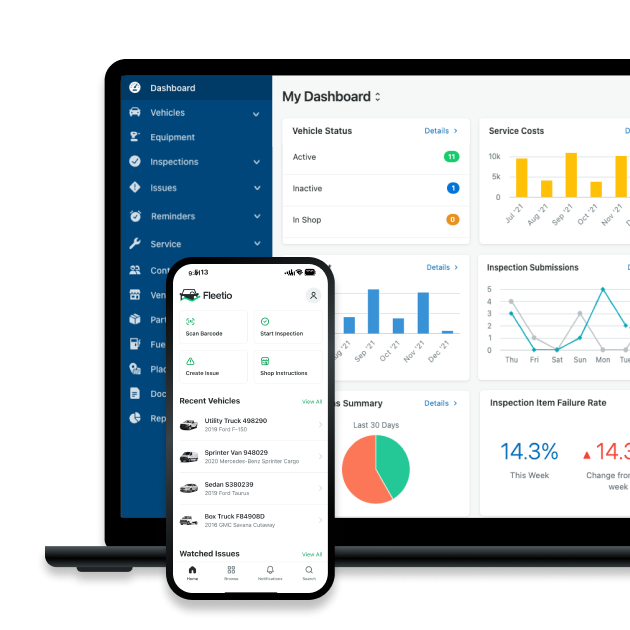
California Fleet FAQs

Director of Fleet Content, Fleetio
Zach Searcy is the Director of Content at Fleetio with more than 5 years of experience in the automotive and fleet industries. His content creation days started in middle school when he and his friends began filming lightsaber battles to upload to a new website: 'YouTube.'
LinkedIn|View articles by Zach SearcyReady to get started?
Join thousands of satisfied customers using Fleetio
Questions? Call us at 1-800-975-5304