Fleet Telematics: Turn Alert Signals Into Maintenance Action
Telematics tells you what's happening. Maintenance software determines what happens next (or it better). Here's how fleets turn DTC faults, mileage and location data into maintenance action.
Mar 7, 2025 | Updated: Sep 18, 2026
11 min read

What you need to know about fleet telematics
- Telematics captures the signal. Maintenance software creates the outcome: GPS data, DTC faults and mileage readings only become valuable when they trigger maintenance action.
- The biggest challenge isn't collecting data: Most fleets already have the telematics data they need. The opportunity lies in turning that data into work orders, preventive maintenance and more informed maintenance decisions.
- Integration determines ROI: Connecting telematics with fleet maintenance software helps teams prioritize repairs, improve preventive maintenance compliance and keep assets on the road longer.
Most fleets have more telematics data than they know what to do with. Assets constantly report their location, DTC faults keep rolling in and odometer readings update automatically without lifting a finger. Collecting the data isn't the challenge anymore. Turning it into maintenance action is.
Telematics captures the signal. Maintenance software is what turns that signal into work that actually gets done. Every maintenance outcome starts with a signal, but only fleets that act on those signals truly capture the full value of telematics.
Closing that gap starts with understanding what telematics actually captures, where the signal stalls and what it takes to turn it into real maintenance work. That's where a fleet optimization platform comes into play.
What Is Fleet Telematics?
Fleet telematics is like a smoke alarm. It can tell you something needs attention, but it won't put out the fire for you. Behind that alert is a relatively straightforward system. Fleet telematics combines GPS, asset diagnostics and a wireless data connection to continuously collect operational data from your assets. A device wired into the engine control module — or an OEM-native connection on newer assets — captures location, speed, odometer readings, DTC faults, and driver behavior signals such as harsh braking and excessive idling. That data then travels over a cellular or satellite network before landing in a telematics platform.
In practice, telematics helps fleet managers:
- Know where every asset is at any moment
- Coach drivers when harsh braking and idling spike
- Catch a fault code before it grounds an asset
- Tie odometer data to preventive maintenance schedules
- Hold the line on Federal Motor Carrier Safety Administration (FMCSA) and Department of Transportation (DOT) compliance
- Cut fuel waste linked to bad routing
But every one of those use cases depends on something happening after the data arrives. The telematics platform captures the signal. But if it doesn’t convert into maintenance work, what’s the point?
Alerts Can’t Turn a Wrench
The signal itself is rarely the bottleneck. Most fleets running 50 assets or more already have a telematics provider, and many run more than one after acquisitions, vehicle-type splits or shifting contracts. The constraint sits between an alert firing and the work it should trigger.
A diagnostic trouble code (DTC) on a service van earns its keep only when it reaches a technician with enough context to prioritize the repair. A milestone odometer reading is just another data point until it triggers a preventive maintenance (PM) task that lands on a tech's calendar with parts and instructions attached. Location data answers "where is this asset right now" almost everywhere. The harder question is what the maintenance team should do because of where the asset is.
That gap is where the value of telematics either compounds or evaporates. A fleet with telematics but no maintenance system to act on the data ends up paying for instrumentation that never moves the work forward (or adds more work to your plate). The dashboards look pretty to leadership, but they produce nothing in the shop. A DTC fires on a service van Friday afternoon, nobody triages it over the weekend, and the van rolls Monday morning into a roadside breakdown that costs ten times what a scheduled repair would have been. A PM threshold passes because the last odometer reading was entered manually three weeks ago, and now the fleet is out of compliance on an asset everyone assumed was covered. And we could go on and on.
Three Handoffs That Close the Gap
Closing that gap is a maintenance software job, and it involves three concrete handoffs.
1. DTCs become work orders
When a fault triggers in an asset wired to a Geotab or Samsara device, the alert flows into Fleetio with the asset, the code, the timestamp and the related history. Fleetio links that alert to a digital work order with the right parts, photos and assignee, so a technician picks up a ready-to-execute task.
Fault Rules let a manager classify each code in advance, with options to ignore low-signal alerts or flag critical ones, so an inbox of telematics-fed faults arrives already prioritized. Fleetio's Faults Summary report rolls up those alerts across asset groups, so a manager can see whether the same code is appearing across a class of assets before it cascades into unplanned downtime.
Pro Tip
DTC faults create value only when they become maintenance work. Automatically routing them into digital work orders helps technicians spend less time chasing alerts and more time resolving issues.
2. Odometer readings become PM schedules
Telematics integrations automatically log mileage, so PM compliance stops depending on whether a driver remembered to enter a reading at the pump. Service thresholds tied to mileage trigger work without the manual chase.
Town of Apex, North Carolina, manages 400 vehicles plus 230 pieces of equipment to serve 80,000 residents, the kind of fleet where tracking PM schedules manually across that many assets is a losing game. After centralizing on Fleetio with a Geotab integration, the town achieved a 17% year-over-year decrease in total operating costs while consistently meeting an 80% preventive maintenance compliance target. The difference came from automated mileage data feeding directly into PM schedules and the procurement decisions the team could make once all the maintenance data lived in one place.
3. Inspections plus telematics become a single asset record
Failed Driver Vehicle Inspection Report (DVIR) items are converted directly into work orders in Fleetio Go, with photos, parts and assignees attached. When that record sits next to telematics-fed odometer history, fault codes and location pings, the technician working the repair has the full operational picture in one place.
Boyle Transportation, a national trucking company that handles security-sensitive materials for life sciences and defense clients, runs its Samsara telematics in Fleetio for automated odometer updates, DTC alerts and location tracking on the same dashboard. Fleet Maintenance Supervisor Ernest Acevedo describes the workflow this way: "Fleetio makes up 40 percent of what I do. I plan my day based on the Fleetio dashboard." His team saves around 30 minutes per technician daily through Fleetio Go, time that used to go to manually coordinating between telematics alerts and repair workflows.
Fleetio is extending that signal-to-action loop further with AI Service Advisor, currently in open beta. It prioritizes issues by operational risk, flags exceptions on repair orders, and routes the telematics faults that need attention first.
Bring context to every repair decision
AI Service Advisor helps prioritize issues, surfaces repair-order exceptions and gives maintenance teams the context they need to make more informed repair decisions.
Explore AI Service Advisor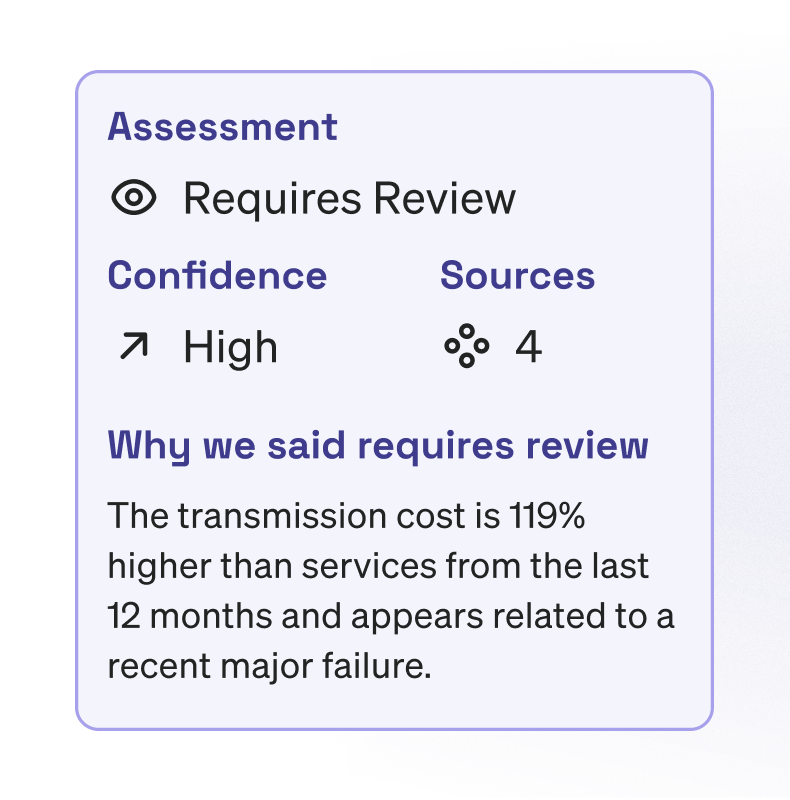
One Maintenance System, Any Telematics Stack
Closing the gap on a single asset with one telematics provider is one thing. Most fleets are not single-provider shops. After an acquisition, a contract change or a pilot program, a typical operation ends up with one telematics provider on the trucks, another on the trailers, partial coverage on the equipment and no telematics on the spares. The maintenance system has to work across whatever signal a fleet actually has.
Fleetio integrates natively with Geotab, Samsara and Verizon Connect, and a public API handles the rest. Fuel-card integrations with WEX, Comdata, Car IQ, and Coast bring transaction data into a single asset record. The integration design lets a fleet add a provider, swap one out or run mixed coverage without rebuilding the maintenance system underneath.
JW Danforth, a mechanical contractor founded in 1884 with 170-plus assets across HVAC, plumbing, piping and building electrical controls work, runs Fleetio with a Geotab integration. The team treats Fleetio as more of an asset-management system than a fleet-management tool, drawing on automated DTC notifications, asset locations and custom asset categorization. Asset Manager Jenniffer Rothschild describes Fleetio as "like having my own helpful friend at my side throughout the day; reducing stress and keeping details in order." Integration depth lets that breadth happen across a varied asset base.
Source-agnostic design has a straightforward payoff. A fleet's telematics stack should follow operational fit, with no obligation to which maintenance vendor the team picked five years ago. Fleetio sits on the maintenance side of the integration so that the choice of telematics provider stays open.
Tracking with telematics + Fleetio
| Feature | Telematics | Fleetio | Why You Need Both |
|---|---|---|---|
GPS location tracking
| ✅ |
— |
Fleetio pulls real-time location data from telematics for live maps and asset insights. |
|
| Engine diagnostics (DTC alerts) | ✅ | ✅ | DTCs from telematics trigger work orders and maintenance actions in Fleetio automatically. |
| Odometer updates | ✅ | ✅ | Telematics captures mileage; Fleetio uses it to automate PM schedules and compliance tracking. |
| Maintenance reminders | ⚠️ (Limited) | ✅ | Some telematics tools offer basic reminders, but Fleetio enables full workflow automation, status tracking and technician visibility. |
| Digital work orders | — | ✅ | Fleetio turns alerts into actionable tasks, streamlining service workflows and approvals. |
| Driver behavior monitoring | ✅ | — | Behavior data from telematics feeds into Fleetio reports and safety improvement efforts. |
| Preventive maintenance workflows | ⚠️ (Manual setup) | ✅ | Fleetio automatically triggers PM tasks based on real-time mileage and service thresholds. |
| Asset service history | ⚠️ (Limited) | ✅ | Fleetio maintains detailed service records, linked to DTCs, inspections, and technician actions. |
| Reporting & cost analysis | ⚠️ (Basic) | ✅ | Fleetio provides in-depth cost-per-mile tracking, downtime analysis, and trend benchmarking. |
| Third-party maintenance management | — | ✅ | Fleetio streamlines shop communication, integrates with national maintenance providers, and centralizes outsourced service data. |
| Integration capabilities | ✅ | ✅ | Fleetio integrates bi-directionally with top telematics providers (Geotab, Verizon Connect, Samsara, etc.) to centralize fleet data and actions. |
Location to Maintenance Motion
Fault codes and odometer readings are now included in maintenance work. Location is the signal that, until recently, stayed trapped in the telematics dashboard, answering "where is this asset" and stopping there. Fleet Map, launched in April 2026, is the location-side extension of the same closed-loop logic that already processes DTCs and odometer readings in Fleetio.
Fleet Map merges asset location, geofence events and nearby-vendor context with Fleetio-native location signals like inspections, fuel transactions and service entries. The result is a map view where location triggers maintenance action:
- An asset entering a yard while overdue on a PM becomes a coordination event the maintenance team can act on
- An asset stopping at a fuel location that does not match a recent transaction shows up as an exception worth a second look
- An asset near a Maintenance Shop Network partner shows up alongside the asset on the map, so an outsourced repair stays inside the same workflow
Like the rest of the platform, Fleet Map works regardless of how many telematics providers a fleet runs or where the coverage gaps sit.
Pro Tip
Location data becomes significantly more valuable when it helps maintenance teams decide what to do next — not simply where an asset happens to be.
How Fleetio Moves Maintenance and Fuel
When every signal, from fault codes to odometer readings to location events, flows through one maintenance system, the cost picture changes dramatically. Two of the largest line items in any fleet budget are maintenance and fuel. And telematics data fed into the right maintenance workflow moves both.
Fleetio centralizes every cost tied to an asset, including in-house labor, outsourced repairs, parts, fuel and fees, then links those costs to telematics-fed usage data. A real Total Cost of Ownership (TCO) number falls out of that record, so finance stops stitching estimates together from spreadsheets and exports. Cost per mile becomes a routine report that a finance team can pull on demand. Repair-versus-replace decisions get defensible data to back them up.
The Maintenance Shop Network extends the same principle to outsourced repairs. Outsourced repairs flow through line-item review inside Fleetio before the work happens. This gives the fleet manager the ability to reject the recommended cabin filter add-on or the "while we're in there" service line that does not match the asset's actual mileage and fault history. With telematics data already in the asset record, that line-item judgment carries the asset's actual history.
Outsmart outsourced maintenance
Review repair estimates, manage vendors and keep every outsourced repair connected to your maintenance workflow with Fleetio's Maintenance Shop Network.
Explore the Maintenance Shop Network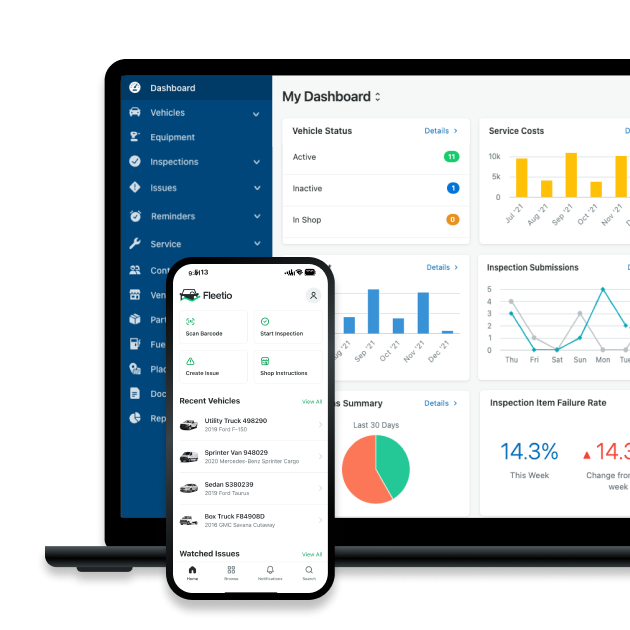
One Place To Run Matinenance
Every integration Fleetio adds follows the same principle: take a signal the fleet is already generating and close the loop between that signal and the maintenance work it should trigger. Fleet Map is the latest example, turning location into coordination, just as fault codes and odometer readings already become work orders and PM schedules.
The question worth asking: how much of your telematics spend is producing maintenance action today, and how much is producing dashboards?
Book a demo or start a free trial of Fleetio.
Telematics FAQs

Senior Fleet Content Specialist
As a Senior Fleet Content Specialist at Fleetio, Rachael Plant uses her near decade of industry experience to craft practical content aimed at helping fleet professionals tackle everyday challenges with confidence.
LinkedIn|View articles by Rachael Plant
Senior Copywriter
Tyler Freeland is a Senior Copywriter at Fleetio. A former creative writer for Freightliner and Western Star, he now transforms complex (and sometimes common) fleet management topics into practical, engaging insights that fleet professionals can apply every day.
LinkedIn|View articles by Tyler FreelandReady to get started?
Join thousands of satisfied customers using Fleetio
Questions? Call us at 1-800-975-5304